
If you are comparing Hafs vs Warsh, you may have heard Māliki in one Quran recording and Maliki in another. You may be hearing two recognized transmissions of Quran recitation: Ḥafṣ ʿan ʿĀṣim and Warsh ʿan Nāfiʿ. They are not two competing books, and the difference is not simply a reciter’s accent. They are carefully transmitted reading traditions with their own recitation details.
This guide explains what the names mean, shows a familiar example from Al-Fātiḥah, and gives a simple way to choose and compare recordings without becoming confused. If your teacher or local mushaf uses one reading, use that as your starting point and ask before changing.
What do “Ḥafṣ” and “Warsh” mean?
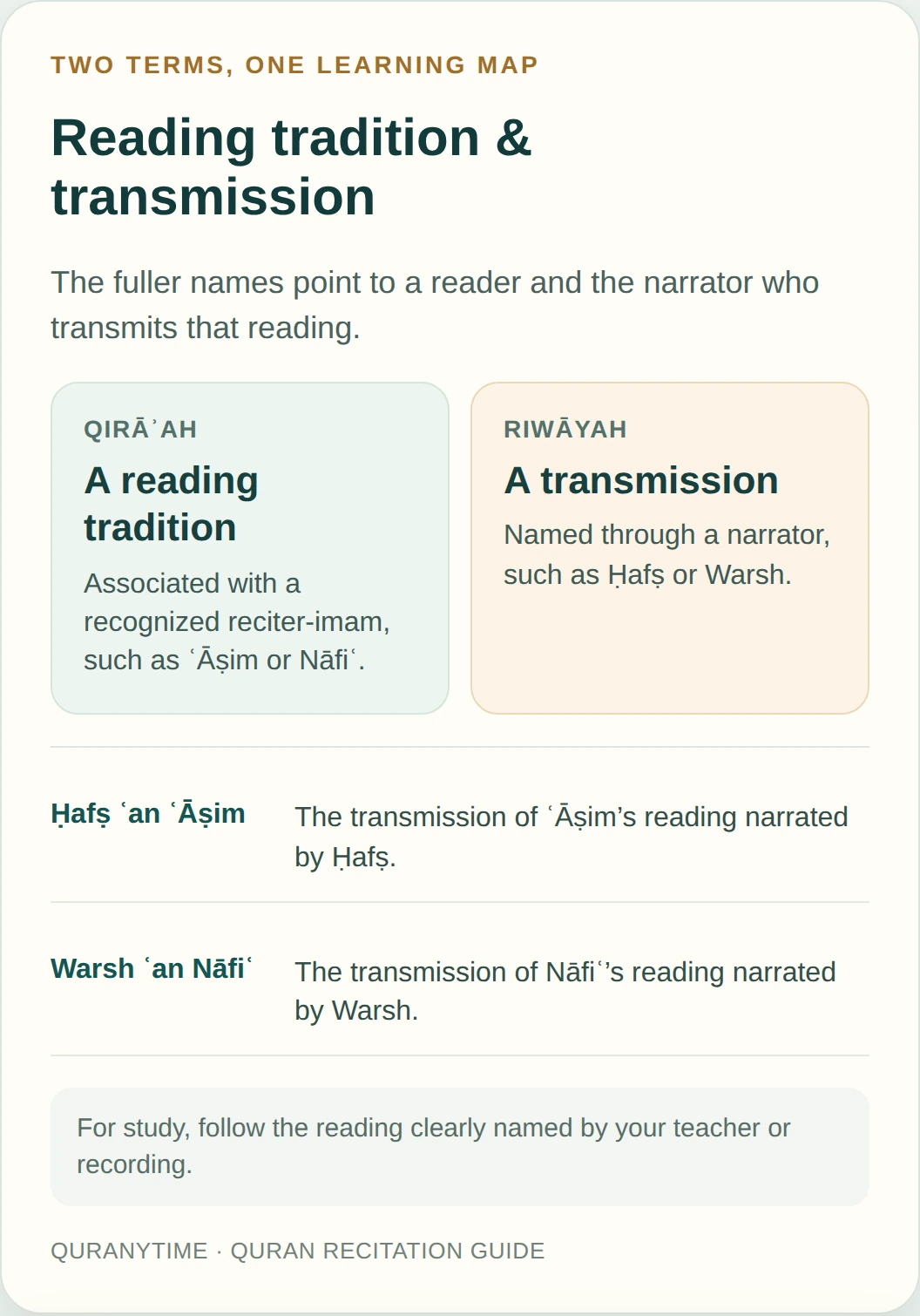
In everyday learner conversations, people often say “Hafs” or “Warsh” as shorthand. More fully, Ḥafṣ ʿan ʿĀṣim means the transmission (riwāyah) of the reading associated with ʿĀṣim as narrated by Ḥafṣ. Warsh ʿan Nāfiʿ is the transmission of the reading associated with Nāfiʿ as narrated by Warsh. The words identify a transmitted way of reciting, not the identity of a particular recording artist.
For a beginner, it helps to keep two terms separate. A qirāʾah is a recognized reading tradition associated with a reciter-imam; a riwāyah names a transmission of that reading. The terminology can be presented in more detail by scholars, but the practical point is simple: Ḥafṣ and Warsh are transmitted routes that you may encounter in a teacher’s lessons, an audio recording, or a printed mushaf.
Specialists describe the accepted readings through their transmission and the conventions they preserve. An accessible overview from the Yaqeen Institute’s guide to the origins of the Quran’s variant readings explains that recognized readings can differ in pronunciation, vowelization, lengthening, and, at particular places, word forms. These are not casual edits or a reader improvising. For study, use a reliable teacher and a source that clearly identifies the reading being taught.
A familiar example: Al-Fātiḥah 1:4
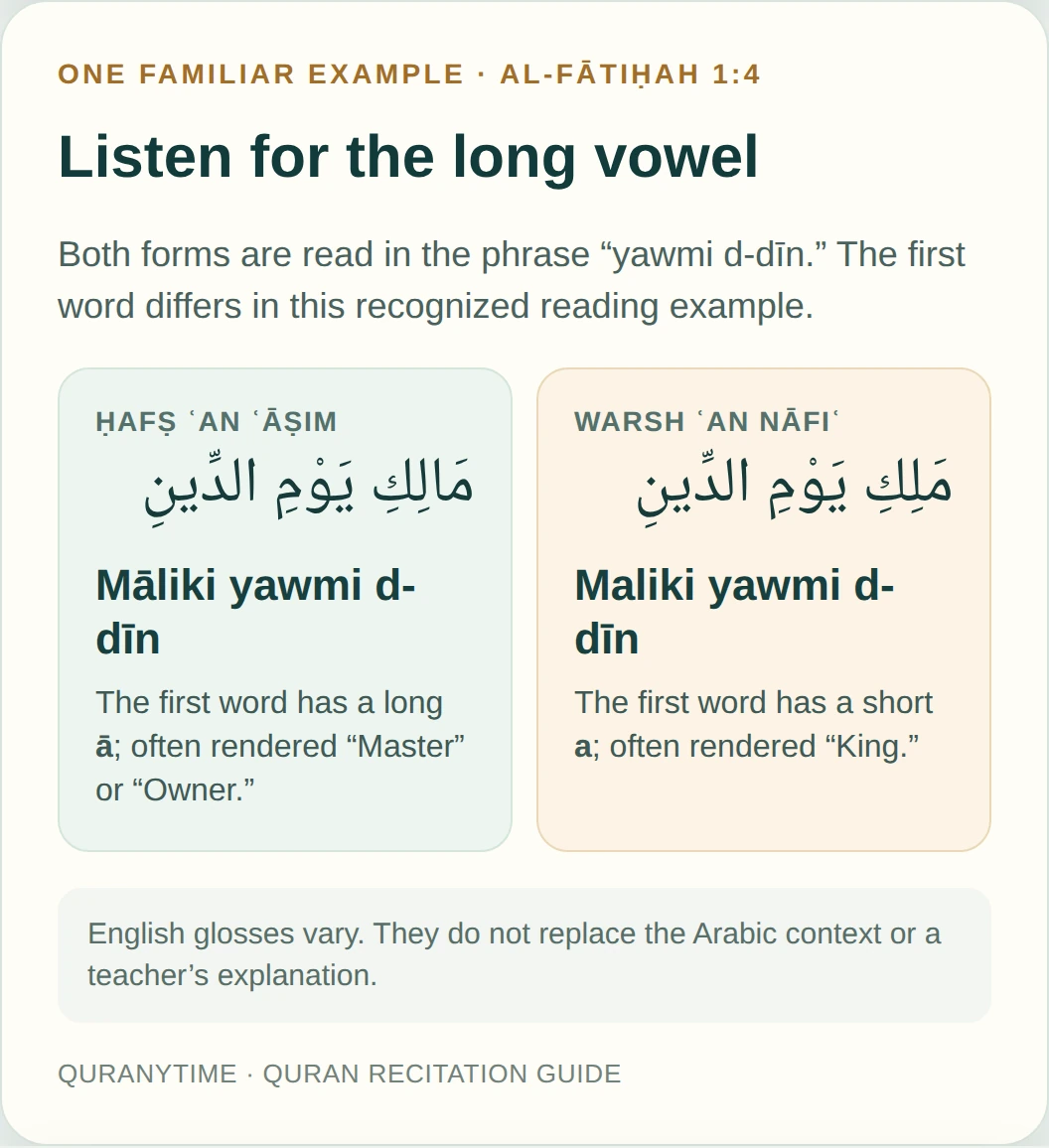
One well-known comparison appears in “Master of the Day of Judgment” in Al-Fātiḥah. In Ḥafṣ, the word is commonly written مَالِكِ and read Māliki, with a long ā. In Warsh, it is commonly written مَلِكِ and read Maliki, without that long vowel. The surrounding phrase is يَوْمِ الدِّينِ, yawmi d-dīn.
English translations often render the first word as “Master” or “Owner” and the second as “King.” A translation is only a guide to meaning; it is not a complete account of Arabic grammar, recitation, or interpretation. The useful lesson is that a small written or vowel difference can belong to a recognized reading tradition. It is not a reason to accuse a reciter of making a mistake when the reading has been correctly learned and identified.
Listen to the same short passage in both transmissions below. The clip recites Al-Fātiḥah first in Ḥafṣ and then in Warsh. Focus on verse 4, but listen to each complete recitation rather than isolating one sound. That makes it easier to hear how each reading is carried through the passage.
Hafs vs Warsh: how can the readings sound different?
Some differences are easy to hear; others are not obvious unless you know what to listen for. Depending on the passage, a learner may notice vowel quality or length, a pronunciation rule, or a different word form. There is no single “Hafs accent” or “Warsh accent” that every person must sound like. Individual voices, pace, recording quality, and melodic style also vary. A beautiful melody can make two recitations sound different even when they follow the same transmission.
That is why it helps to distinguish a reading tradition from a performance choice. Tajweed explains how the selected reading is articulated; a reciter’s melody and vocal tone are choices in performance. If you are learning the general Tajweed rules of the Quran, keep those fundamentals separate from the additional details your teacher may teach for a particular riwāyah.
A useful comparison keeps the variables steady. If you can, hear the same passage in two clearly labelled transmissions, preferably with a reciter and pace you can follow. Comparing different reciters may make melody, speed, or vocal timbre seem like a reading difference. Start with a specific, verifiable feature such as the vowel in Al-Fātiḥah 1:4. For a rule that is not obvious by ear, pause and ask a teacher rather than deciding from one isolated sound.
Also separate recitation from page design. A mushaf’s script style can look unfamiliar because of layout, calligraphic conventions, or spelling and notation choices. That does not automatically mean you are seeing a different riwāyah. Quranytime’s comparison of Uthmani and Indo-Pak Quran scripts explains the visual distinction; ask your teacher to identify the actual reading tradition printed in your copy.
Which one should a beginner learn first?
Start with the reading your qualified teacher, course, and local learning materials already use. If your class teaches Ḥafṣ, practise from the matching mushaf and listen to recordings labelled Ḥafṣ ʿan ʿĀṣim. If your teacher teaches Warsh, follow a Warsh-labelled mushaf and recordings from that route. Consistency is useful while you are learning letters, vowels, and recitation rules.
This is a study recommendation, not a claim that one is universally better. Ḥafṣ is widely used across many parts of the Muslim world, while Warsh is well established in many North and West African communities. Actual practice varies by country, teacher, family, and institution. The names on an audio file or mushaf matter more than guessing from the speaker’s nationality.
If you later want to learn another reading, do it intentionally with a teacher who can explain its rules. Avoid switching back and forth randomly while memorizing a passage, especially when you are still learning its basic pronunciation. For example, some pause details taught in a Hafs lesson are specific to that study context; see Quranytime’s guide to the four commonly taught Hafs saktah pauses rather than assuming every note applies identically to every transmission.
A simple way to compare two recordings
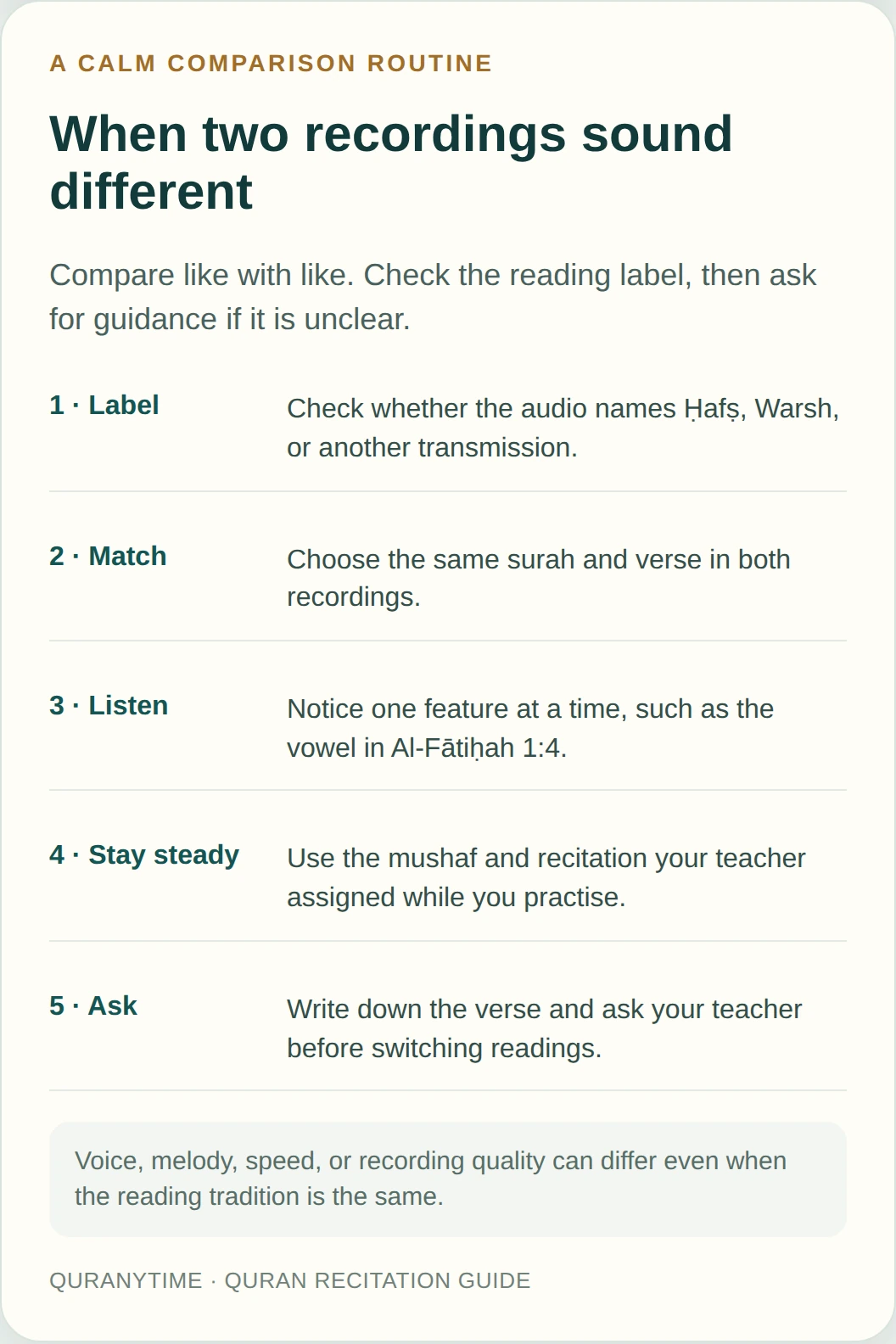
When two audio clips seem different, check them in a calm order. First, read the title or description to see whether the recitation is labelled Ḥafṣ, Warsh, or another transmission. If it is not labelled, do not guess; choose a clearly identified recording for study. Then compare the same verse in both clips, not different verses or different melodic performances.
Next, listen for one detail at a time. Al-Fātiḥah 1:4 is a convenient example because the length of the first vowel is audible. Repeat a short phrase, then return to the full verse so you do not turn one sound into a disconnected drill. Quranytime’s listen–pause–check routine for Quran audio can help structure that practice. If the sound remains uncertain, note the verse and ask your teacher instead of copying an unlabelled social-media clip.
Once you can hear the target clearly, practise it inside a complete phrase at a comfortable pace. Avoid stretching every vowel just to make a contrast obvious, and do not rush the surrounding words. If you are working on smooth, steady reading as well as accuracy, Quranytime’s guide to building Quran fluency without rushing offers a related practice approach.
Common questions
Are Hafs and Warsh two different Qurans?
No. They are names of recognized transmitted readings of the Quran, not names for separate books. Their precise recitation features are studied within established traditions. Some word forms or sounds differ at specific points, so it is equally misleading to say that every detail is identical or that every difference is a contradiction.
Is Hafs more correct than Warsh?
This is not a useful beginner ranking. Both names refer to recognized transmissions within Quranic recitation traditions. Learn the route your teacher is qualified to teach, and do not treat a difference in a valid reading as an error simply because it is unfamiliar to you.
Can I read a Warsh mushaf if my class uses Hafs?
You can learn about other readings, but do not assume that a page’s appearance alone tells you which one it uses. Ask your teacher to identify the reading and to show you the relevant notation. A teacher’s feedback and the course’s chosen audio are particularly helpful while you are learning to recite or preparing for an ijazah in Quran recitation.
Can I learn both?
Many learners study more than one transmission, but it is best to do so in an organized way. Keep each reading’s notes, examples, and practice audio clearly labelled, and learn with a teacher who can check your recitation. You do not need to compare every verse to begin reading the Quran; first build a sound foundation in the route you are currently taught.
Keep one clear learning path
When a recording sounds different, check its label, compare the same passage, and ask a qualified teacher what you are hearing. Stay with one clearly identified reading while you build confidence; expand later with guidance. This keeps listening practice focused and helps you distinguish a transmitted reading from accent, melody, or page design. If you would like individual help matching your current recitation to a teacher-led study plan, you can book your free Quran and Arabic trial class.