
If you are learning to describe the weather in Arabic, start with two everyday words: الطَّقْس (aṭ-ṭaqs, “the weather”) and الجَوّ (al-jaww, “the weather” or “atmosphere”). Then add a few conditions, seasons, and question patterns. This guide shows the words in clear Arabic script, explains how Modern Standard Arabic and Egyptian speech can differ, and gives you a short forecast dialogue to practise. The goal is not to memorize a long list; it is to understand a forecast and make a simple, natural reply.
Two useful words for “weather”
الطَّقْس (aṭ-ṭaqs) is common in formal writing, news, and weather forecasts. الجَوّ (al-jaww) is also widely used for weather or atmosphere and often appears in everyday conversation. The first letter of jaww is ج: it is commonly pronounced like “j” in Modern Standard Arabic and like a hard “g” in Egyptian Arabic. Both words are useful; listen for context rather than assuming one is wrong.
When you want to ask a question, combine either word with اليَوْمَ (al-yawma, today): كَيْفَ الطَّقْسُ اليَوْمَ؟ means “How is the weather today?” For more question forms, review these essential Arabic question words.
Essential weather vocabulary in Arabic
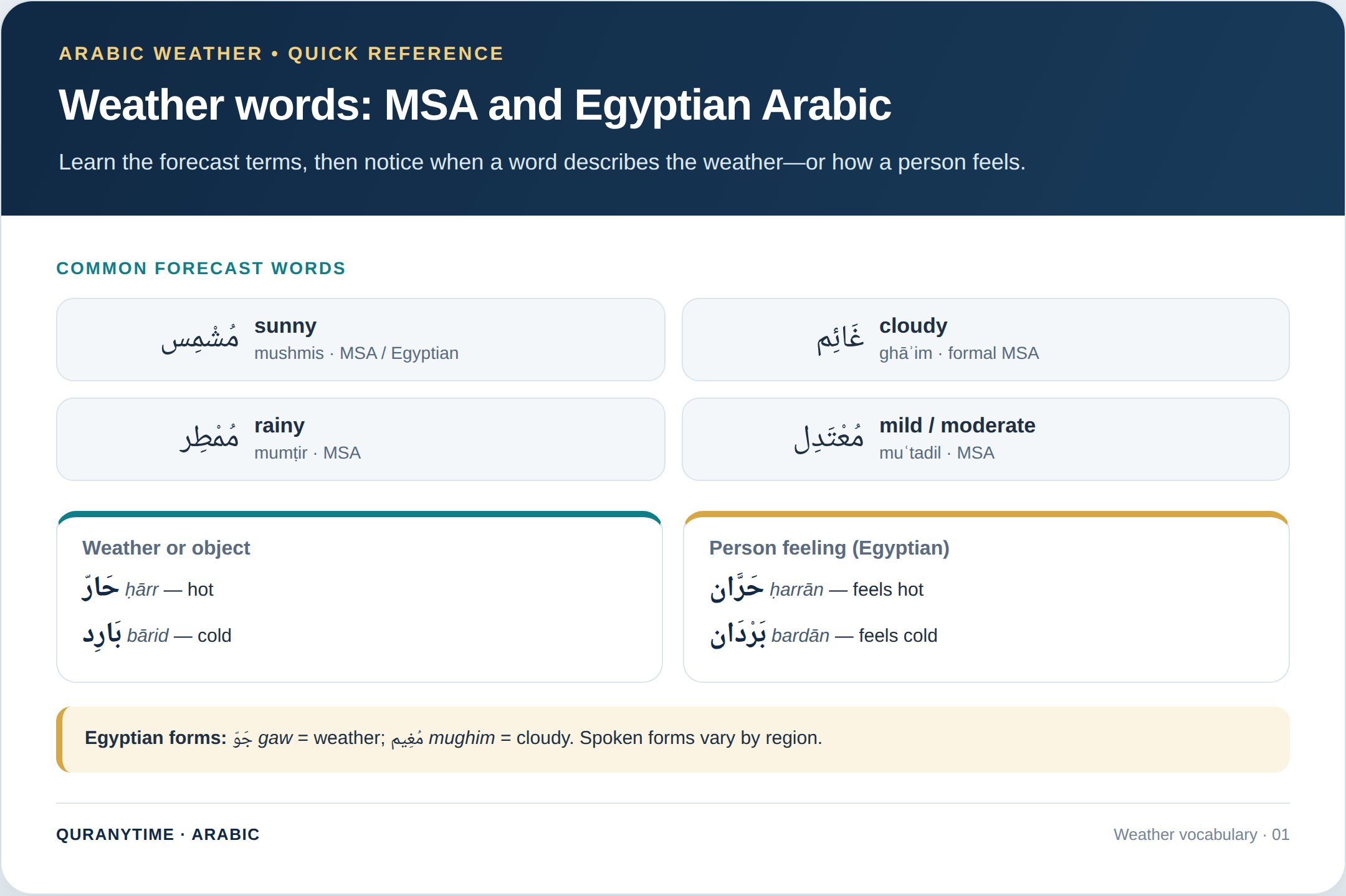
Learn a small set of words first. The adjectives below describe the weather itself. Some can also describe objects or places, so a sentence will show what is hot, cold, sunny, or cloudy.
| Arabic | Pronunciation | Meaning |
|---|---|---|
| مُشْمِس | mushmis | sunny |
| غَائِم | ghāʾim | cloudy (formal Arabic) |
| مُمْطِر | mumṭir | rainy |
| حَارّ | ḥārr | hot (weather or an object) |
| بَارِد | bārid | cold (weather or an object) |
| مُعْتَدِل | muʿtadil | mild or moderate |
| رِيَاح | riyāḥ | winds |
| مَطَر | maṭar | rain |
| دَرَجَةُ الحَرَارَة | darajat al-ḥarāra | temperature |
One helpful pattern is noun plus adjective: الطَّقْسُ حَارٌّ means “the weather is hot,” while السَّمَاءُ غَائِمَةٌ means “the sky is cloudy.” The adjective follows its noun and agrees with it in gender. Quranytime’s beginner guide to Arabic adjective agreement explains this pattern in more detail.
Modern Standard Arabic and Egyptian weather words
Arabic learners often hear different forms for the same idea because a formal forecast and an everyday conversation may use different vocabulary. A University of Oregon open textbook for Egyptian Arabic lists جَوّ (gaw, weather), مُشْمِس (mushmis, sunny), مُمْطِر (mumṭir, rainy), and مُغِيم (mughim, cloudy), alongside useful contrasts for heat and cold. See the university’s Egyptian Arabic weather vocabulary table for those dialect forms.
A particularly useful distinction is between the weather and how a person feels. In the textbook’s Egyptian forms, حَارّ (ḥārr) can describe hot weather or an object, while حَرَّان (ḥarrān) describes a person who feels hot. Similarly, بَارِد (bārid) describes cold weather or an object, and بَرْدَان (bardān) describes a person who feels cold. These are helpful Egyptian distinctions; do not treat them as universal forms in every Arabic dialect.
For example, a speaker might say الجَوّ حَارّ اليَوْم (“The weather is hot today”) but أَنَا حَرَّان (“I feel hot”). The subject changes the meaning, even though both sentences concern heat. In other varieties, the preferred wording may differ, so label the dialect when you make vocabulary notes.
Ask about the forecast with simple sentence frames
Instead of memorizing every forecast phrase, practise a few frames and replace one word at a time. These examples use clear Modern Standard Arabic forms that are widely understood.
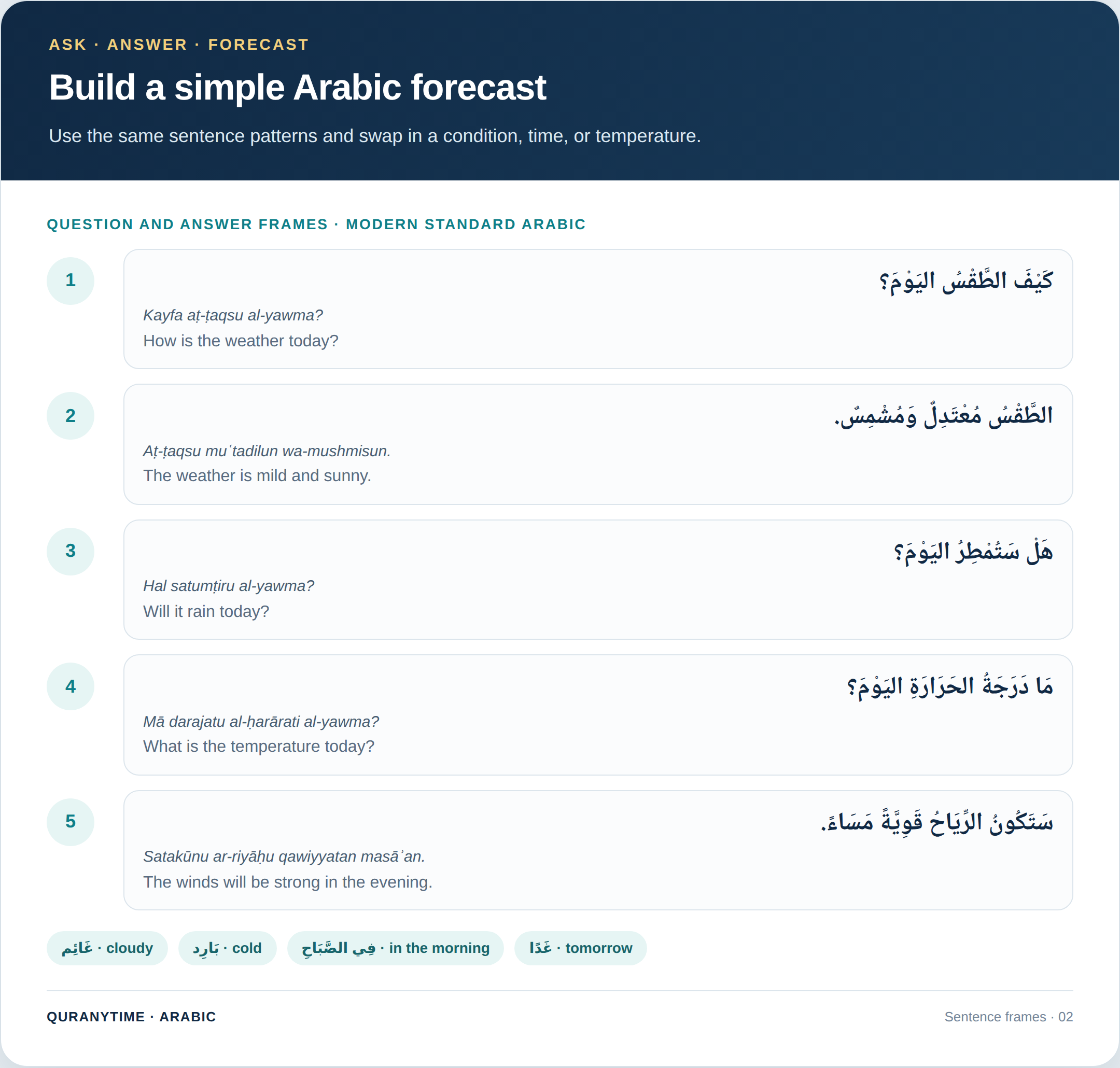
- كَيْفَ الطَّقْسُ اليَوْمَ؟ — Kayfa aṭ-ṭaqsu al-yawma? — How is the weather today?
- الطَّقْسُ مُعْتَدِلٌ وَمُشْمِسٌ. — Aṭ-ṭaqsu muʿtadilun wa-mushmisun. — The weather is mild and sunny.
- هَلْ سَتُمْطِرُ اليَوْمَ؟ — Hal satumṭiru al-yawma? — Will it rain today?
- مَا دَرَجَةُ الحَرَارَةِ اليَوْمَ؟ — Mā darajatu al-ḥarārati al-yawma? — What is the temperature today?
- سَتَكُونُ الرِّيَاحُ قَوِيَّةً مَسَاءً. — Satakūnu ar-riyāḥu qawiyyatan masāʾan. — The winds will be strong in the evening.
In a forecast, you may see the feminine form قَوِيَّةٌ (qawiyyatun) with الرِّيَاحُ because the noun is treated as feminine. To practise the time expressions in these sentences, see how to tell time in Arabic. You can also revise common Arabic prepositions such as فِي (fī, in) in phrases like فِي الصَّبَاحِ (“in the morning”).
Listen for changes in a forecast
A weather report often tells you what is expected to change, not only the condition at one moment. Learn a few action verbs so you can follow the sequence: تَرْتَفِعُ دَرَجَةُ الحَرَارَةِ ظُهْرًا (tartafiʿu darajatu al-ḥarārati ẓuhran, the temperature rises at noon) and تَنْخَفِضُ دَرَجَةُ الحَرَارَةِ لَيْلًا (tankhafiḍu darajatu al-ḥarārati laylan, the temperature falls at night).
You may also hear تَهُبُّ رِيَاحٌ خَفِيفَةٌ (tahubbu riyāḥun khafīfatun, light winds blow) or تَتَوَقَّعُ النَّشْرَةُ الجَوِّيَّةُ أَمْطَارًا خَفِيفَةً (tatawaqqaʿu an-nashratu al-jawwiyyatu amṭāran khafīfatan, the forecast expects light rain). Notice how the verb signals a change, the time word tells you when, and the noun gives you the event. Even a longer forecast becomes easier to follow when you listen for these three parts.
For a practical reply, connect the weather with a plan: سَأَحْمِلُ مِظَلَّةً (saʾaḥmilu miẓallatan, I will carry an umbrella) or سَأَلْبَسُ مِعْطَفًا (saʾalbasu miʿṭafan, I will wear a coat). The prefix سَـ points to the future, so you can reuse these patterns when the condition or season changes.
Four seasons and the weather they bring
The four seasons are الرَّبِيع (ar-rabīʿ, spring), الصَّيْف (aṣ-ṣayf, summer), الخَرِيف (al-kharīf, autumn), and الشِّتَاء (ash-shitāʾ, winter). Use them in a short sentence: يَكُونُ الجَوُّ حَارًّا فِي الصَّيْفِ (“The weather is hot in summer”) or يَكُونُ الجَوُّ بَارِدًا فِي الشِّتَاءِ (“The weather is cold in winter”). If you need the names of months and days for a longer forecast, review days and months in Arabic.
Do not assume that every region has the same seasonal experience. A vocabulary lesson teaches you how to describe conditions; it does not predict what a particular country’s weather will be like. For accurate local decisions, use a current forecast from a trusted weather service.
Read a short forecast dialogue
Read the Arabic once for meaning, then again while noticing the question, weather adjective, and time word. The dialogue is in Modern Standard Arabic.
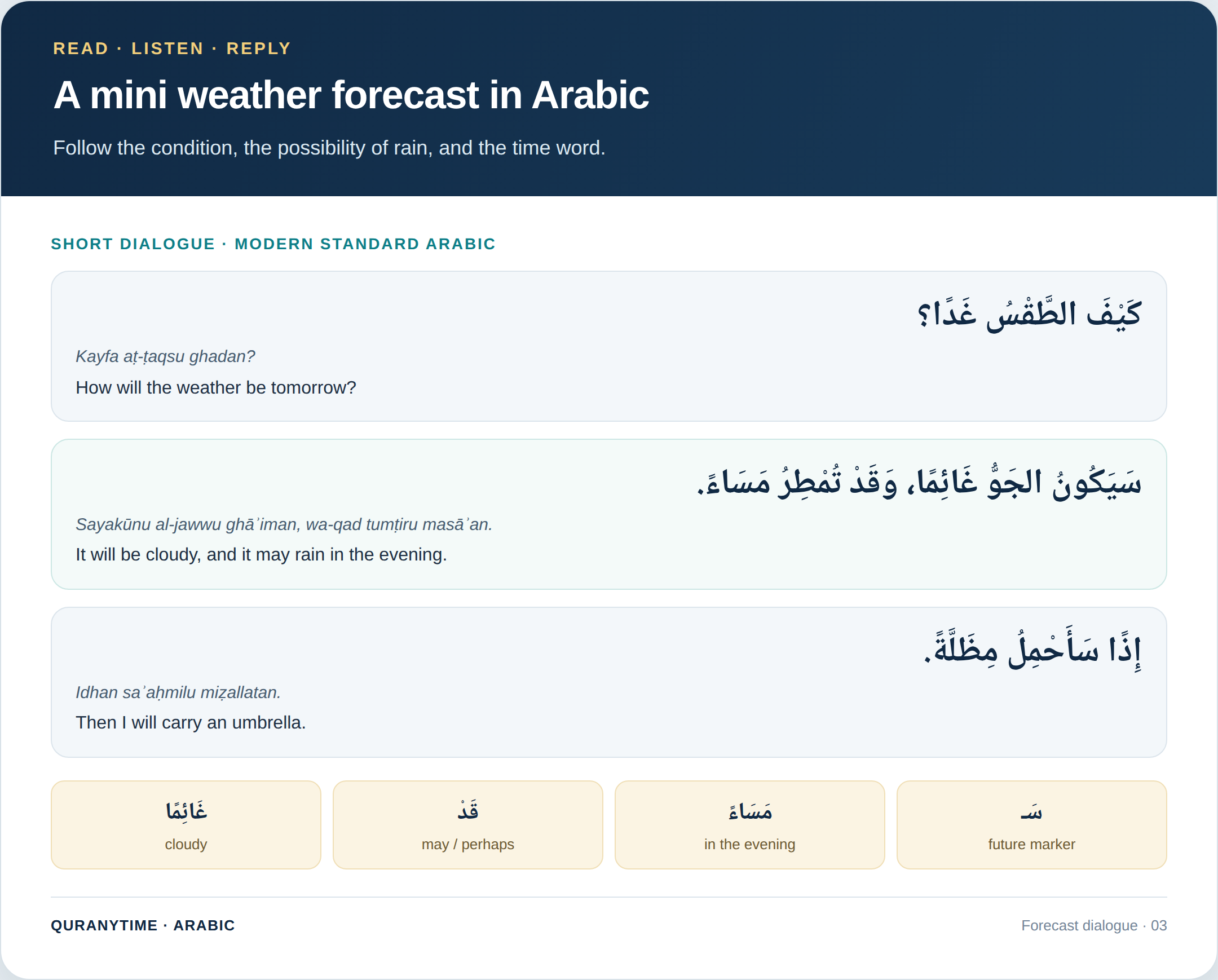
سَامِي: كَيْفَ الطَّقْسُ غَدًا؟
Sāmī: Kayfa aṭ-ṭaqsu ghadan?
Sami: How will the weather be tomorrow?
نَادِر: سَيَكُونُ الجَوُّ غَائِمًا، وَقَدْ تُمْطِرُ مَسَاءً.
Nādir: Sayakūnu al-jawwu ghāʾiman, wa-qad tumṭiru masāʾan.
Nader: It will be cloudy, and it may rain in the evening.
سَامِي: إِذًا سَأَحْمِلُ مِظَلَّةً.
Sāmī: Idhan saʾaḥmilu miẓallatan.
Sami: Then I will carry an umbrella.
Notice قَدْ (qad) softens the statement to “may,” and مَسَاءً (masāʾan) means “in the evening.” Weather descriptions often use nominal sentences, while verbs describe what happens. Compare Quranytime’s guides to Arabic nominal sentences and Arabic verbal sentences. The guide to Arabic verb conjugation can help you recognize forms such as تُمْطِرُ (“it rains”) and سَتُمْطِرُ (“it will rain”).
Use a real forecast as listening practice
The short Arabic broadcast below discusses Egypt’s weather and includes forecast language in natural speech. It is a recorded news segment, not a current forecast. On the first listen, try to catch the words for rain and temperature. On the second listen, note when the speaker refers to a place, a season, or a coming change. You do not need to understand every sentence; use the repeated weather words as listening anchors.
A five-minute practice routine
- Choose three conditions, such as sunny, cloudy, and rainy. Say each Arabic word aloud and point to it in the vocabulary card.
- Ask كَيْفَ الطَّقْسُ اليَوْمَ؟ and answer with one weather adjective and one time phrase.
- Make one sentence about a person feeling hot or cold, then contrast it with a sentence describing the weather. Label the Egyptian forms if you use them.
- Listen to the forecast clip once without pausing. Replay a short section and write down one familiar weather word.
Practising a question-and-answer exchange aloud can also support Arabic reading and conversation work. If you would like individual guidance with Quran reading or Arabic pronunciation, book a free Quran and Arabic trial class.
Common questions
What is the most common word for “weather” in Arabic?
الطَّقْس (aṭ-ṭaqs) is common in formal Arabic and forecasts. الجَوّ (al-jaww) is also widely used, especially in everyday speech. Which word sounds more natural depends on the register and dialect.
How do I say “It is raining” in Arabic?
A useful Modern Standard Arabic sentence is تُمْطِرُ الآنَ (tumṭiru al-āna, “It is raining now”). To ask whether it will rain today, say هَلْ سَتُمْطِرُ اليَوْمَ؟ (hal satumṭiru al-yawma?).
Are the Egyptian forms used everywhere?
No. Egyptian Arabic is one spoken variety. Forms such as حَرَّان (“a person feels hot”) and بَرْدَان (“a person feels cold”) are useful to recognize in Egyptian speech, but other dialects may use different wording. For broad reading, learn the formal forms first and label dialect vocabulary clearly.
Once you can name the conditions, ask a forecast question, and describe one change in your own words, you have the core tools for a simple weather conversation. Add a few new terms at a time, listen to natural speech, and keep the variety—formal or dialectal—clear in your notes.