

When a still noon or a tanween mark appears in Quran reading, the next pronounced letter tells you what to do with its n-like sound. That one check leads to four familiar tajweed rules: izhar, idgham, iqlab, and ikhfa. This guide explains noon sakinah and tanween rules in a practical order, with Quran examples, a Hafs-specific exception, and a short routine for using the rules while reading rather than only memorizing their names.
Quick answer: pronounce the noon clearly before six throat letters (izhar); merge it before six letters in يَرْمَلُون (idgham); change it to a concealed meem before ب (iqlab); and partly conceal it, with ghunnah, before the remaining fifteen letters (ikhfa). The letters are grouped below so you can check the following sound instead of guessing.
First, distinguish noon sakinah from tanween
نْ is a written nūn carrying sukūn: the letter can occur inside a word or at its end. Tanween is written as a doubled vowel mark—ـً، ـٍ، ـٌ—at the end of a noun. It is not a separate written nūn, although in connected recitation it contributes an n-like sound. For this family of rulings, both forms are treated alike: listen for the n sound and inspect the letter that comes immediately after it.
It helps to recognize the written marks before applying a sound rule. Quranytime’s guide to fatha, kasra, damma, sukūn, and tanween reviews how those marks look and sound. The distinction matters because the rule is not chosen by whether the n sound is written as a letter or supplied by tanween; it is chosen by the next letter.
A simple way to choose the rule
- Check that you are connecting. These rules describe the sound when the nūn or tanween is joined to what follows. A pause changes the connection; do not carry a rule across a stop.
- Find the n sound. Look for نْ or one of the three tanween marks.
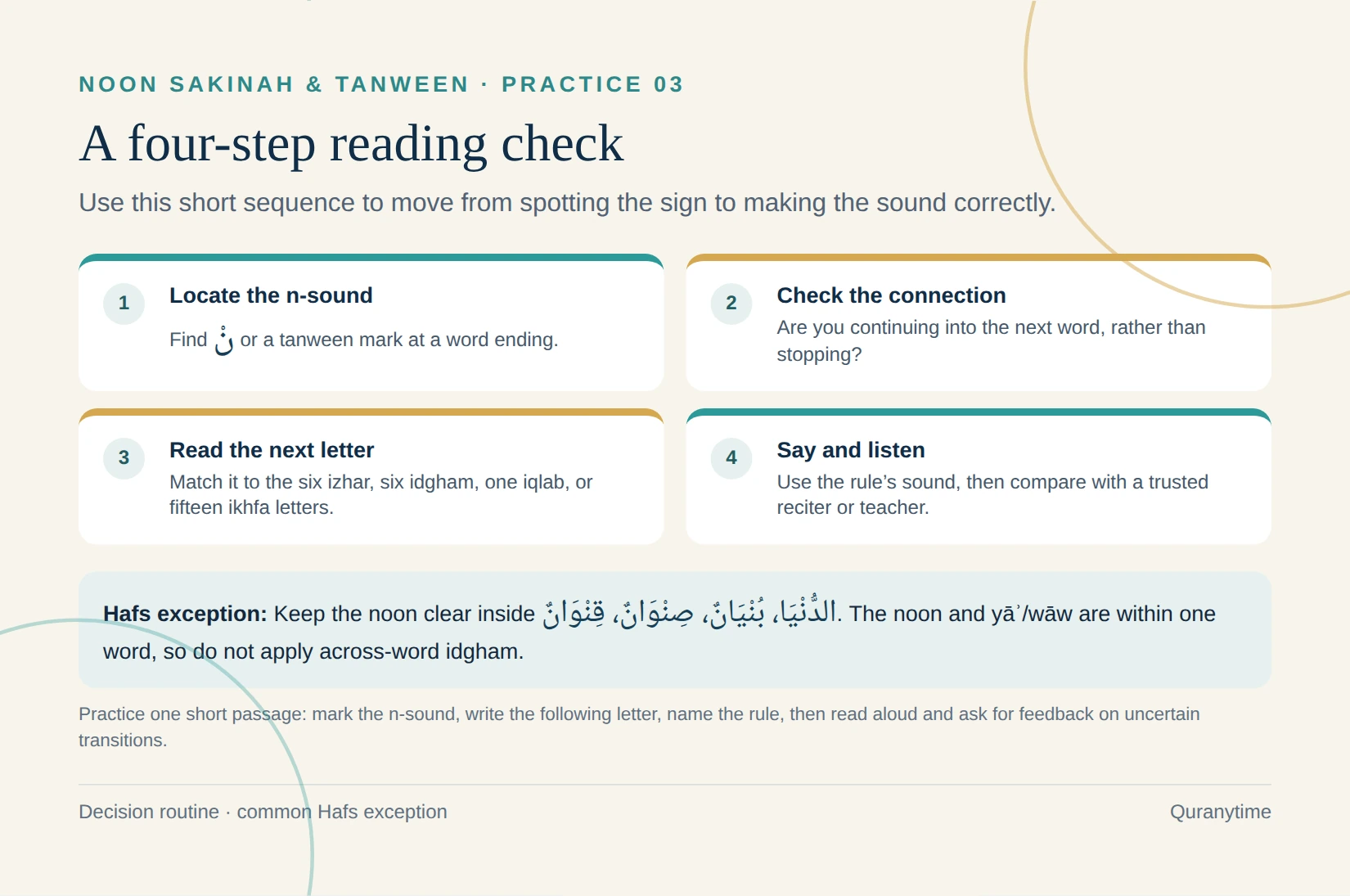
- Look one pronounced letter ahead. In connected reading, the first letter after the n sound determines its rule.
- Use the letter group. Say the n clearly, merge, convert to meem, or conceal it according to the table.
The at-a-glance reference below puts the complete letter groups beside the sound action. It is a lookup aid, not a substitute for hearing a qualified reciter demonstrate where the sound is placed.
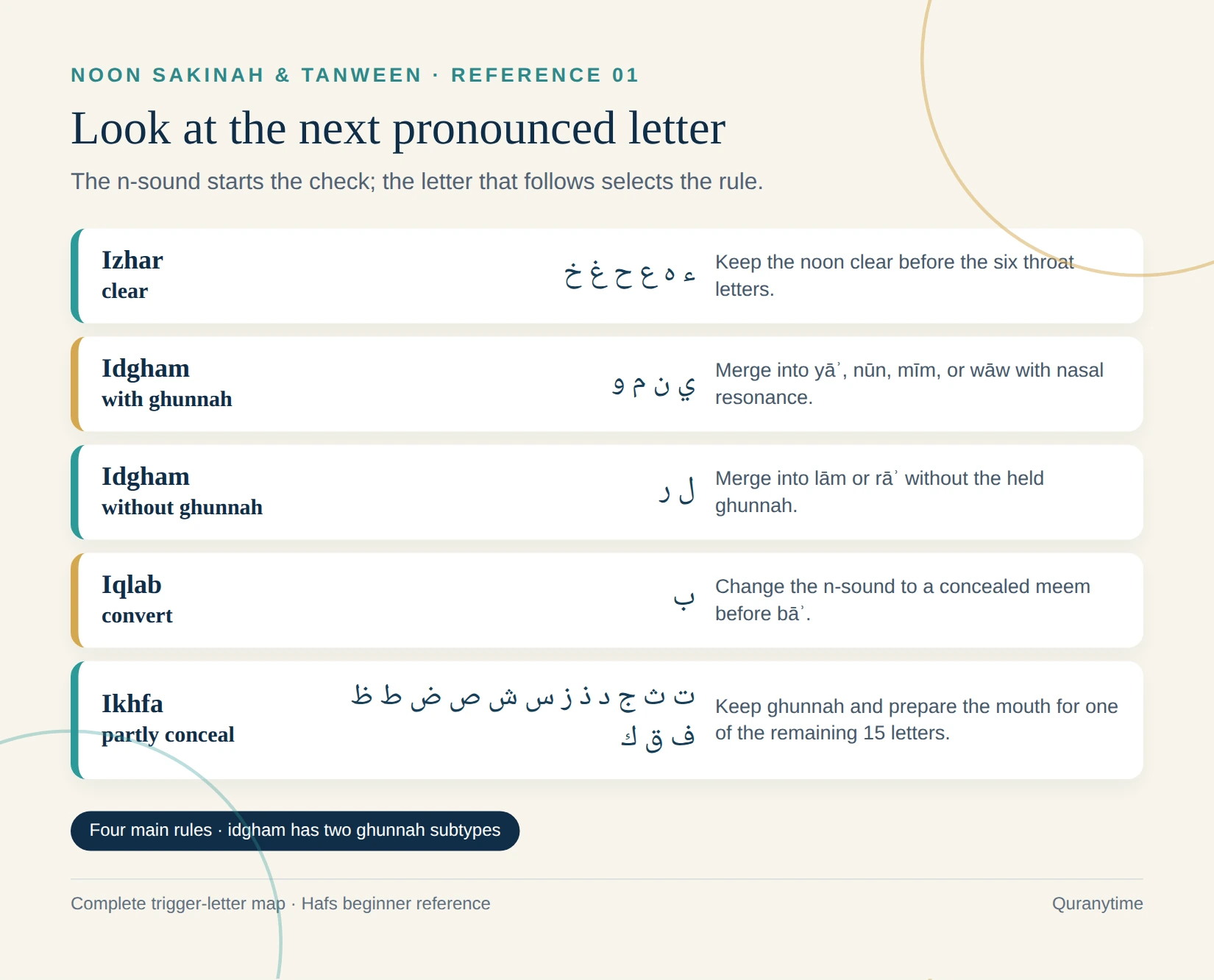
For the wider set of common Quran-reading principles, keep this focused lesson alongside Quranytime’s chart of eight core tajweed rules. Here, we will slow down on the four rules that govern the nūn sound.
1. Izhar: keep the noon clear
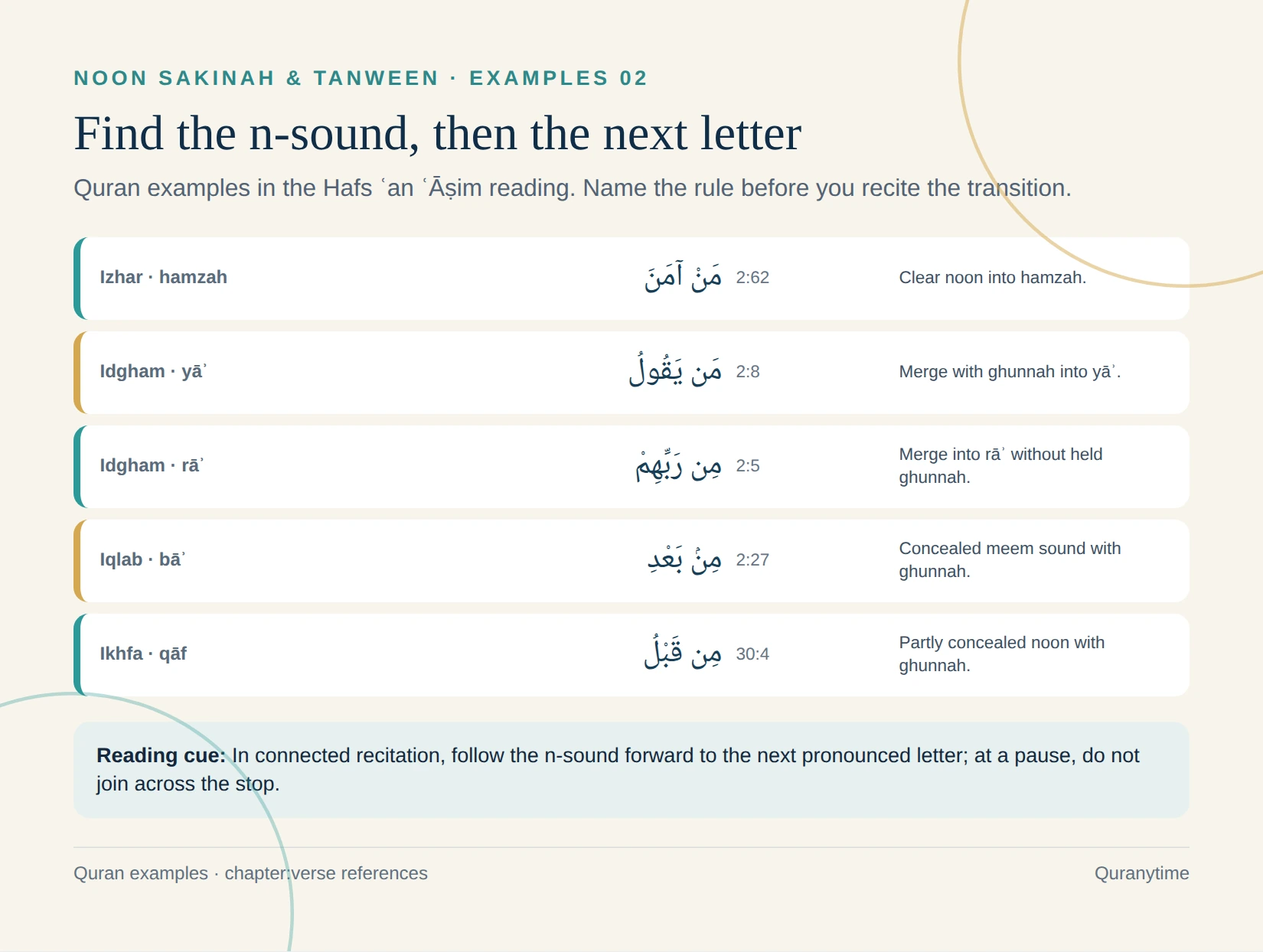
Izhar means making the noon sound clear. It applies before six throat letters: ء، ه، ع، ح، غ، خ. For example, in مَنْ آمَنَ (Quran 2:62), the nūn in مَنْ meets hamzah in the next word. Read the noon distinctly and move on; do not add an exaggerated nasal hold or merge it into the hamzah.
Some teachers group the six letters with a short mnemonic. Whatever memory aid you use, return to the actual letter on the page: hamzah, hāʾ, ʿayn, ḥāʾ, ghayn, or khāʾ. Izhar does not mean making the nūn unnaturally sharp. Keep its normal articulation clear, then let the throat letter begin.
2. Idgham: merge into the next letter
Idgham means merging the n sound into the following letter. The six idgham letters are collected in يَرْمَلُون: ي، ر، م، ل، و، ن. The key learner question is whether the merge keeps ghunnah (nasal resonance): it does for ي، ن، م، و, often remembered as يَنْمُو; it does not for ل، ر.
Compare مَن يَقُولُ (Quran 2:8), where the n sound joins yāʾ with ghunnah, with مِن رَبِّهِمْ (Quran 2:5), where it merges into rāʾ without that held nasal sound. The two subtypes are easy to mix if you memorize only the six-letter word, so practise the subtype at the same time as the letter. Quranytime’s guide to how idgham types differ covers the broader categories; this lesson concerns the specific nūn/tanween pattern.
In the Hafs reading, this idgham is across two words. When a nūn with sukūn is followed by yāʾ or wāw inside one word, read it clearly in the four familiar words الدُّنْيَا، بُنْيَانٌ، صِنْوَانٌ، قِنْوَانٌ. This is often called izhar mutlaq. It is a useful exception: seeing a yāʾ or wāw after a still nūn does not mean you should merge automatically; first check whether the meeting is within one word or across a word boundary.
3. Iqlab: change the n sound before bāʾ
Iqlab applies before one letter only: ب. The n sound changes to a concealed meem sound with ghunnah, as in مِنۢ بَعْدِ (Quran 2:27). The lips close gently for the meem before opening into bāʾ. Some printed mushafs show a small meem as a visual cue, but the cue is not a separate word or an instruction to pronounce a full, strong meem. If your copy has the mark, use it to spot the rule; learn the sound by listening and repeating.
4. Ikhfa: partly conceal the noon
Ikhfa is used before the fifteen letters left after setting aside the izhar, idgham, and iqlab groups: ت، ث، ج، د، ذ، ز، س، ش، ص، ض، ط، ظ، ف، ق، ك. The n sound is neither fully clear as in izhar nor fully merged as in idgham. Keep ghunnah, conventionally measured as two counts in beginner instruction, while shaping the mouth toward the next letter. In مِن قَبْلُ (Quran 30:4), for instance, the next letter is qāf, so the reader uses ikhfa rather than a separately released, strong n.
Do not turn ikhfa into a long hum or a full n followed by qāf. The nasal sound should be even, and the tongue prepares for the next letter without completing the n articulation. For ghunnah’s sound and listening practice, see Quranytime’s guide to pronouncing ghunnah in Quran recitation. Your teacher can help you tune the length and mouth position to your own reading.
What to listen for in the examples
All five examples in the visual aid follow the Hafs ʿan ʿĀṣim reading. Read each one slowly enough to identify the nūn or tanween and the next pronounced letter, then say the rule name before reciting it. This order builds a useful habit: the sign on the page starts your check, but the following letter completes it.
For another independently written overview of the same four-rule framework, you can compare FAST Tajweed Intensive workshop’s overview of noon sakinah and tanween. Use it as a companion reference; always follow your teacher and the reading tradition being taught for detailed pronunciation.
Common mistakes—and a better practice routine
- Choosing a rule from the mark alone. The noon or tanween tells you where to start; the following pronounced letter tells you which rule applies.
- Confusing “clear” with “extra nasal.” In izhar, keep the n clear and natural instead of stretching it.
- Forgetting the idgham split. Remember ي ن م و with ghunnah and ل ر without it.
- Reading an internal yāʾ or wāw as automatic idgham. In the four Hafs words listed above, the nūn and following letter are within one word, so keep the n clear.
- Applying the connected rule across a pause. If you stop, do not join the n sound to the next word; observe the pause and resume by checking the next connected phrase.
Try a five-minute drill with one short passage or a few lines from a familiar surah. First mark every nūn sākinah and tanween. Next, write only the following letter above each spot. Sort the letters into izhar, idgham, iqlab, or ikhfa. Then read aloud, keeping the correct ghunnah where required and listening for the transition into the next letter. Finally, ask a teacher to check two or three examples you found difficult. This focused loop is more useful than repeating letter lists without applying them in context.
If you are building a regular listening routine, Quranytime’s beginner Arabic listening practice plan offers a simple way to work short listening sessions into the week. For a broader overview of how the rule families fit together, see the site’s beginner guide to Tajweed rules of the Quran. If you would like an instructor to hear your recitation and point out where the n sound changes, you can book a free Quran and Arabic trial class.
Frequently asked questions
How many rules do noon sakinah and tanween have?
They have four main rule groups: izhar, idgham, iqlab, and ikhfa. Idgham is commonly taught in two subtypes—one with ghunnah and one without—so a chart may show five rows while still describing four main rules.
What is the difference between noon sakinah and tanween?
Noon sakinah is a written nūn with sukūn and can occur within a word or at its end. Tanween is a doubled vowel mark at the end of a noun that supplies an n-like sound in connected recitation. The same four rules govern both when reciting into the next letter.
How long is ghunnah?
In the beginner rule descriptions for idgham with ghunnah, iqlab, and ikhfa, teachers commonly use a two-count measure. Keep it steady, not exaggerated, and let a qualified teacher calibrate the timing in your recitation.
Do I apply the rule when I stop between words?
The four-way check describes connected recitation. If you pause, the following word is not joined across the stop. Follow your teacher’s instruction for the stopping form, especially when tanween is at the end of the word.