

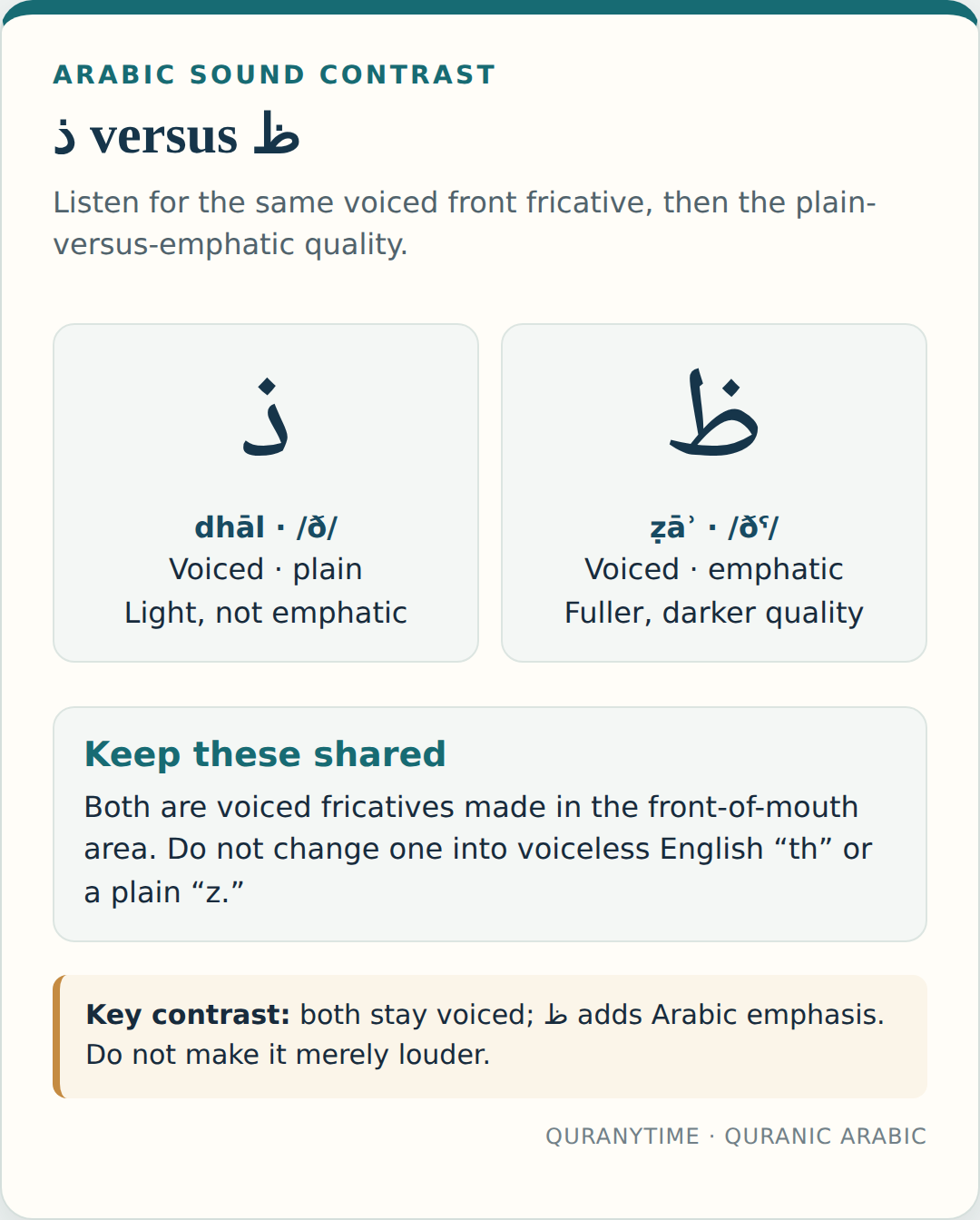
If you are looking for the Arabic ظ vs ذ pronunciation difference, begin with the key contrast: both are voiced sounds made near the front teeth, but ذ (dhāl) is plain while ظ (ẓāʾ) is emphatic. In Quran recitation, hearing that difference matters more than memorizing two English spellings. This guide gives you a listening cue, Quranic examples, and a short way to practise without turning one sound into another.
The aim is careful learning, not self-judgment. Regional Arabic speech can vary, but this article focuses on reading Quranic Arabic clearly. Use the examples as a study aid, and take a specific question about your own recitation to a qualified teacher.
The quick answer: same front area, different quality
For ذ, put the tongue tip lightly at or just between the upper and lower front teeth and let voiced air pass: it is close to the “th” in English this for speakers who pronounce that sound. Keep it voiced; the “th” in thin is voiceless, so it is not the same sound. For ظ, keep the voiced, front-of-mouth fricative but give it the heavier emphatic quality used in Arabic. Do not replace it with a plain English “z,” and do not turn it into the stop sound ض.
IPA descriptions commonly represent ذ as /ð/ and ظ as /ðˤ/. The second symbol marks an emphatic counterpart, not simply a longer or louder ذ. A peer-reviewed acoustic study of Arabic emphatic consonants describes ظ as a voiced emphatic interdental fricative and discusses measurable effects on nearby vowels. It also notes that scholars do not agree on every detail of the secondary constriction, so learners should focus on the reliable contrast—plain versus emphatic—rather than imitate one rigid tongue-root instruction.
Notice what changes—and what stays the same
Both letters are fricatives: the airflow continues through a narrow opening rather than stopping completely. Both are voiced, which means the vocal folds vibrate. You can lightly touch your throat while saying the English word this to notice voicing; it should buzz. The Arabic target is still Arabic, though—English is only a first listening bridge, not a substitute for learning the letter.
The main contrast is the emphatic coloring of ظ. In broad descriptions of Arabic phonetics, emphasis involves a secondary constriction or tongue-body adjustment farther back in the vocal tract, which gives the sound a fuller, darker quality and can color adjacent vowels. There are different analyses of the exact gesture, so avoid telling every learner that one single part of the tongue must move in precisely one way. Instead, keep the tongue tip in the front articulation area, maintain voicing, and compare the quality with ذ. If the result sounds like an ordinary “z,” or like ض, reset and listen again.
This is why a transliteration can mislead. “Dh” may help you remember ذ, while “ẓ” signals the emphatic letter ظ, but English spelling cannot fully reproduce either sound. If you want a larger map of tongue and throat positions, review Quranytime’s guide to makharij, the articulation points of the letters, then compare the broader set of letter qualities in Tajweed.
Hear both letters in a Quranic example
Surah Luqman 31:13 is especially useful because the verse contains both letters. In the opening phrase وَإِذْ قَالَ لُقْمَانُ (wa-idh qāla Luqmānu), the final consonant of idh is ذ. Later, يَعِظُهُ (yaʿiẓuhu, “he was advising him”) contains ظ. The verse ends with the memorable phrase لَظُلْمٌ عَظِيمٌ (la-ẓulmun ʿaẓīm), where ظ occurs twice.
Read the verse first at a comfortable pace, then listen for the contrast between the light, plain ذ in wa-idh and the emphatic ظ in yaʿiẓuhu and la-ẓulmun. The transitions between words matter: do not add a vowel after the final ذ in idh, and do not blur the emphatic quality of ظ just because it is surrounded by other consonants. The embedded recitation below is a listening model for the verse; follow along with the words rather than trying to copy the reciter’s melodic style.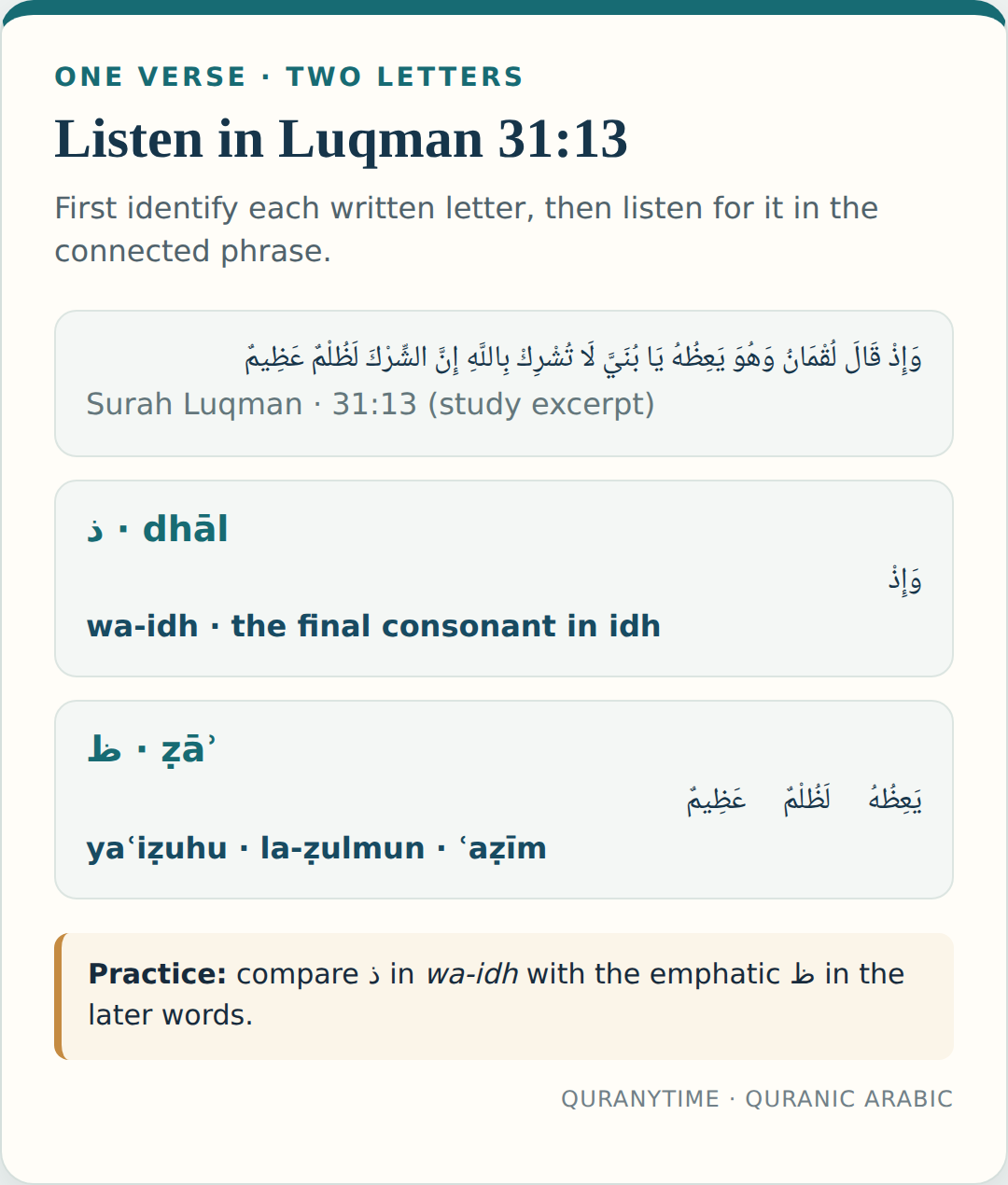
A three-part practice sequence
1. Isolate the sound
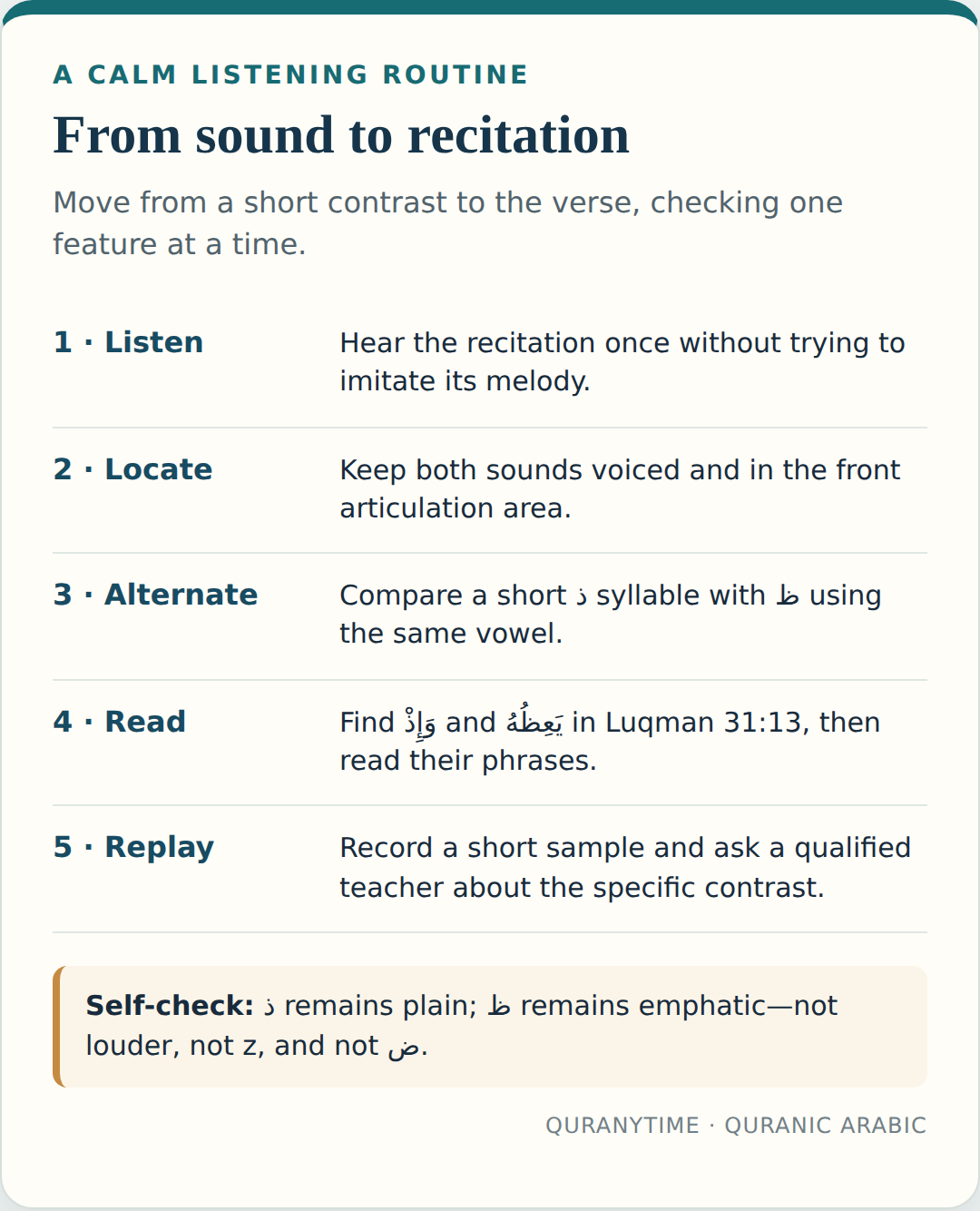
Say ذ in a short syllable such as dha, then pause. Keep the sound voiced and light. Next say ظ in the same vowel environment, such as ẓa, preserving the front fricative but making the quality emphatic. Alternate slowly: dha—ẓa, dhi—ẓi, dhu—ẓu. Do not rush between the pair. The point is to hear a stable contrast, not to make the second sound louder.
2. Practise in real words
Use Quranic words you can verify in a mushaf or with a teacher. For ذ, try idh in وَإِذْ and alladhīna in الَّذِينَ. For ظ, practise yaʿiẓuhu, ẓulmun, and ʿaẓīm from Luqman 31:13. Say each word once slowly and once in its phrase. Avoid inventing a minimal pair: the verse examples are useful contrasts, but they are not a controlled pair differing only by ذ and ظ.
3. Join the phrase without losing the contrast
Read وَإِذْ قَالَ لُقْمَانُ … وَهُوَ يَعِظُهُ … إِنَّ الشِّرْكَ لَظُلْمٌ عَظِيمٌ in short groups. First separate the target words; next connect each one to its neighbors; finally read the phrase at a natural pace. If you are also learning to distinguish other close consonants, Quranytime’s practice guide for English-speaking Quran learners offers a broader listening-first routine, and its lesson on Qaf versus Kaf shows how to focus on one contrast at a time.
Common mix-ups to watch for
- Using voiceless “th” for ذ: English thin begins with a voiceless sound. ذ is voiced. Check for gentle vibration in your throat.
- Using “z” for ظ: A plain z-like sound does not carry the Arabic emphatic quality. Keep the voiced front fricative and listen for the darker, fuller coloring.
- Replacing ظ with ض: The two are both emphatic, but they are not the same consonant. ظ is a continuous fricative; ض is a stop-like emphatic consonant in standard descriptions. Keep the airflow difference.
- Adding an extra vowel: In wa-idh qāla, do not turn the final consonant of idh into a new syllable. Keep the word boundary clear.
- Overdoing “heaviness”: Emphasis is not shouting, tightening the jaw, or exaggerating a growl. If your mouth tenses, slow down, relax, and compare the two letters again.
Other sound contrasts can help you build a useful ear, but keep each task narrow. For example, Quranytime’s lessons on Dhad (ض), Ḥa versus Hā, and ʿAyn (ع) each focus on a different articulation problem. When you hear a possible recitation error, its guide to Lahn Jali and Lahn Khafi explains how to think about correction without treating every difficulty as the same kind of mistake.
Record yourself and check one thing at a time
Make a short recording of wa-idh, then yaʿiẓuhu, then the phrase la-ẓulmun ʿaẓīm. Listen back once for the front contact and once for the plain-versus-emphatic quality. Do not try to judge every Tajweed rule in a single replay. If possible, ask a qualified teacher to listen to the original audio, since phone recordings and room acoustics can change how a sound seems.
A simple self-check is to alternate the words without changing their vowels: idh—ʿaẓīm, idh—ʿaẓīm. Ask three questions: Did ذ remain voiced and light? Did ظ keep its emphatic character without becoming a plain z? Did the connected phrase stay clear without an added vowel? If one answer is uncertain, slow down and practise only that step. A written transliteration can remind you what to compare, but it cannot confirm your mouth position or the sound you actually produced.
For steady progress, keep a small practice note: the word, the verse, the sound you were checking, and the correction your teacher gave. Revisit it after a day rather than repeating the same phrase dozens of times while tired. If you would like an individual correction plan, you can book Quranytime’s free trial class and ask the teacher to listen specifically for ذ and ظ in your recitation.
Takeaway
Remember the compact contrast: ذ is a voiced, plain front fricative; ظ is a voiced, emphatic front fricative. Learn the sound from an accurate recitation, connect it to the written letter, and practise the pair inside words and phrases. In Luqman 31:13, the sequence from wa-idh to yaʿiẓuhu and la-ẓulmun ʿaẓīm gives you a practical way to hear and review both letters in context.