
Why does Arabic sometimes say ثَلَاثَةُ أَيَّامٍ for “three days,” but ثَلَاثُ لَيَالٍ for “three nights”? The number changes shape because Arabic treats the gender of the counted noun as part of the number phrase. The rule is regular once you look up the noun’s singular form instead of guessing from its plural.
This guide covers the traditional 3–10 pattern in Quranic and formal Arabic, with vocalized examples. It is a grammar aid, not tafsir.
If you want to review number words first, start with our Arabic numbers 1–100 overview; this guide zooms in on the special agreement pattern for 3–10.
The quick rule for Arabic numbers 3–10
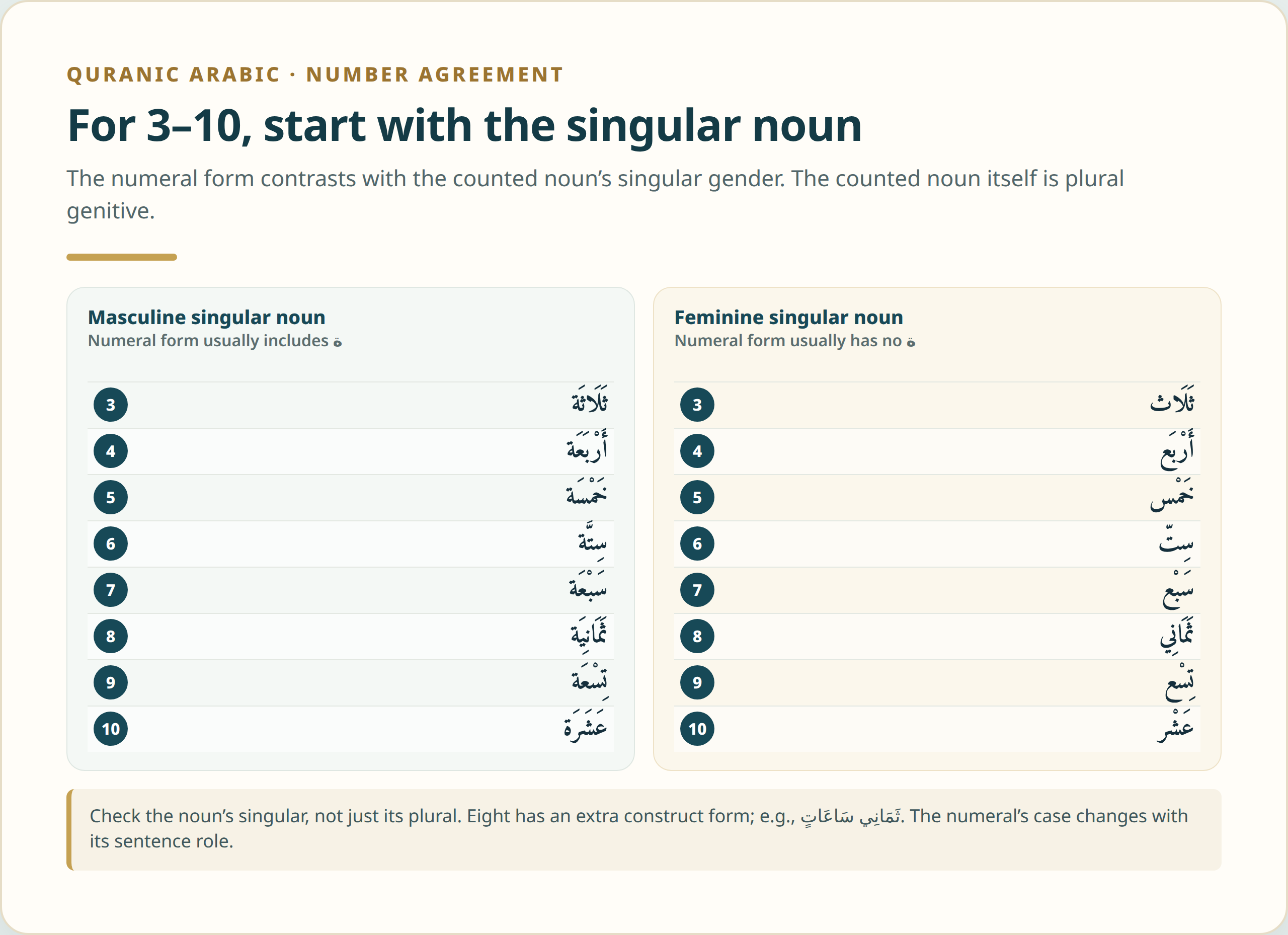
With the numbers three through ten, the numeral normally takes the opposite grammatical gender from the singular noun being counted. The counted noun then appears as a plural in the genitive case. So first identify the singular noun, then choose the numeral form. The phrase may look “reversed,” but its pieces follow a pattern.
| Number | If the singular noun is masculine | If the singular noun is feminine |
|---|---|---|
| 3 | ثَلَاثَة | ثَلَاث |
| 4 | أَرْبَعَة | أَرْبَع |
| 5 | خَمْسَة | خَمْس |
| 6 | سِتَّة | سِتّ |
| 7 | سَبْعَة | سَبْع |
| 8 | ثَمَانِيَة | ثَمَانِي |
| 9 | تِسْعَة | تِسْع |
| 10 | عَشَرَة | عَشْر |
The table gives the form selected by the singular noun, before sentence case is added. Eight is a little irregular: with a feminine counted noun, ثَمَانِي is used in a construct phrase such as ثَمَانِي سَاعَاتٍ; read its ending from a fully vocalized example.
For example, يَوْمٌ (a day) is grammatically masculine, so the number in “three days” uses the form with ة: ثَلَاثَةُ أَيَّامٍ. لَيْلَةٌ (a night) is feminine, so “three nights” uses the form without that ending: ثَلَاثُ لَيَالٍ. The ending ة is a helpful clue, but grammatical gender belongs to the noun, not to the number of people or objects in the phrase.
How to choose the right form
- Find the counted noun. Ask what is being counted: days, nights, months, books, or another noun.
- Recover its singular form. A plural may not show its gender clearly. Check a reliable dictionary or a word-by-word resource if you are unsure; our guide to using a Quran dictionary shows how to trace a word back to its root and meaning.
- Check grammatical gender. Do not infer gender from whether the noun refers to a man, woman, or inanimate thing. Arabic grammatical gender is a property of the noun and can differ from English expectations. Review Arabic adjective agreement for another place where gender and number affect nearby words.
- Choose the opposite numeral shape. In the traditional learner rule, a masculine singular noun pairs with the number form ending in ة (such as أَرْبَعَة); a feminine singular noun pairs with the form without it (such as أَرْبَع).
- Read the counted noun as a plural genitive. In the 3–10 construction, the counted noun is plural and genitive. Some forms are broken plurals rather than regular suffix forms; see common broken plural patterns in the Quran.
- Then check the numeral’s case. Its final vowel depends on its job in the sentence. The numeral can be nominative, accusative, or genitive; the counted noun’s genitive status does not force the numeral to have the same ending. Our case-endings guide explains how to read those sentence roles.
Keep two decisions separate: the singular noun’s gender selects the numeral form; the sentence role selects its case ending. The counted noun remains plural genitive.
See the pattern in Quranic examples
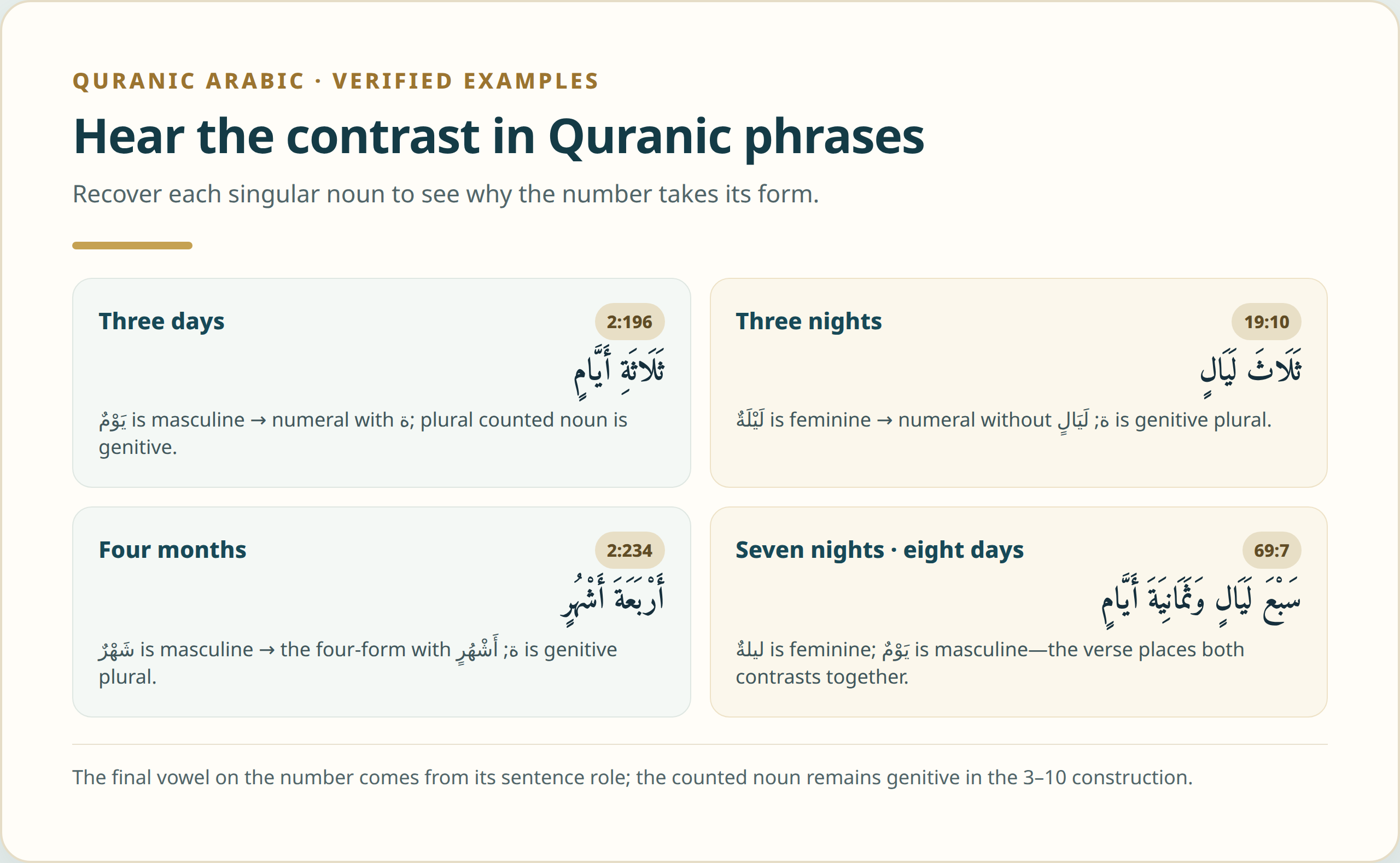
In Al-Baqarah 2:196, the phrase is فَصِيَامُ ثَلَاثَةِ أَيَّامٍ فِي الْحَجِّ, “then fasting three days during Hajj.” The singular noun is يَوْمٌ, a masculine noun. That is why the number appears as ثَلَاثَةِ, with ة. The counted noun is أَيَّامٍ, a plural genitive form. Here the number itself is genitive because it follows صِيَامُ in a construct phrase.
In Maryam 19:10, Zakariyya’s sign is described with ثَلَاثَ لَيَالٍ, “three nights.” The singular is لَيْلَةٌ, feminine, so the numeral is ثَلَاثَ, without ة. The number is accusative in this time expression, while لَيَالٍ is plural genitive. The iḍāfa guide can help when you meet a counted noun linked to a number in a construct phrase.
Al-Haqqah 69:7 places both patterns side by side: سَبْعَ لَيَالٍ وَثَمَانِيَةَ أَيَّامٍ—“seven nights and eight days.” The singular لَيْلَةٌ is feminine, so seven appears as سَبْعَ; the singular يَوْمٌ is masculine, so eight appears as ثَمَانِيَةَ. The counted nouns are plural genitive. The Quranic Arabic Corpus’s word-by-word analysis of 69:7 labels the number and counted noun forms in this phrase, making the contrast easy to inspect.
A second masculine example appears in Al-Baqarah 2:234: أَرْبَعَةَ أَشْهُرٍ وَعَشْرًا, “four months and ten [days].” The singular noun شَهْرٌ is masculine, so four takes the form أَرْبَعَةَ. The plural أَشْهُرٍ is genitive. Read the surrounding words too: the case vowel on the numeral reflects its role in the sentence, not a different gender rule.
Do not guess from the plural alone
Arabic plurals can be irregular. For example, أَيَّامٌ is the plural of masculine يَوْمٌ, while لَيَالٍ is the plural of feminine لَيْلَةٌ. The plural’s written shape does not always make the original gender obvious. When uncertain, check the singular entry in a dictionary, then return to the verse. Some plurals change their internal pattern rather than adding a suffix, so compare the examples in the broken-plural step above.
Also distinguish a counted plural from other number-related constructions. A dual noun means “two” and has its own endings and agreement; it is not simply a 3–10 plural. Our guide to Arabic dual nouns in Quranic reading covers that separate pattern. Likewise, an iḍāfa chain can affect definiteness: the first noun may be identified by the noun that follows it. For that contrast, see definite and indefinite nouns in Arabic.
Where this rule stops
Do not extend the 3–10 pattern to every number. One and two generally agree with the noun; 11–19 and the tens follow other structures. For numbers outside 3–10, check their own rule instead of carrying over “opposite gender plus plural genitive.”
Eight needs extra care. Quran 69:7 has ثَمَانِيَةَ أَيَّامٍ with masculine يَوْمٌ; with a feminine noun, ثَمَانِي appears in a construct phrase such as ثَمَانِي سَاعَاتٍ. Learn the whole vocalized phrase and check its case in context.
Practice the rule with three checks
Try the following before looking at the answer key in the visual. For “three books,” start with كِتَابٌ (masculine), so the number takes the form with ة: ثَلَاثَةُ كُتُبٍ. For “three cars,” start with سَيَّارَةٌ (feminine), so use ثَلَاثُ سَيَّارَاتٍ. For “four months,” the singular is masculine شَهْرٌ, giving أَرْبَعَةُ أَشْهُرٍ as a dictionary-form phrase. In an actual sentence, the number’s final vowel may change with its grammatical role.
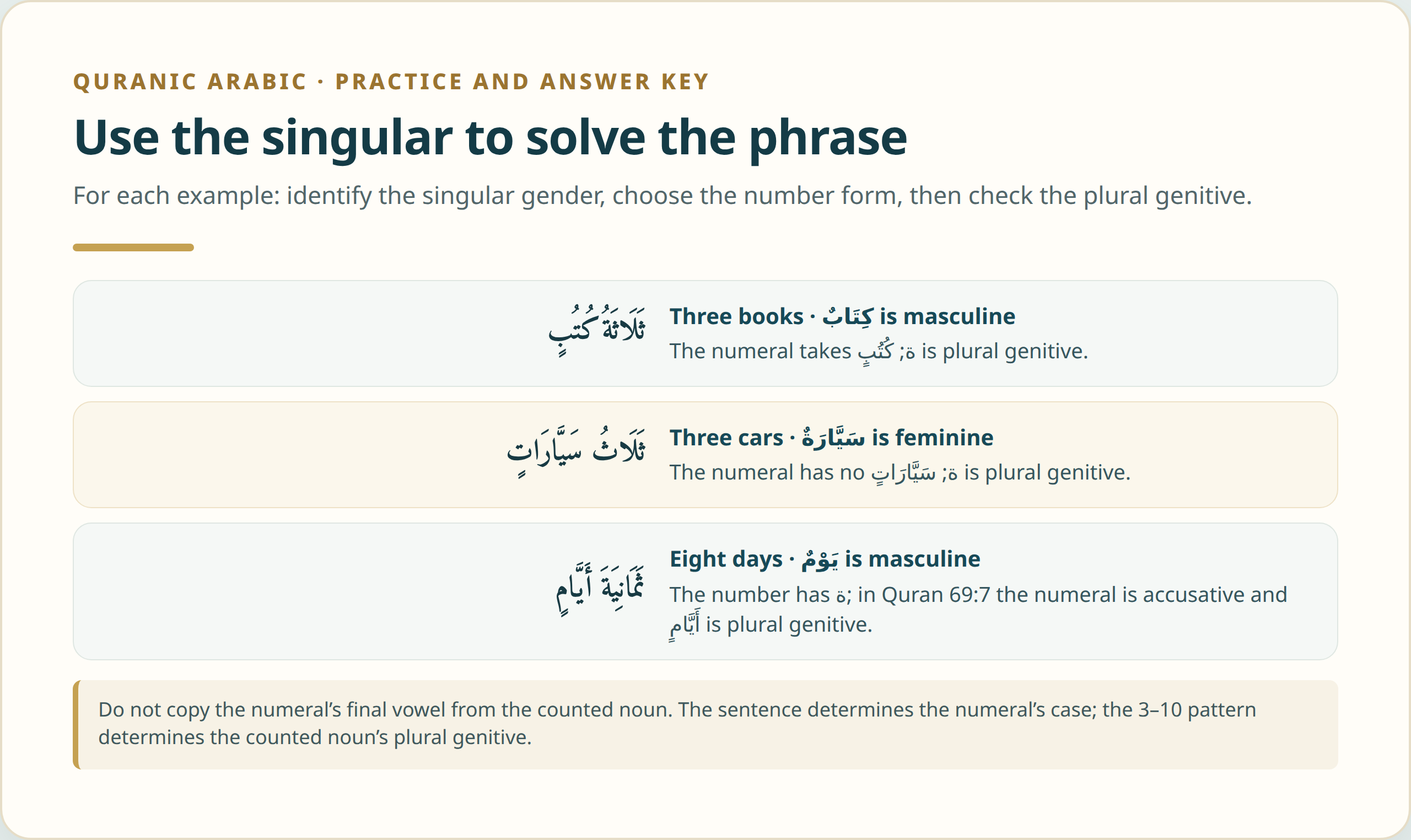
Keep four notes as you practise: the verse phrase, the noun’s singular, its gender, and the clue for the numeral’s case. For 3–10, trace the noun back to its singular, choose the contrasting form, then read the full sentence.
If you would like a teacher to work through a Quranic Arabic example with you, you can book a free Quran and Arabic trial class and bring a verse or number phrase to discuss.
For listening practice, hear Surah Al-Haqqah 69:7, which contains the paired phrases “seven nights” and “eight days.” The recitation is text-led, with the target verse heard around 00:55–01:03; follow the Arabic line and identify the singular noun behind each plural before replaying the phrase.