
Arabic learners often recognize a fatḥah, kasrah, or ḍammah but still hesitate when a word contains alif, wāw, or yāʾ. Is that next letter a consonant, a long vowel, or part of a different sound? This guide to short and long vowels in Arabic answers that question through clear sound pairs and Qur’anic examples. The goal is not to replace your teacher’s recitation or explain every Tajweed extension. It is to help you see the pattern, hear the difference, and practise without turning every alif, wāw, or yāʾ into a long vowel.
What “short” and “long” mean in Arabic
Arabic has three basic short vowel qualities: a, i, and u. In Arabic writing they are usually shown by marks placed above or below a consonant: fatḥah for a, kasrah for i, and ḍammah for u. These marks are not separate letters. They tell you how to voice the consonant that carries them. If you need a broader introduction to the three short-vowel marks used in Quran reading, start there.
Each quality has a corresponding long vowel: ā, ī, and ū. The mouth shape stays close to the matching short vowel; what changes is the time the vowel is held. In simple beginner notation, macrons over a, i, and u show that longer sound. This is not the English spelling contrast in words such as “cap” and “cape.” Arabic ā is not automatically an English-style “ay” sound; it is an extended Arabic a. You can hear why vowel length matters in familiar names such as Musa and Bilal; use the pronunciation notes in our Muslim name generator with Arabic spellings to compare their spellings and long-vowel cues.
A short vowel can be present in speech even when its mark is omitted from ordinary Arabic text. A long vowel is commonly represented by a letter after the consonant carrying the short-vowel mark. Qur’anic pages normally show more reading marks than everyday unvowelled prose, but small alif forms and other Qur’anic writing conventions may appear. This is one reason it helps to learn the Arabic letter shapes and how they connect alongside the vowel marks.
When a new word feels uncertain, use a four-step scan: identify the consonant with its vowel mark, read that short vowel, inspect the following letter, then ask whether it completes the matching long-vowel pattern or begins a consonant or diphthong. Confirm by listening to a trusted recitation or teacher. This sound contrast appears across Arabic learning contexts; if you are comparing goals, see this guide to Quranic Arabic and Modern Standard Arabic. Vowel length by itself does not tell you a word’s register.
For quick review, write each short mark beside its matching long-vowel letter. Cover the second column and recall the pattern, then reverse the drill: listen to a word and mark the syllable you hear as long. This turns recognition into an active reading skill instead of a chart you only remember while looking at it.
The three short-to-long pairs
Use the same consonant, b, to hear the pattern. بَ is ba; adding alif gives بَا, bā. بِ is bi; yāʾ after kasrah gives بِي, bī. بُ is bu; wāw after ḍammah gives بُو, bū. These are sound frames for practice, not a list of standalone words.
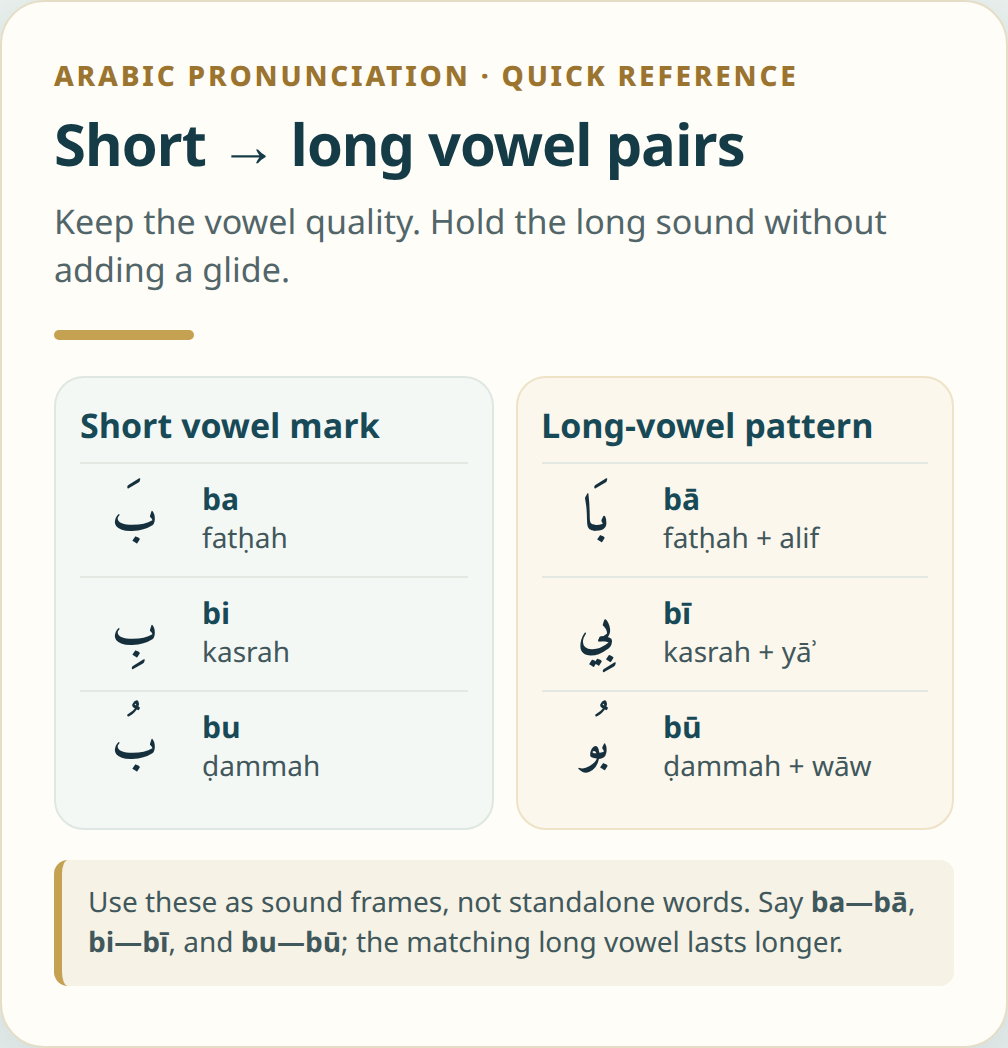
Say each short form once, then sustain the long form without changing its basic vowel quality: ba—bā, bi—bī, bu—bū. Avoid adding an extra glide at the end. The aim is not to say bay, bee, or boo according to English spelling habits; follow the Arabic sound and the model you hear.
How the spelling usually signals a long vowel
In a common teaching pattern, an alif after a consonant with fatḥah signals long ā; a yāʾ with sukūn after kasrah signals long ī; and a wāw with sukūn after ḍammah signals long ū. The consonant comes first, then its short-vowel mark, then the matching length letter. A free Arabic lesson from LibreTexts on Arabic long vowels also introduces these alif, wāw, and yāʾ patterns and explains the short-versus-long timing contrast.
That pattern is a useful guide, not permission to lengthen every occurrence of those three letters. Wāw may be the consonant w, as in the conjunction وَ (wa). Yāʾ may be the consonant y, as at the beginning of يَدٌ (yadun, “a hand”). The surrounding marks and sounds determine the job. If the word is fully marked, read the complete pattern instead of looking at one letter alone. For help with text where short marks are absent, use this guide to reading Arabic without vowel marks.
Hear the contrast inside Qur’anic words
Look at fully vocalized words rather than trying to memorize letters in isolation. In the common Ḥafṣ recitation of Al-Fātiḥah 1:4, مَالِكِ (māliki) has a long ā in its first syllable and a short i at the end. In Al-Fātiḥah 1:5, نَسْتَعِينُ (nastaʿīnu) contains long ī. In Al-Fīl 105:1, الْفِيلِ (al-fīli) likewise has long ī. These examples show that a single word may contain both a long vowel and short vowels.
For long ū, listen for نُورٌ (nūrun) in An-Nūr 24:35. The first vowel is sustained; the ending follows the word’s case and the rules of connection or stopping. Do not mistake the aw sound in يَوْمِ (yawmi) in Al-Fātiḥah 1:4 for long ū. It is a diphthong, a glide from one vowel quality to another, not the same sound as yū.
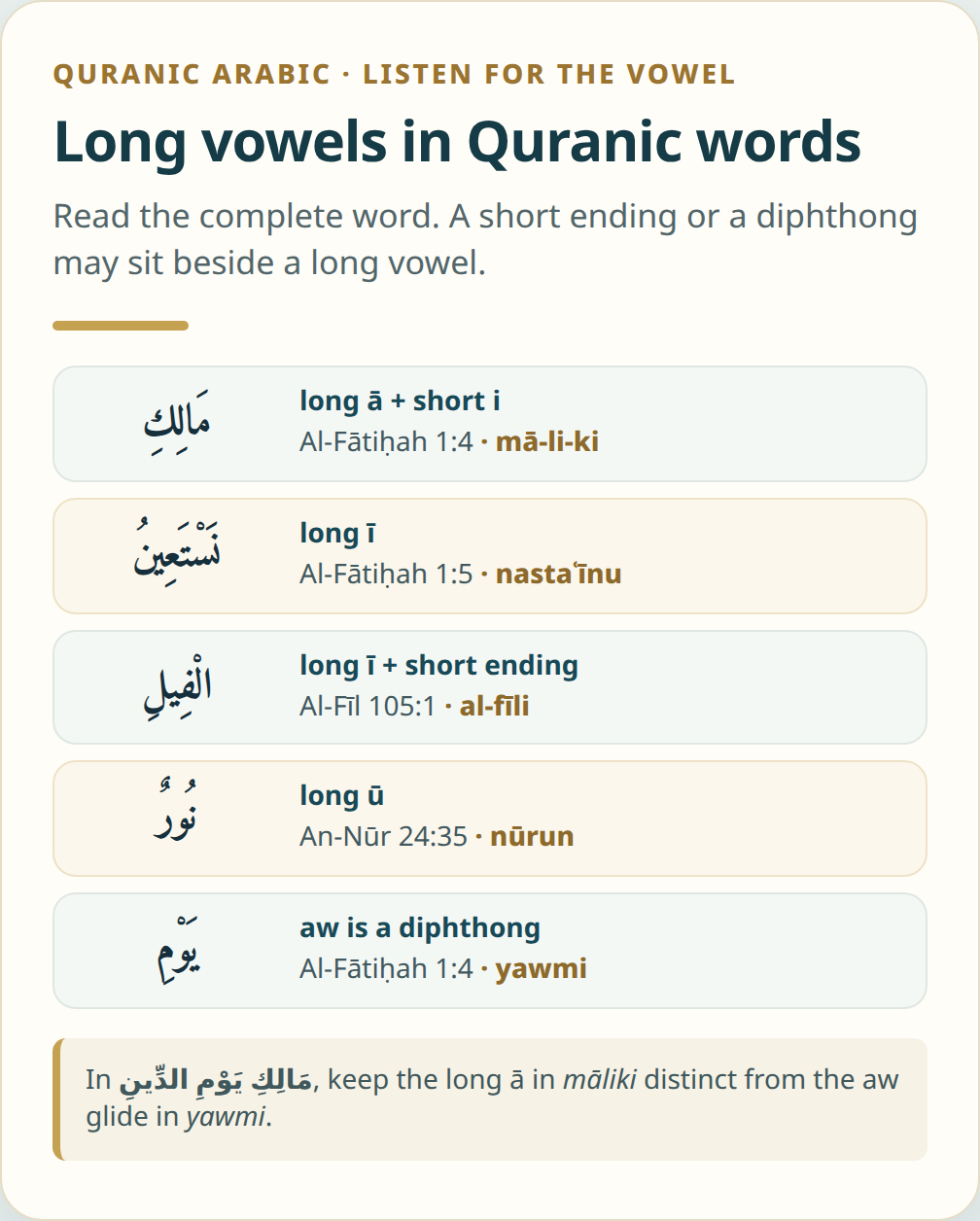
Read those words slowly once, then at a natural pace. Keep the long vowel audible, but do not stretch the word until its rhythm or meaning changes. For a broader foundation in sounded-out words, the Quranytime Arabic Reading Guide offers related beginner reading practice.
Vowel length and Tajweed madd are connected, but not identical
A long vowel is part of the word’s sound pattern. Tajweed madd describes how a reciter handles length in Qur’anic recitation, including cases where a long-vowel letter meets a hamzah or sukūn and the required extension changes. A beginner can first learn to recognize the base ā, ī, or ū, then study the applicable recitation rule. Do not shorten a clearly written long vowel because you have not yet learned its madd category, and do not extend a short vowel just to make it sound emphatic.
The natural length is taught within a recitation tradition and should be modelled by a qualified teacher. Stopping at the end of an āyah can also affect how the final syllable is heard. For those details, study the separate guide to Tajweed madd rules and their recitation counts. This article focuses on hearing the short-versus-long contrast; it is not a substitute for learning Tajweed rules or the signs in your muṣḥaf.
A practical listen–read–record routine
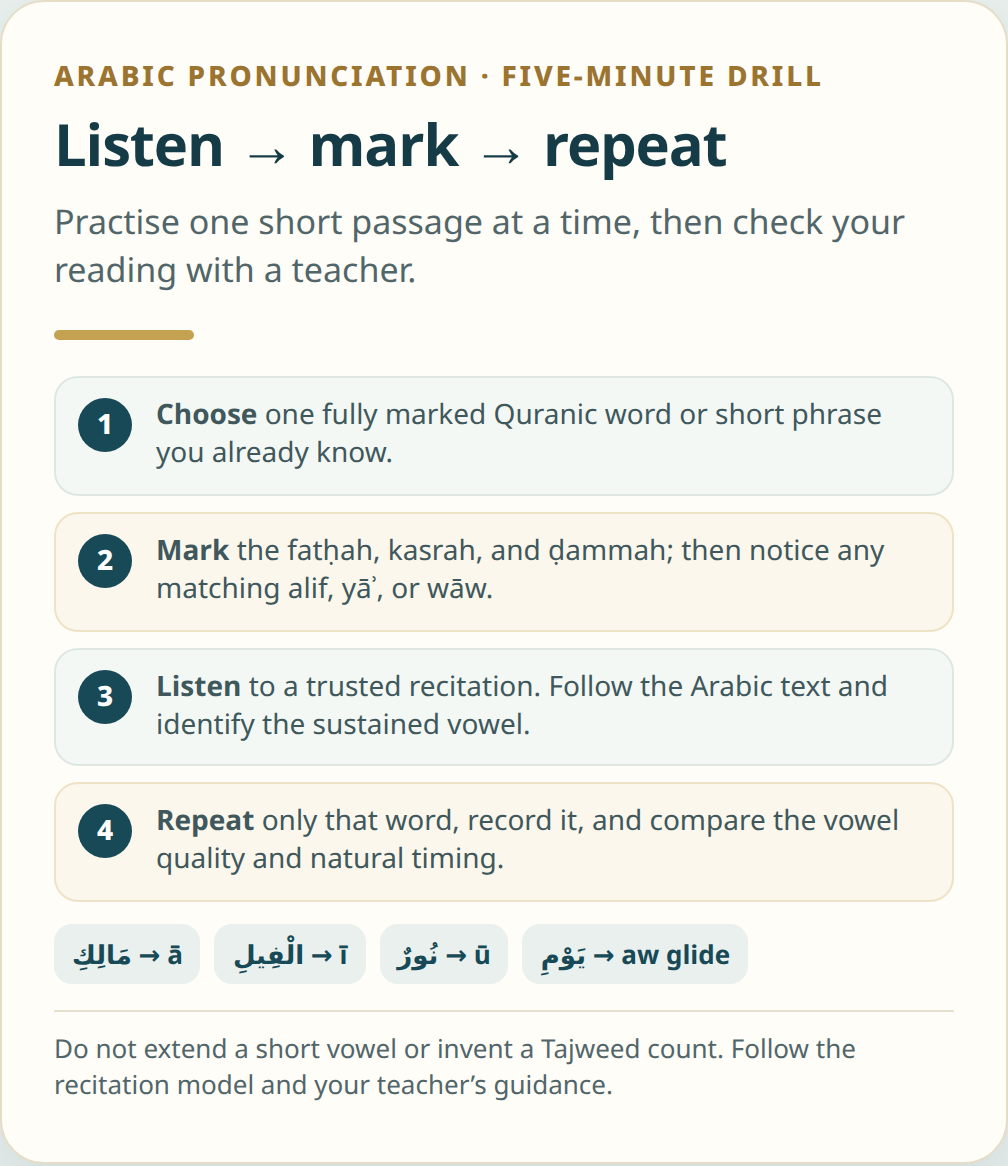
Choose a short passage you already know, such as Al-Fātiḥah. First follow the Arabic text with your finger and circle the three short-vowel marks in a copy or study sheet. Next, mark the alif, wāw, or yāʾ that serves as a long vowel. Read the word silently by syllables, then listen to a reliable recitation and notice where the vowel is sustained. Repeat the word, not the whole passage, until the contrast is clear.
The video below shows Al-Fātiḥah with Arabic text highlighted alongside its recitation. At verse 1:4, follow مَالِكِ يَوْمِ الدِّينِ. Notice the long ā in māliki; then hear the short vowel in yawmi and the diphthong aw. Text and sound together can help you connect the marks to what you hear.
Use a listen–pause–check routine: play one phrase, pause, repeat it, and compare your recording with the model. Keep the recording short and focus on one contrast at a time. Quranytime’s listen–pause–check method for Quran audio can help you build a steady routine. You can also use the beginner Arabic listening practice routine when you want to move from one word to a short phrase.
Common mistakes to avoid
- Calling every alif, wāw, or yāʾ a long vowel. Check the preceding vowel and the letter’s position. A wāw with fatḥah may be the consonant w, while a wāw after ḍammah can indicate long ū.
- Assuming unmarked means soundless. Ordinary Arabic writing often leaves short-vowel marks out. Readers infer them from vocabulary, grammar, and context; the letter sequence still carries the word.
- Changing the vowel quality. Long ā is a sustained Arabic a, not automatically a diphthong. Practise the sound your teacher uses rather than relying on English letter names.
- Confusing length with a doubled consonant. Shaddah signals a consonant pronounced with doubling; it does not turn a short vowel into a long one.
- Using the same duration in every Quranic context. Recitation rules, the reading tradition, and stopping context matter. Follow a qualified teacher and your muṣḥaf rather than improvising counts.
For a guided check of your Arabic reading and recitation, you can book a free Quran and Arabic trial class. Bring one short passage and ask your teacher to listen specifically for the difference between short vowels, long vowels, and diphthongs.