
Quranic Arabic for beginners
When an Arabic sentence begins with an action, do not translate word by word immediately. First ask: What is the verb? Who carries the action? Does the action reach an object? That pause turns a crowded line into a few roles. This guide introduces Arabic verbal sentences through the terms fiʿl (verb), fāʿil (subject or doer), and mafʿūl bihi (direct object).
Classical and Quranic Arabic often uses verb-first order, but it also allows subject-first clauses. A direct object may be omitted or expressed as an attached pronoun. A prepositional complement has a different role; do not label it a direct object. Keep these possibilities open as you parse.
The three core roles
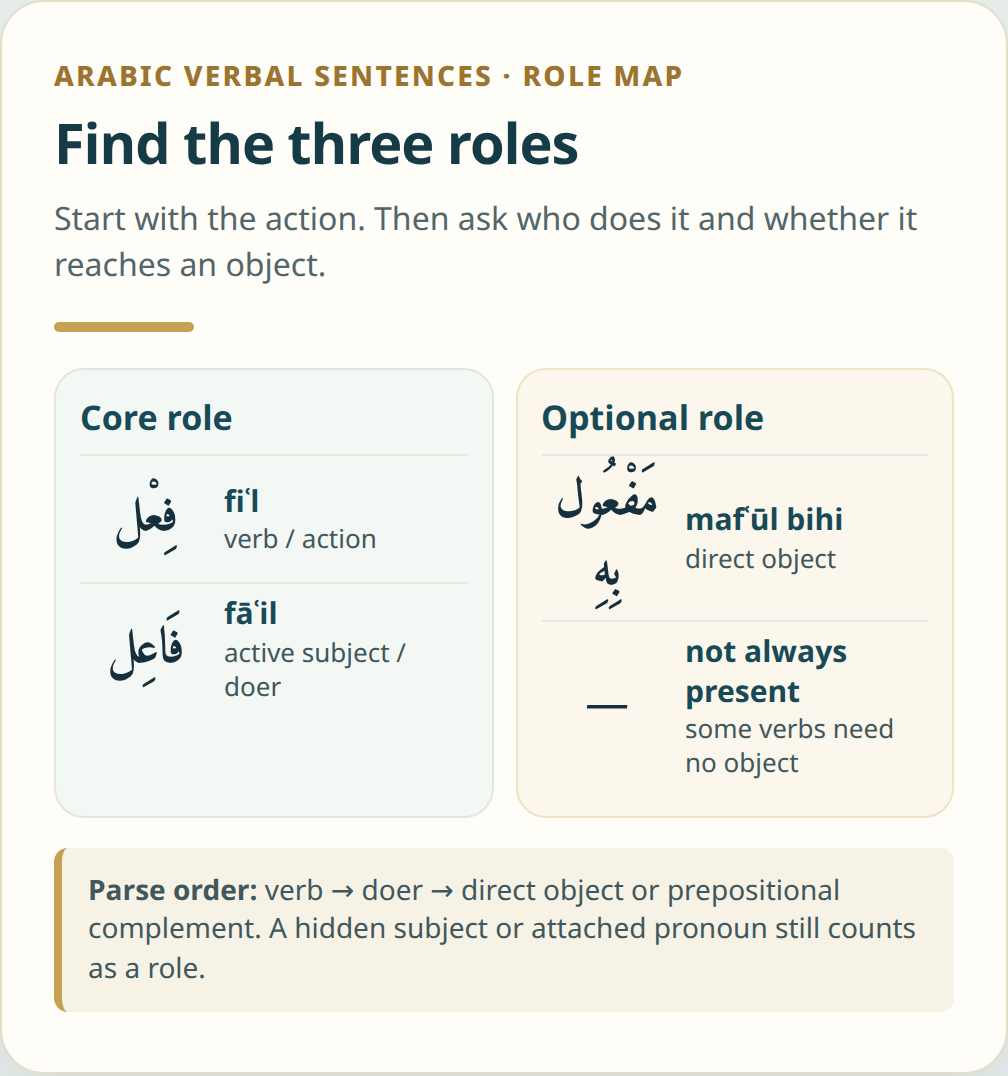
Fiʿl (فِعْل) names the action or event. In a verbal sentence, begin by locating the finite verb and noticing its tense, person, gender, and number clues. Review Arabic verb conjugation to recognize changing forms. A pattern may suggest nuance but does not identify every sentence role; see Arabic verb forms in Quranic Arabic.
Fāʿil (فَاعِل) is the grammatical subject of an active verb. It may be an overt noun after the verb, an attached subject pronoun, or an understood pronoun. It occupies the nominative case position even when no final case vowel is visible or heard.
Mafʿūl bihi (مَفْعُول بِهِ) is the direct object: the person or thing directly affected by a transitive action. It is optional. كَتَبَ الطَّالِبُ kataba al-ṭālibu means “the student wrote”; the sentence is complete even without saying what was written. Add الدَّرْسَ al-darsa, and the lesson becomes the direct object. For a compact reference to how active verbs, subjects, and objects are annotated, consult the Quranic Arabic Corpus verb documentation.
What the verb may hide or attach
Arabic often lets the verb carry the subject. In كَتَبْتُ katabtu, the ending -tu identifies “I”; there is no separate noun for the subject. In a past-tense third-person masculine form such as كَتَبَ kataba, the understood subject can be “he,” conventionally written in a parse as a hidden pronoun huwa when context supplies it. A hidden subject is still a subject; do not invent an extra noun.
An object can also be attached. Compare قَرَأَهُ qaraʾahu, “he read it.” The verb supplies the hidden “he,” while -hu is an attached object pronoun, “it/him” according to context. The attached pronoun is not the fāʿil. Mark the two jobs separately. The guide to Arabic pronouns for Quranic reading can help when these small endings become hard to see.
Case supports syntax: the fāʿil is nominative and a direct object is accusative. Ordinary Arabic texts may omit short vowels; Quran copies usually include them, but stopping can conceal an audible ending. Attached pronouns occupy a case position without a visible case ending. Combine morphology, meaning, order, and agreement. A focused review of Arabic case endings and iʿrāb can be your next step, not your first test.
Verb-first and subject-first order
Traditional grammar calls a clause that begins with a verb a jumlah fiʿliyyah, a verbal sentence. A common formal pattern is fiʿl + fāʿil + mafʿūl bihi: verb, subject, optional object. In a simple original example, قَرَأَ الطَّالِبُ الدَّرْسَ qaraʾa al-ṭālibu al-darsa means “The student read the lesson.”
Arabic also allows a subject-first presentation: الطَّالِبُ قَرَأَ الدَّرْسَ al-ṭālibu qaraʾa al-darsa. In traditional parsing, this is normally a nominal sentence with a verbal clause as its predicate. The learner’s first job remains the same: identify who did what. In standard Classical examples, a verb-first clause with a following overt plural subject commonly has a singular verb form: حَضَرَ الطُّلَّابُ “the students attended.” With subject-first order, full agreement is expected in standard formal usage: الطُّلَّابُ حَضَرُوا. This is a formal Classical/Quranic pattern, not a universal rule for every modern dialect.
Do not confuse a direct object with a noun after a preposition. In ذَهَبَ الطَّالِبُ إِلَى الْمَكْتَبَةِ, “the student went to the library,” إِلَى الْمَكْتَبَةِ is a prepositional complement, not a mafʿūl bihi. Review Arabic prepositions when you need to distinguish these roles. The same caution applies to passive voice: in a passive clause, the original doer may be unmentioned and the following noun is analyzed as a passive subject (often called nāʾib al-fāʿil), not an active fāʿil. See the Arabic passive voice reading guide for that separate pattern.
Three Quranic examples
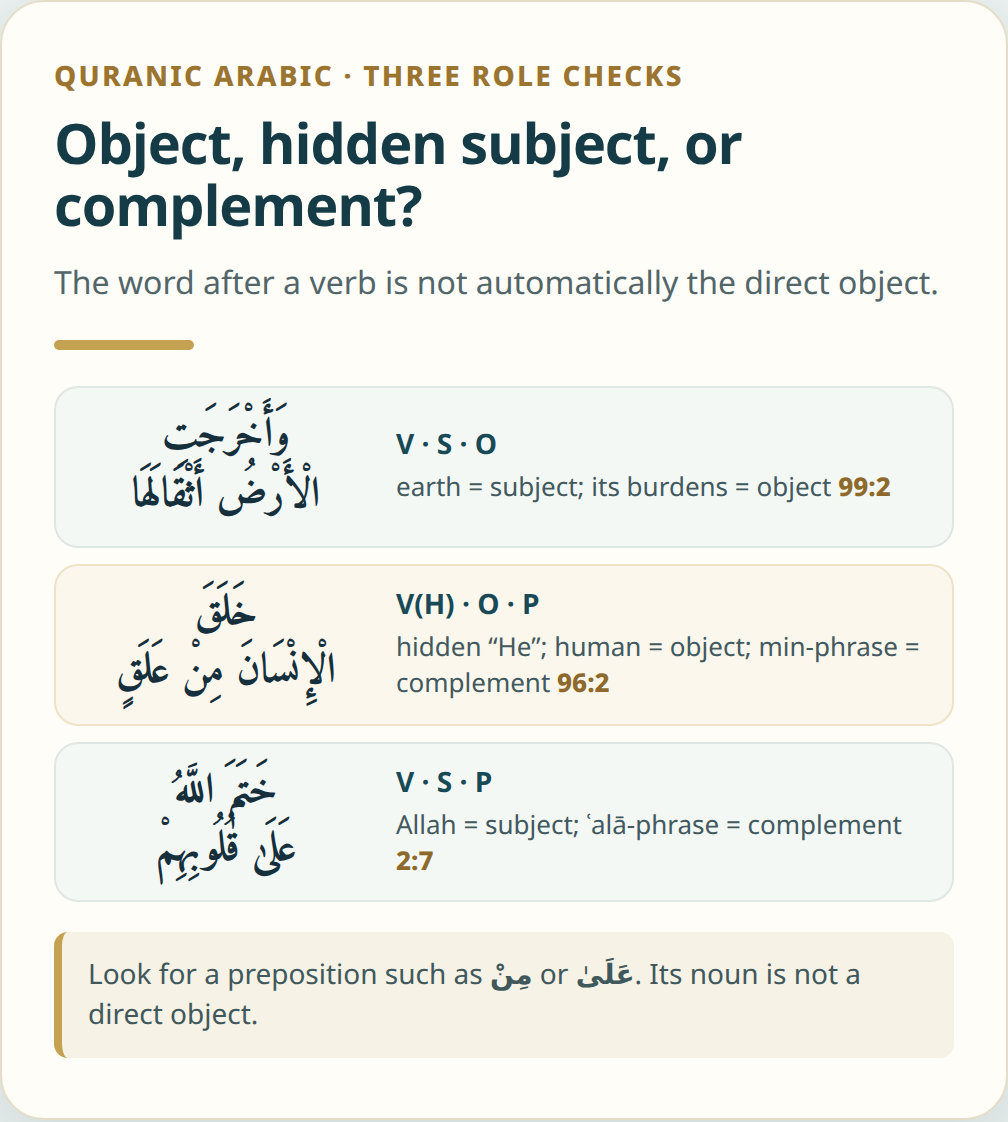
Quran 99:2: وَأَخْرَجَتِ الْأَرْضُ أَثْقَالَهَا. The verb is أَخْرَجَتْ “brought out,” with the feminine -at marker. The fāʿil is الْأَرْضُ “the earth.” The mafʿūl bihi is أَثْقَالَهَا “its burdens,” where -hā is an attached possessive pronoun inside the object phrase. The feminine marker in the verb agrees with al-arḍ; it is not a separate subject pronoun.
Quran 96:2: خَلَقَ الْإِنْسَانَ مِنْ عَلَقٍ. Here خَلَقَ is “created.” Its active subject is a hidden huwa (“He”), not a noun written after the verb. الْإِنْسَانَ is the direct object, “the human being.” The phrase مِنْ عَلَقٍ begins with min, so it is a prepositional phrase, not a second direct object.
Quran 2:7: خَتَمَ اللَّهُ عَلَىٰ قُلُوبِهِمْ. The verb is خَتَمَ “sealed,” and اللَّهُ is the overt fāʿil. The phrase عَلَىٰ قُلُوبِهِمْ begins with ʿalā; it is a prepositional complement, not a direct object. The attached -him means “their” within the noun phrase “their hearts.”
A five-step parse you can repeat
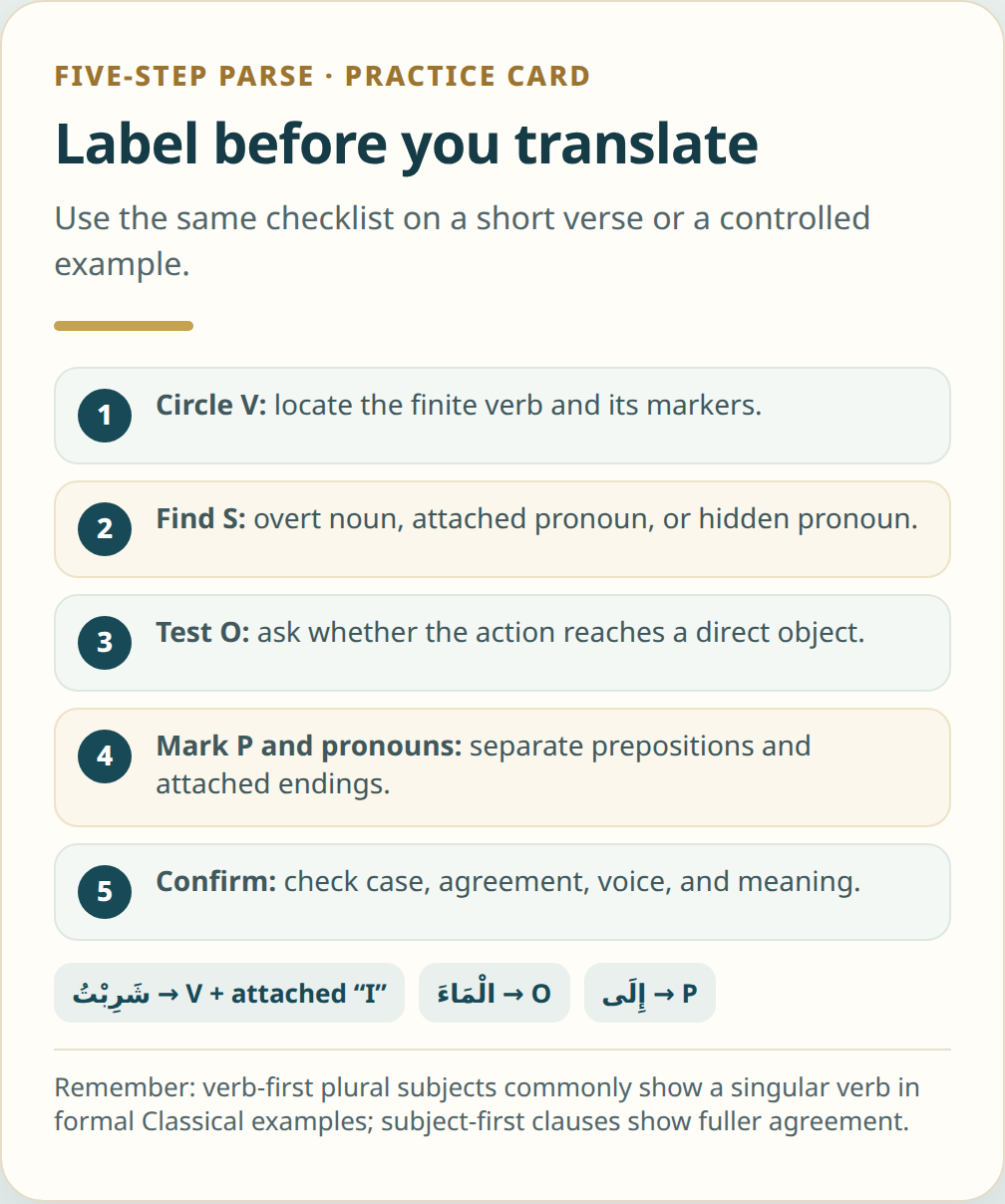
- Circle the finite verb. Note tense and any person, gender, or number marker.
- Ask who is doing or carrying the action. Look for an overt noun after the verb; if none appears, check attached endings or an understood subject.
- Ask whether the action reaches a direct object. If a noun is introduced by a preposition, label it as a complement instead.
- Separate attached pronouns. Decide whether each small ending marks the subject, object, or possession.
- Confirm, then translate. Check case clues, agreement, voice, and the clause’s overall meaning. Only then make a natural English sentence.
This order protects you from a common beginner error: assigning roles by English word order alone. It also keeps a verb-first sentence distinct from the separate topic of Arabic nominal sentences, mubtada, and khabar. If a weak verb changes shape, consult the practical guide to weak verbs in Quranic Arabic after you have identified its clause role.
Practice: label before translating
For each sentence, write V for fiʿl, S for fāʿil, O for direct object, P for prepositional complement, and H for a hidden subject.
- كَسَرَ الْوَلَدُ الْقَلَمَ
- شَرِبْتُ الْمَاءَ
- ذَهَبَتِ الْبِنْتُ إِلَى الْبَيْتِ
- رَأَيْتُهُ
Answer key: (1) كَسَرَ V, الْوَلَدُ S, الْقَلَمَ O: “The boy broke the pen.” (2) شَرِبْتُ V with “I” built into the verb, الْمَاءَ O: “I drank the water.” (3) ذَهَبَتْ V, الْبِنْتُ S, and إِلَى الْبَيْتِ P: “The girl went to the house.” (4) رَأَيْتُ V with attached subject -tu (“I”), and -hu is the attached O: “I saw him/it,” depending on context.
FAQs
Does every Arabic verbal sentence have an object?
No. Intransitive verbs can make a complete clause with a subject only. A transitive verb may also omit its object when the context makes it understood.
Is the first noun always the subject?
No. In a verb-first clause, the verb comes before an overt subject. A noun after a verb may be an object or part of a prepositional phrase, so test its relationship rather than relying on position.
Can I see every case ending in a Quran page?
Not every grammatical case has a visible final short vowel: attached pronouns and some noun forms use other signs. Pausing can also conceal audible endings. Check morphology and context too.
What should I do when the clause is passive?
Pause the active-sentence template. Identify the passive verb and look for the noun functioning as the passive subject; do not automatically search for an active doer.
Keep practicing with feedback. Bring a few role-labeled verses to a free trial class and ask a teacher to check your verb, subject, object, and complement decisions. With repetition, parsing becomes a reading habit rather than a guessing exercise.