
Quranic Arabic grammar · beginner guide
Why is الشَّمْسُ feminine in Arabic, while الْقَمَرُ is masculine? Every Arabic noun has grammatical gender, including words for objects and ideas. The label is not decided by the English translation or whether something is alive.
This guide explains Arabic noun gender: endings that offer clues, feminine nouns with no visible marker, and agreement in Quranic examples. Learn to confirm a noun’s gender rather than guess from its last letter.
What grammatical gender means
Arabic nouns are masculine (mudhakkar, مُذَكَّر) or feminine (muʾannath, مُؤَنَّث). For people, forms often match the person described: طَالِبٌ is a male student and طَالِبَةٌ a female student. Nonhuman nouns also have conventional gender: كِتَابٌ “book” is masculine; سَيَّارَةٌ “car” is feminine.
That category matters because nearby words often agree with the noun. An adjective, demonstrative, pronoun, or verb may take a masculine or feminine form. The gender label itself does not change because a noun is in a different case; case endings show the noun’s role in the sentence, while gender helps other words match it. For a neutral university introduction to Arabic noun gender and agreement, see Michigan State University’s open Arabic textbook.
Clue 1: the ending ة
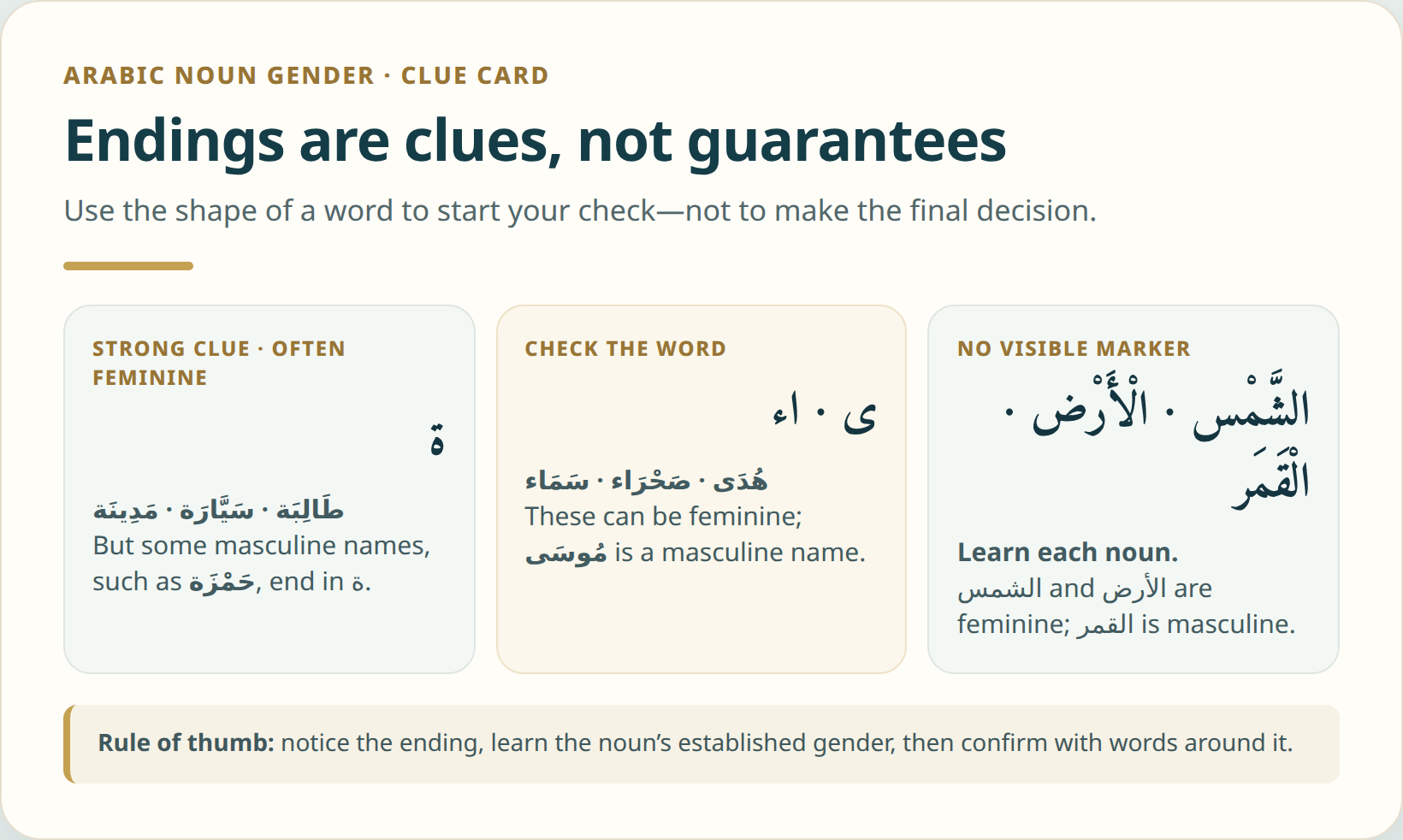
The letter ة, called tāʾ marbūṭah, is the most familiar sign of a feminine noun. It appears in words such as مَدِينَةٌ “city,” سَيَّارَةٌ “car,” and طَالِبَةٌ “female student.” This is a useful first check, not a guarantee. Some masculine personal names end in ة, including حَمْزَةُ and طَلْحَةُ. The spelling gives you a clue; the word’s established use gives you the answer.
When you stop on a word, ة is often pronounced like a final “h” or soft “a”; when the word is connected in speech, it is commonly heard as “t.” That pronunciation change is not a change of gender. If the letter itself is new, review how tāʾ marbūṭah sounds at a pause and in connected reading.
Clue 2: endings such as ى and اء
Some feminine nouns and adjective forms end in ى or اء: كُبْرَى is a feminine adjective form (“greater/largest”), while صَحْرَاءُ (“desert”) and سَمَاءٌ (“sky”) are feminine nouns. These patterns can help you notice a likely feminine form, but they are not an all-purpose rule. For example, مُوسَى and مُصْطَفَى are masculine names. Do not decide a noun’s gender by its final letter alone.
Also separate a noun from an adjective that describes a noun. A pair such as الْمَدِينَةُ الْكُبْرَى (“the large/major city”) shows a feminine adjective agreeing with a feminine noun. That agreement is useful evidence, but it is a different topic from how the noun got its gender. See the site’s guide to Arabic adjective agreement for a deeper look at matching forms.
Many feminine nouns have no visible ending
Some common feminine nouns do not end in ة, ى, or اء. Learn their gender with the word itself. In Quranic Arabic, الشَّمْسُ “the sun,” الْأَرْضُ “the earth,” and النَّفْسُ “the soul/self” are feminine. Their spelling does not display the familiar feminine ending, so the noun’s usage and its agreement provide the clue.
Learn contrasting pairs: الشَّمْسُ “sun” is feminine; الْقَمَرُ “moon” is masculine. Similarly, اللَّيْلُ “night” is masculine, while السَّمَاءُ “sky” is feminine. Record gender with each vocabulary item.
Quran examples: look for more than the noun
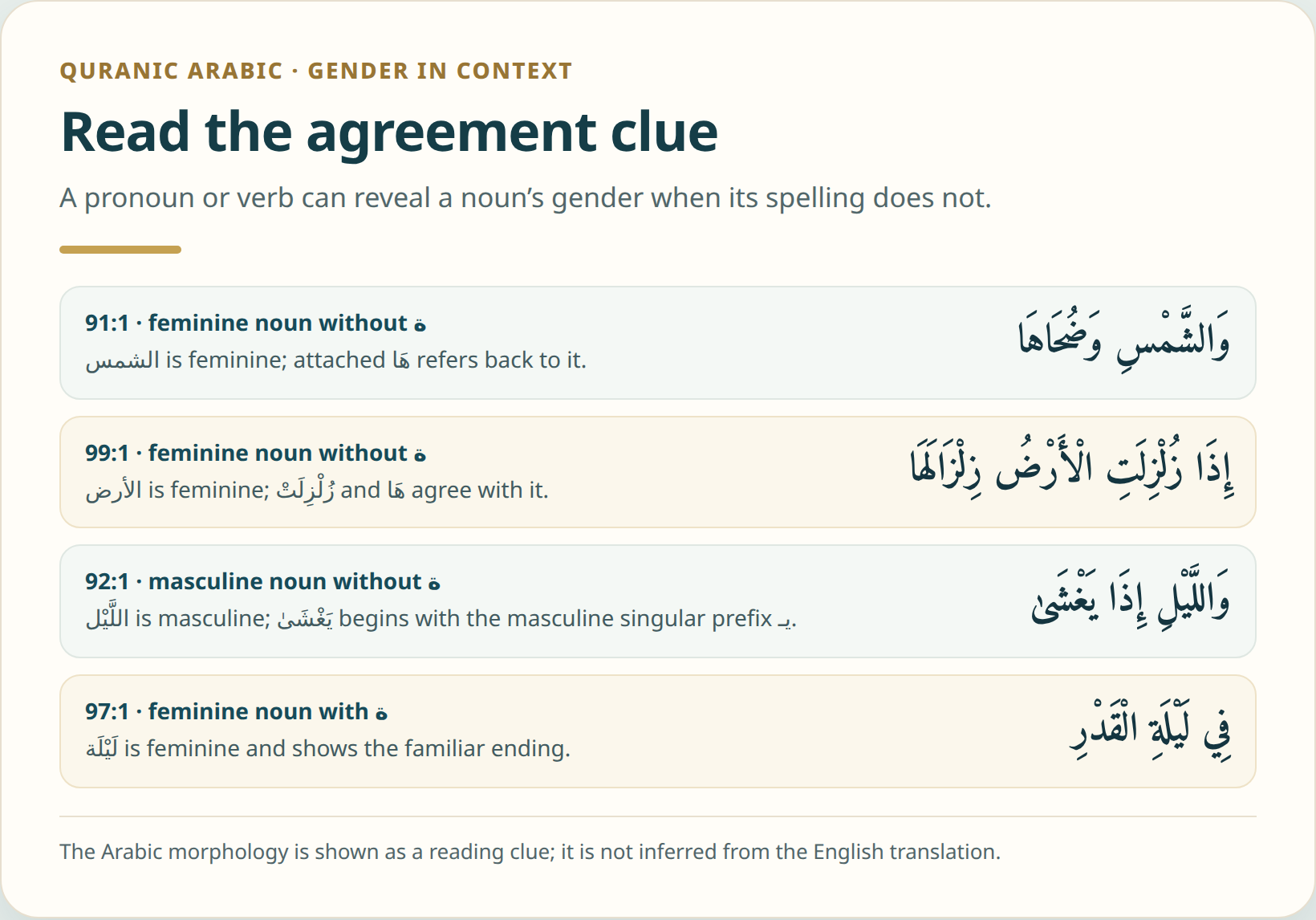
In a fully vowelled Quranic line, a pronoun or verb can confirm a noun’s gender. For instance, in وَالشَّمْسِ وَضُحَاهَا (91:1), the attached هَا in “its brightness” is feminine and refers to الشَّمْسِ. In the next verse, وَالْقَمَرِ إِذَا تَلَاهَا (91:2), the moon is masculine, while the object pronoun هَا refers back to the sun. One short passage gives you both genders in context.
Two more examples make the pattern visible:
- إِذَا زُلْزِلَتِ الْأَرْضُ زِلْزَالَهَا (99:1): زُلْزِلَتْ is a feminine singular verb, and هَا in زِلْزَالَهَا is a feminine pronoun. Both fit the feminine noun الْأَرْضُ.
- وَنَفْسٍ وَمَا سَوَّاهَا (91:7): نَفْسٍ is a feminine noun without ة; the attached هَا in “fashioned it” agrees with it.
For a masculine contrast, read وَاللَّيْلِ إِذَا يَغْشَىٰ (92:1). The noun اللَّيْلِ has no feminine marker, and يَغْشَىٰ begins with the masculine singular verb prefix يـ. In فِي لَيْلَةِ الْقَدْرِ (97:1), by contrast, لَيْلَةِ is feminine and carries the familiar ending ة. The ending helps in one example; grammar in context helps in the others.
Listen to Surah Ash-Shams and follow the words on screen. At about 00:17, find وَالشَّمْسِ وَضُحَاهَا; as you listen, notice the feminine هَا attached to “its brightness.”
Use agreement as a cross-check
Once you have a noun, inspect the words around it. Arabic demonstratives distinguish masculine and feminine: compare هَذَا الْقَمَرُ (“this moon”) with هَذِهِ الشَّمْسُ (“this sun”). Adjectives can provide another check: الشَّمْسُ مُشْرِقَةٌ pairs a feminine noun with a feminine adjective, while الْقَمَرُ مُنِيرٌ pairs a masculine noun with a masculine adjective. Review Arabic demonstrative pronouns and the chart of Arabic pronouns for Quranic reading to recognize those forms.
Verbs can also carry gender information. A form such as زُلْزِلَتْ contains a feminine singular ending, while many masculine singular verbs begin with يـ in the imperfect. Do not turn one example into a rule for every word order: agreement can depend on whether the verb comes before or after its subject, and on the subject’s number. The Arabic verb-conjugation guide covers verb forms, and Arabic nominal sentences show how noun descriptions fit into a sentence.
Case endings answer a different question: they show a noun’s grammatical role, not whether it is masculine or feminine. The two clues often appear together, as when الشَّمْسِ is genitive after an oath particle in 91:1 but remains grammatically feminine. If the final vowel marks or pauses are confusing, see Arabic case endings in Quranic Arabic. And if you are studying the special gender pattern of numbers three through ten, use the separate guide to Arabic numbers 3–10; that counting rule does not redefine a noun’s gender.
A quick method when you meet an unfamiliar noun
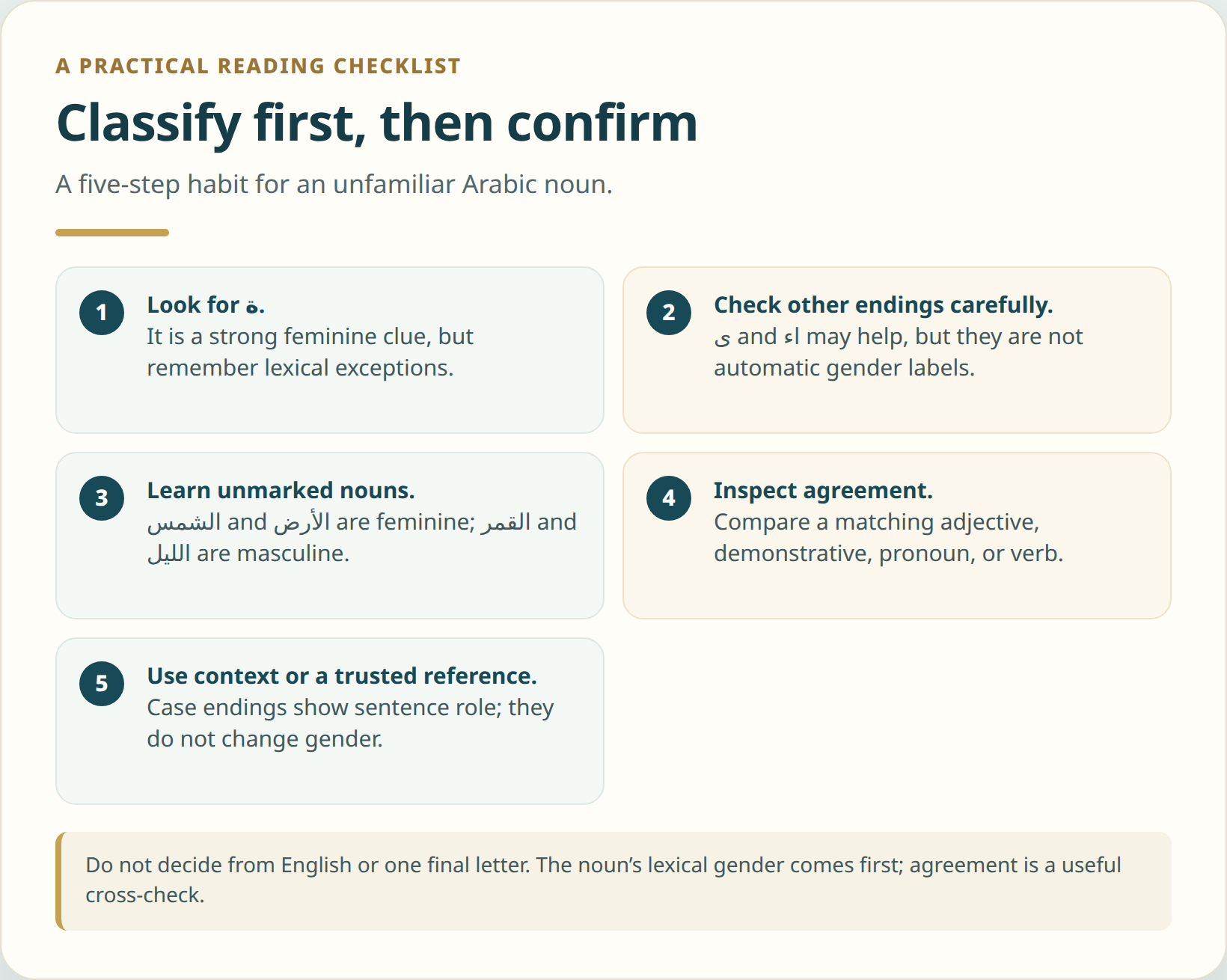
- Look for ة. It is a strong feminine clue, but remember names such as حَمْزَةُ.
- Treat other endings carefully. ى and اء may occur in feminine forms, but the same endings can occur in masculine names or other patterns.
- Learn common unmarked nouns with their gender. Examples include الشَّمْسُ, الْأَرْضُ, النَّفْسُ, and الْقَمَرُ.
- Check the sentence. Look at a matching adjective, demonstrative, pronoun, or verb, while remembering that number and word order can affect agreement.
- Confirm rather than force a guess. Use a trusted dictionary or a reliable text with grammatical notes when the spelling and surrounding words do not settle it.
Try it: which clue helps?
Before reading the answers, decide whether each noun is masculine or feminine and name the clue you used: الشَّمْسُ, الْقَمَرُ, لَيْلَةُ الْقَدْرِ, and الْأَرْضُ.
Answers: الشَّمْسُ is feminine with no visible ة; الْقَمَرُ is masculine with no visible feminine ending; لَيْلَةُ is feminine and shows ة; and الْأَرْضُ is feminine without that ending. The lesson is not “guess from the last letter.” It is “notice clues, then learn the noun’s established gender and confirm it in context.”
Common mistakes to avoid
Do not infer gender from an English translation, treat ة as infallible, or assume every feminine noun has it. Before using agreement as evidence, identify what a pronoun or verb refers to. A modifier reflects agreement; it does not decide the noun’s lexical gender.
Build confidence with real reading practice. Bring a Quranic example such as الشَّمْسِ وَضُحَاهَا to your teacher when you book a free Quran and Arabic trial class. A teacher can help you identify the noun first, then read the pronoun or verb that agrees with it.