

An Arabic email can be grammatically correct and still leave the reader wondering what to do. A useful first goal is therefore modest: write a message that identifies you, makes one request, supplies the details needed to answer it, and closes politely. You do not need ornate expressions or a long introduction to achieve that.
This workshop builds a short Modern Standard Arabic email about arranging a lesson. The same decisions transfer to asking a library for information, confirming an appointment, or contacting an administrator. The examples are teaching models, not claims about a universal rule for every Arabic-speaking workplace. Follow an institution’s preferred format when it provides one.
Start with the decision you need
Before translating anything, complete this English sentence: “After reading my email, the recipient should…” If the answer is “tell me which times are available,” make availability the central request. If you also ask about fees, certificates, textbooks, and holiday dates, a beginner’s short email quickly becomes a difficult questionnaire.
Write three notes: who you are, what you need, and one constraint that matters. For example: new student; wants a trial lesson; available on Tuesday evening. Leave out your full learning history unless it changes the answer. This planning step prevents the common problem of translating a long English message word for word and losing the request inside it.
If introductions still take effort, practise a few reusable structures from our Arabic greetings and introductions guide before composing the whole email. Choose a greeting appropriate to your recipient and relationship; a familiar teacher and an unfamiliar office need not receive the same opening.
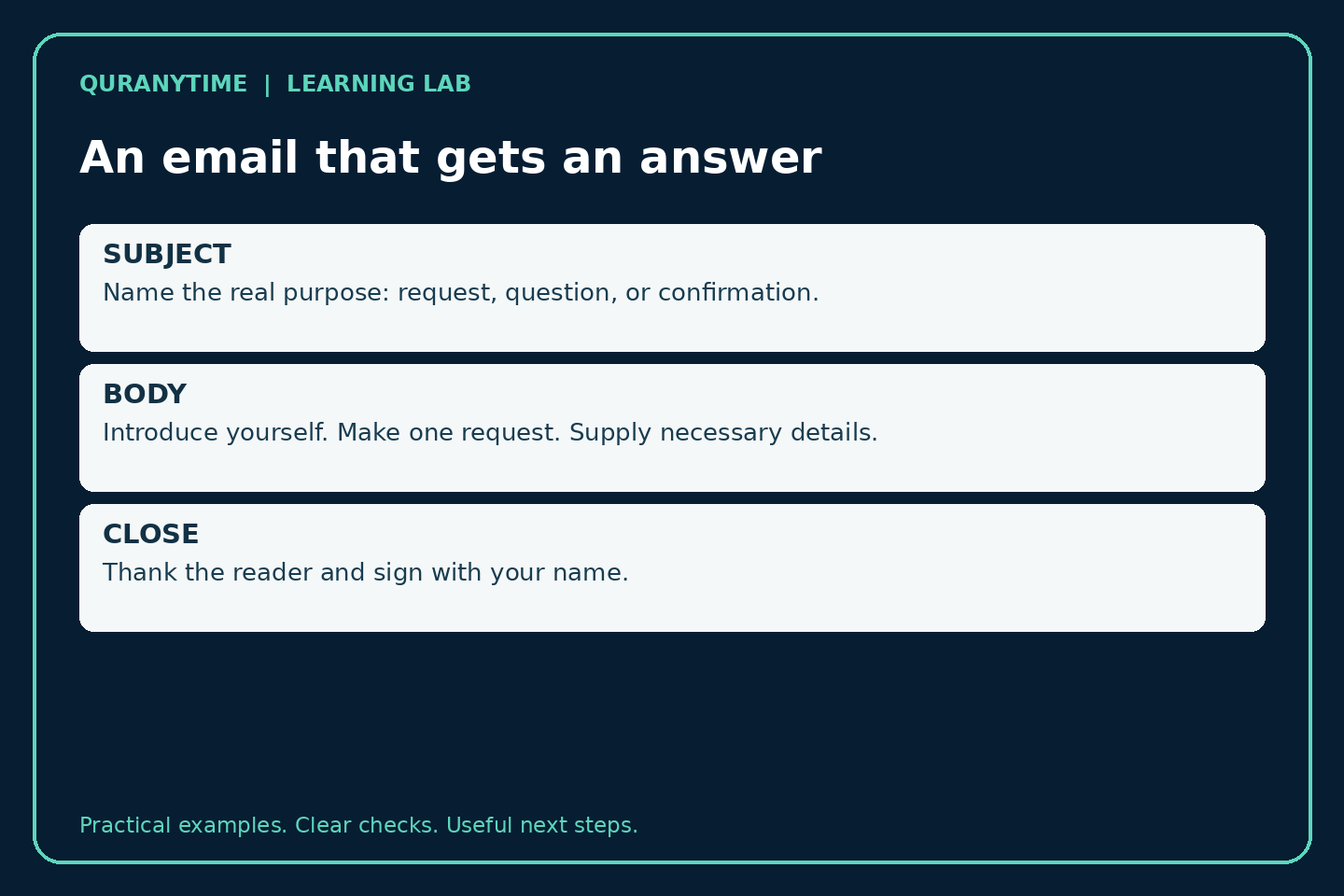
Build a subject line that helps someone find the message
A subject is a label, not a miniature letter. These examples identify a purpose:
- طلب موعد لدرس تجريبي — Request for a trial-lesson appointment.
- سؤال عن مواعيد الدروس — A question about lesson times.
- تأكيد موعد الدرس — Confirmation of the lesson appointment.
The first word changes the function: طلب is a request, سؤال is a question, and تأكيد is a confirmation. Do not use تأكيد if nobody has agreed to the appointment yet. A misleading subject can create a practical misunderstanding even when every word is spelled correctly.
Compare سؤال with سؤال عن مواعيد الدروس. The second helps the recipient sort and retrieve the message. Conversely, a subject containing your entire schedule is hard to scan. Put the constraint in the body. Avoid adding “urgent” merely to attract attention; reserve urgency language for a real deadline that you explain.
A two-minute subject exercise
Choose a subject for each situation: you want the office to send the lesson schedule; you are accepting an already offered appointment; you need to ask whether beginner classes are available. Possible answers are طلب جدول الدروس, تأكيد موعد الدرس, and سؤال عن دروس المبتدئين. Other clear versions are possible. Judge your answer by whether it describes the actual action, not whether it matches the model exactly.
Use an opening you can sustain
A neutral opening for an office is مرحبًا، followed by a short introduction. A conventional Islamic greeting may be natural in a Quran-learning setting. Do not force a religious greeting into every situation simply because you are writing Arabic. The recipient, setting, and your own intention guide that choice.
For a simple self-introduction, use اسمي آدم — My name is Adam. Then state the relevant relationship: أنا طالب جديد — I am a new student. These are short nominal sentences. If you want to understand their structure, see our Arabic nominal-sentence lesson. An email is not the place to demonstrate every grammar pattern you have learned. Two clear sentences are better than a complicated opening you cannot proofread.
Names deserve separate checking. Copy the recipient’s name from a reliable signature or official page rather than guessing its spelling. If you do not know a person’s title, a general office greeting is often simpler than inventing one. Do not add academic or religious titles merely to make the email sound formal.
Make the request visible
Here are three useful request patterns, with slightly different functions:
| Arabic model | Meaning | Best use |
|---|---|---|
| أريد حجز درس تجريبي. | I want to book a trial lesson. | Directly stating your aim |
| هل يمكنني حجز درس تجريبي؟ | Can I book a trial lesson? | Asking whether booking is possible |
| ما المواعيد المتاحة؟ | What times are available? | Asking for options |
The first is not automatically rude; tone depends on the whole message. Adding من فضلكم — please, addressed to a group or politely to an office — can suit an institutional message. Avoid stacking several politeness formulas around one small question. The reader should be able to locate the request without untangling the sentence.
For a specific person, forms of address and agreement may differ. If you are not yet comfortable changing them, keep a short neutral model and ask a teacher to check the final version. Our Arabic question words guide can help you distinguish asking “what time?” from asking “which days?” That distinction matters more than an elaborate opening.
Supply details that prevent a second email
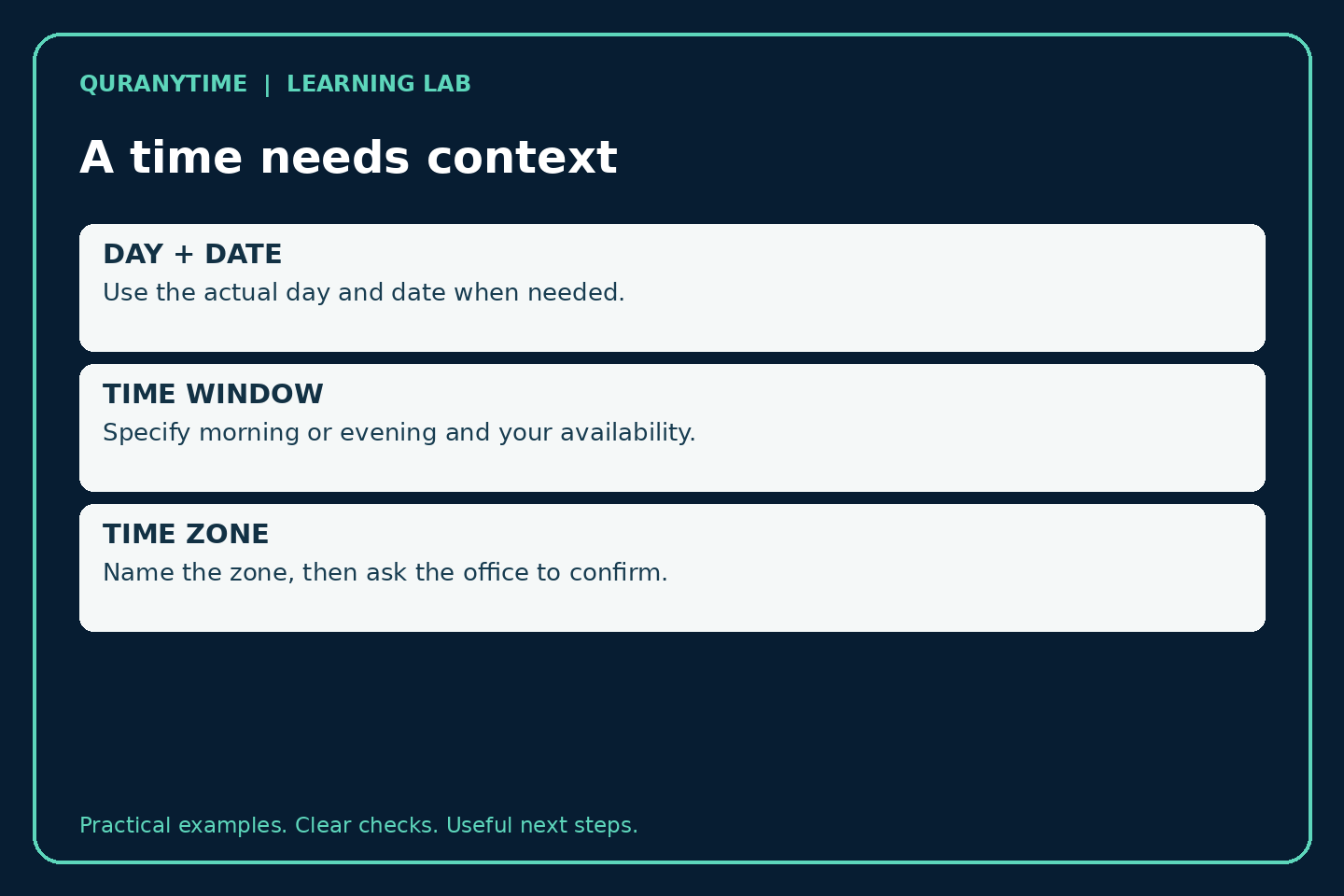
A time without a time zone is incomplete when student and teacher live in different countries. Write the day, date when necessary, approximate time window, and named time zone. Do not assume that “evening” means the recipient’s evening. Seasonal clock changes can also affect the conversion, so use the actual date when making a booking.
A beginner-friendly schedule sentence is: أنا متاح يوم الثلاثاء مساءً — I am available on Tuesday evening, said by a male speaker. A female speaker uses متاحة. If you are unsure of agreement, you can use a simpler noun phrase such as الموعد المناسب: الثلاثاء مساءً — Suitable time: Tuesday evening. This is a practical drafting choice, not a reason to avoid learning agreement.
Use our Arabic days, months, and dates guide and telling-time lesson to check details. Spell out an ambiguous date instead of writing a numerical form that could be read in two ways. Never invent availability on behalf of a teacher or office; offer your window and ask them to confirm.
Read a complete short model
Subject: طلب موعد لدرس تجريبي
اسمي آدم، وأنا طالب جديد. أريد حجز درس تجريبي لتعلّم العربية.
أنا متاح يوم الثلاثاء مساءً بتوقيت القاهرة. ما المواعيد المتاحة؟
شكرًا لكم.
آدم
Meaning: Hello. My name is Adam, and I am a new student. I want to book a trial lesson to learn Arabic. I am available on Tuesday evening, Cairo time. What times are available? Thank you. Adam.
Notice what this message does not claim: it does not say an appointment is booked. It asks for options. It also does not contain a phone number, home address, or personal documents. Share only information relevant to the request, using the institution’s appropriate channel when sensitive documents are needed.
The model is deliberately short enough to inspect sentence by sentence. Replace the name, learning goal, and schedule with true details. Do not copy a model containing Tuesday if you are available on Thursday. Template errors are often factual rather than grammatical.
Check typing and punctuation separately
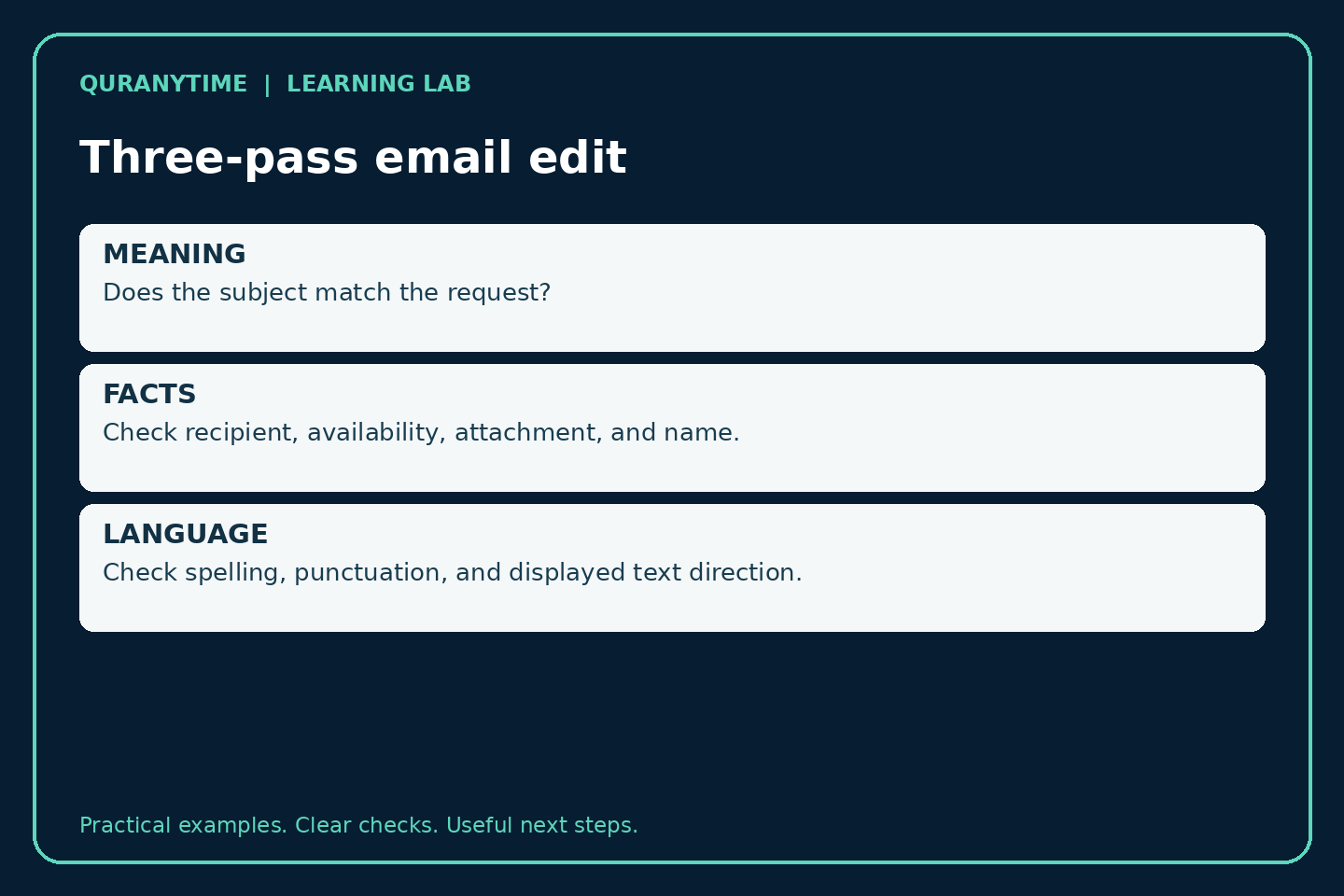
First check the message’s meaning; then check its written form. Arabic uses the question mark ؟ and comma ،. Place punctuation next to the preceding word. In mixed Arabic-English messages, inspect where brackets, numerals, and email addresses appear after sending a test to yourself; bidirectional text can look different from the draft view.
For a practical keyboard setup, use our guide to typing Arabic on an English keyboard. Check letters that are easy to confuse visually, especially final ه and ة in words you have not memorized. Our taa marbuta explanation helps you see why a spelling choice cannot always be made from the final sound alone.
Ordinary emails usually do not need full vowel marks. Add them only when they help clarify something or your teacher has asked for a fully vocalized exercise. Do not scatter uncertain vowel marks through a message to make it look advanced. An accurate plain spelling is more useful than decorative but incorrect marking.
Repair three messages
Message A: مرحبًا. أريد درسًا. شكرًا.
This is understandable but under-specified. What kind of lesson? Is the writer asking about availability or confirming an arrangement? A useful repair is أريد حجز درس تجريبي لتعلّم العربية. ما المواعيد المتاحة؟ The repair adds a goal and an answerable question, without making the email much longer.
Message B: تأكيد موعد الدرس, followed by a body asking whether any lesson is available next week.
The subject and body conflict. Change the subject to سؤال عن مواعيد الدروس or طلب موعد لدرس تجريبي. Do not change the body into a confirmation unless an appointment actually exists. Accuracy about arrangements takes priority over matching a memorized phrase.
Message C: A learner writes “Tuesday at seven,” but the office serves students internationally.
Add the date where useful, whether seven means morning or evening, and the time zone. Ask for confirmation rather than assuming the office will interpret the same local clock. When a numeric date is ambiguous, name the month. This repair is a communication skill, not merely vocabulary practice.
Turn the model into your own message
Write a six-line draft for a real or imaginary request. Give yourself one constraint: the recipient must be able to answer with either available times or one short clarification. Then highlight the request and underline the scheduling detail. If either is missing, revise before asking someone to correct grammar.
Next, change the situation. Instead of booking, ask for the lesson materials: هل يمكنكم إرسال مواد الدرس؟ — Can you send the lesson materials? Instead of asking for options, confirm a time already offered. These changes reveal whether you understand the message or have only memorized its shape. Keep a separate list of expressions you can explain in English.
Ask a teacher to correct two kinds of problems in different colors: language errors and missing information. A beautifully corrected sentence can still omit the day. Conversely, a comprehensible beginner sentence may accomplish its purpose with one small agreement correction. Record the correction that will transfer to your next message rather than rewriting the same email repeatedly.
A final send check
Read only the subject and first two sentences. Is the purpose already clear? Check the recipient address, any attachment you mention, your actual availability, and your name. Then read the message aloud slowly. If you cannot explain a phrase you copied, simplify it or ask about it. Save the useful structure, but recheck facts every time you reuse it.
For additional general writing practice, the university-published Michigan State Arabic writing activities provide a neutral learning resource. For personalized feedback on a message you can genuinely use, Book a Free Trial Class and bring a short draft. A productive lesson can focus on one clear request, one scheduling detail, and the changes that make your next email easier to write independently.