
A public notice rarely gives you a complete conversation. It may contain only two words, a time, and an arrow. To use it successfully, you must identify the action it permits or prevents, locate the important detail, and decide whether you need clarification. This lesson trains that practical reading process with invented Modern Standard Arabic notices.
The examples are language exercises, not official safety, legal, or travel instructions. Real signs vary by country and organization, and a symbol or local regulation may carry information beyond the text. If misunderstanding could affect safety or access, ask an authorized person rather than relying on a beginner vocabulary guess.
Read for a decision, not a translation recital
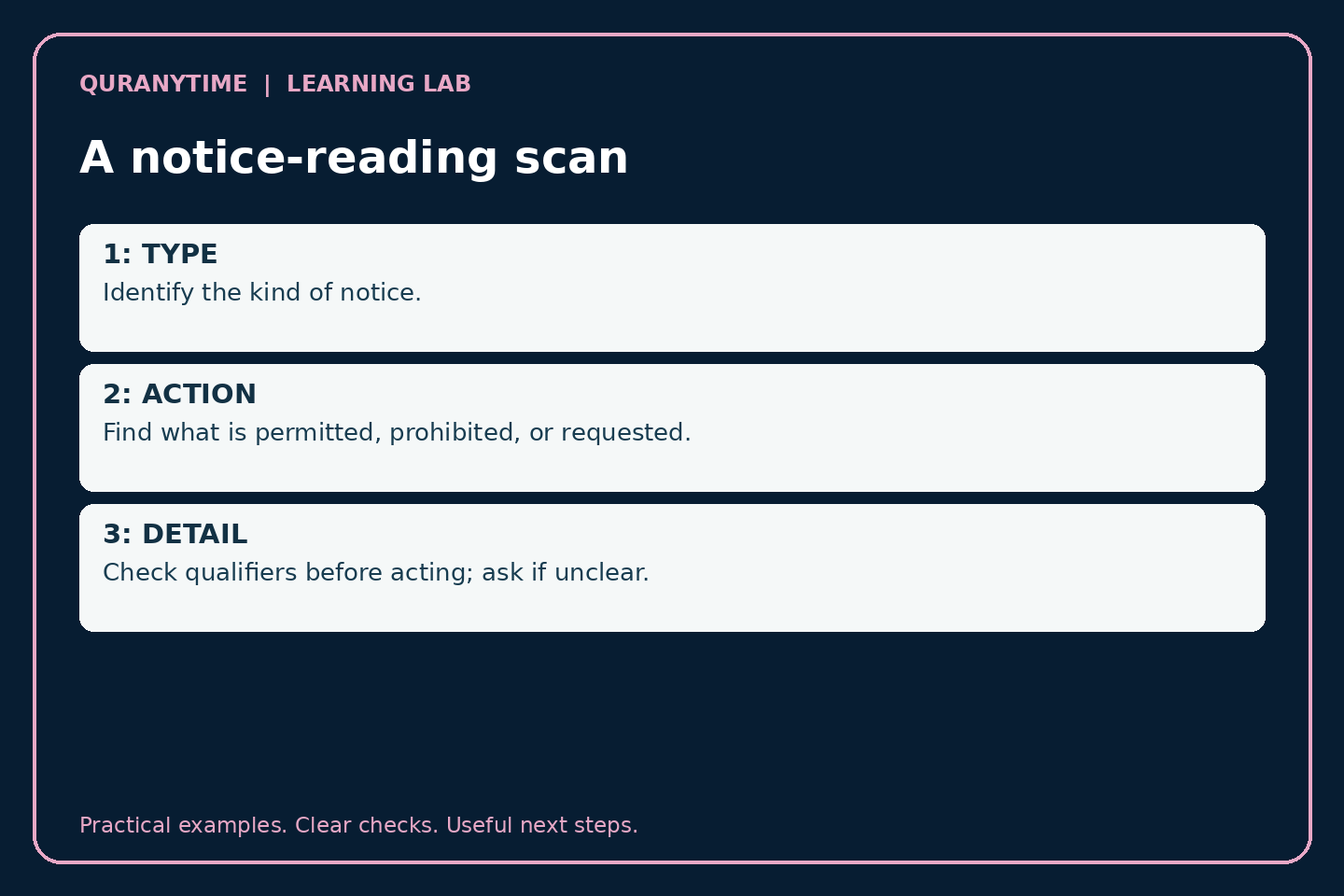
When you see a notice, ask three questions: What kind of message is this? Which word changes what I should do? Which detail limits the message? A shop-hours notice, a prohibition, and a direction sign need different kinds of attention. Translating every word in order can make you miss the one word that reverses the instruction.
For instance, مفتوح means open and مغلق means closed. Recognizing both is more useful than recognizing one and guessing whenever the other appears. Likewise, الدخول means entry, while ممنوع الدخول means entry prohibited. The added word is not optional decoration; it changes the action.
Build your first practice set around contrasts. Put open and closed on separate cards, then permitted and prohibited, then entry and exit. Ask a partner to change only one card while you explain what changed. This is a small, observable skill rather than an unstructured instruction to “read more Arabic.”
A compact sign-reading vocabulary
| Notice wording | Basic meaning | What to check next |
|---|---|---|
| مفتوح | Open | Does a time restriction follow? |
| مغلق | Closed | Is a reopening time shown? |
| مدخل | Entrance | Is there an arrow or access condition? |
| مخرج | Exit | Follow the actual site’s official guidance |
| ممنوع الدخول | Entry prohibited | Do not infer permission from an open door |
| الرجاء الانتظار | Please wait | Is a queue or service desk identified? |
| للموظفين فقط | Staff only | The restriction applies to access |
| يرجى إغلاق الباب | Please close the door | Identify the requested action |
Learn these as complete chunks initially. Later, examine their structure with a teacher. Our Arabic prepositions guide can help with phrases containing لِـ or إلى, and our Arabic imperative lesson develops the language of instructions. A public notice may use a noun phrase or polite formula instead of a direct imperative; do not assume all instructions share one grammatical shape.
A photograph-based notebook can be useful if you have permission to take the picture and avoid capturing private information. Record the exact wording, where it appeared, and the decision it required. Do not publish identifiable people, access codes, or private notices simply to make a vocabulary collection more interesting.
Work out opening hours carefully
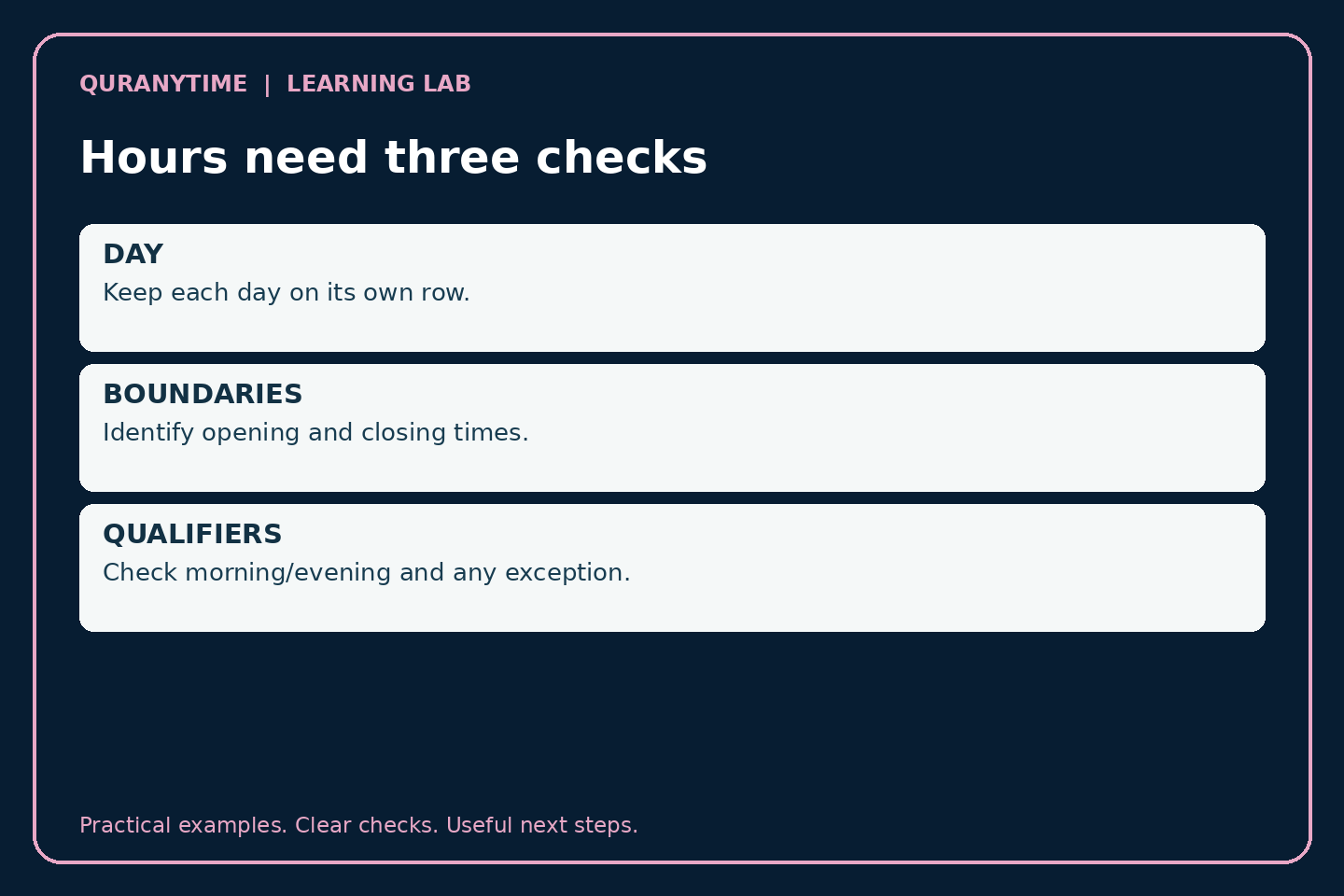
Consider this invented notice: مفتوح من التاسعة صباحًا إلى الخامسة مساءً — Open from nine in the morning until five in the evening. Find من and إلى, then identify the two boundaries. The morning/evening words matter. A learner who recognizes nine and five but ignores those qualifiers may read the schedule incorrectly.
Next add a day: السبت: من التاسعة صباحًا إلى الواحدة ظهرًا. This changes the closing time to one in the afternoon on Saturday. Do not carry the previous day’s hours into the next line. Use your finger or a cursor to keep the day and its corresponding hours together while practising.
Our Arabic telling-time guide supports the clock language, while our days and dates lesson helps with the schedule column. Check whether a real notice uses 12-hour or 24-hour notation. If a service is important, confirm its current hours through the organization’s own channel; a photographed sign can be outdated.
Schedule exercise
Read: الأحد: ٩ صباحًا–٢ مساءً. الاثنين: مغلق. Answer three questions: Is the location open on Monday? What is the Sunday opening time? What is the Sunday closing time? Answers: closed on Monday; nine in the morning; two in the afternoon. These are invented teaching hours and do not describe a real business.
Now change only مغلق to مفتوح. What information is missing? The Monday hours are still unspecified. Recognizing “open” does not give permission to invent a schedule. This is an important reading habit: distinguish what the notice says from what you wish it had said.
Spot restrictions before following directions
A direction arrow and an access restriction can appear together. Imagine an arrow beside للموظفين فقط. You may understand which way to go, but the text restricts who should go there. Reading only the arrow misses the more important part of the message.
Look for limiting words such as فقط — only. Read the entire phrase around them. Compare للطلاب — for students — with للطلاب الجدد فقط — for new students only. The second is narrower. You need not know every adjective in the language to learn this habit of searching for qualifiers before acting.
Use our Arabic directions guide. In this lesson, your practical task is to combine a direction with its restriction. If an unfamiliar notice controls access, ask a staff member a short question such as هل يمكنني الدخول؟ — May I enter? Do not treat a learner worksheet as authority to pass a barrier.
Recognize polite requests that still ask for action
الرجاء الانتظار and يرجى الانتظار both convey a request to wait. A polite formula does not make the action irrelevant. In everyday reading, identify the requested behavior and any location or duration attached to it. You may need to wait here, wait outside, or wait until a staff member calls you.
Another useful model is يرجى إغلاق الباب — Please close the door. First identify the action, then its object. Avoid guessing from one familiar noun: recognizing الباب — the door — does not tell you whether the instruction says open it, close it, or keep it clear.
Make paired cards with opposite actions, checked by a teacher. Read the whole card, explain the difference, and act only in a safe classroom role-play. Physical performance can make the meaning memorable, but it should never involve real emergency equipment, restricted doors, or unsafe situations.
Use a clarification ladder
When a notice is unclear, begin with the narrowest useful question. ماذا يعني هذا؟ — What does this mean? — is a broad starting point. هل المكان مفتوح اليوم؟ — Is the place open today? — focuses on your actual need. هل هذا المدخل للطلاب؟ — Is this entrance for students? — checks a specific access condition.
Our Arabic question words guide can help you form that next question, and our Arabic phrases collection provides additional everyday language. You do not need a long explanation of your level before asking a clear question. Pointing to the notice may help, but remain polite and respect the setting.
A translation app can offer a clue, especially with clear text, but OCR mistakes and missing context can reverse an interpretation. Compare the recognized Arabic against the visible sign before trusting the translation. If you cannot verify a high-consequence instruction, seek a person responsible for that setting.
A notice detective workshop
Notice A: مغلق للصيانة. The key decision is that the location is closed; للصيانة adds “for maintenance.” Do not translate maintenance successfully and overlook closed. A sensible follow-up asks about reopening rather than assuming the closure is permanent.
Notice B: الرجاء الانتظار هنا. The request is to wait, and هنا specifies here. A learner who remembers only “please” has not yet extracted the instruction. Explain the action and place separately, then read the full phrase again.
Notice C: الدخول من الباب الآخر. This indicates entry through the other door. The important next detail is which door is meant in that physical setting. Do not invent a direction from the text alone if there is no arrow or visible reference. Ask someone to show you.
Notice D: للموظفين فقط. This is staff-only access. A language exercise can ask who may enter, but a real reader must respect the restriction even if the door is unlocked. Understanding a sign includes recognizing that it may not apply to you.
Notice E: مواعيد العمل: من الأحد إلى الخميس. The notice gives working days, Sunday through Thursday, but no daily hours. The correct response is to recognize the missing information. Do not supply nine-to-five because it is familiar from another context.
Answer with evidence
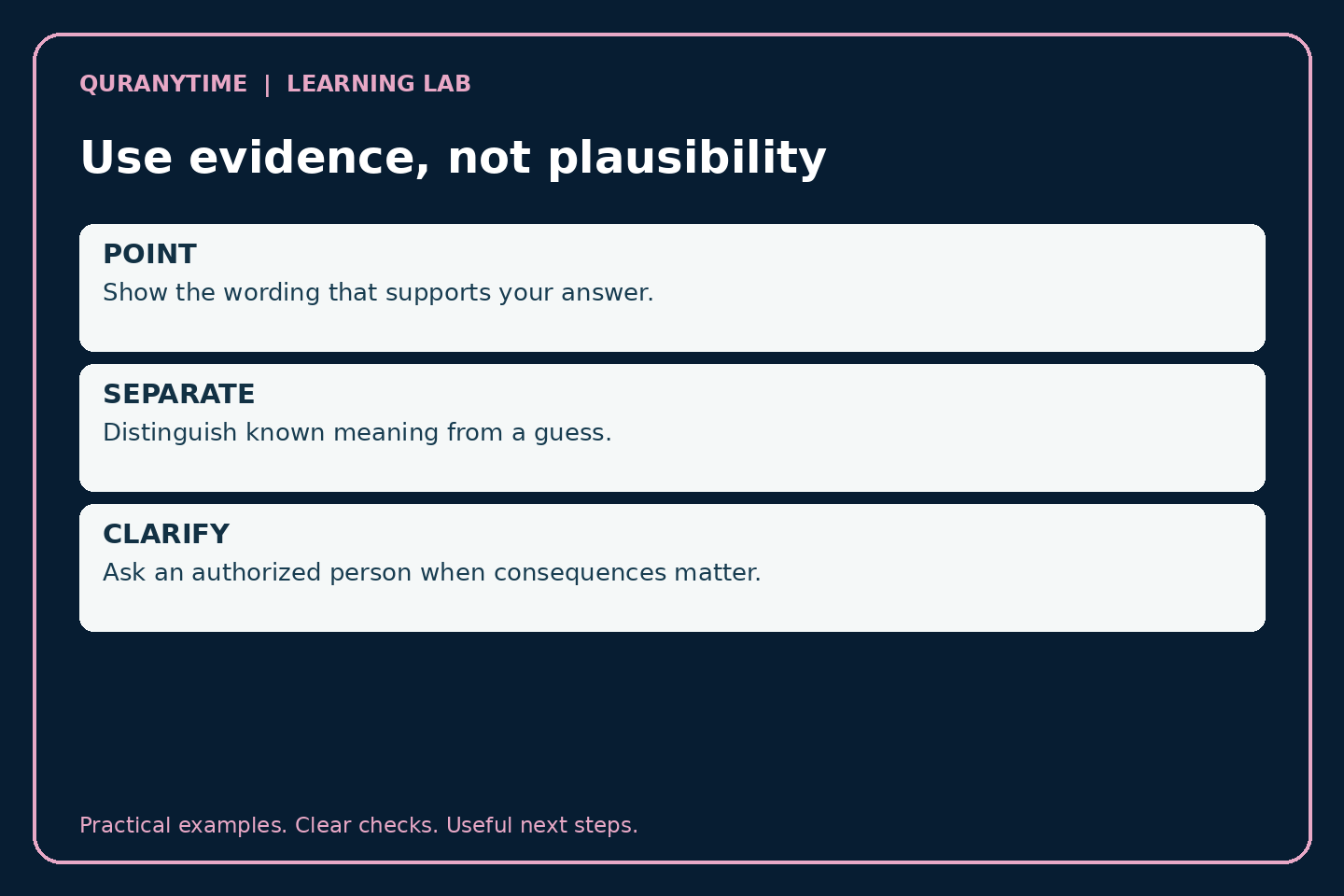
For each notice, underline the word or phrase that supports your answer. If you cannot point to evidence, label your answer as a guess and ask for help. This habit prevents confident but unsupported translation. A good learner answer can be “I know it is closed, but I do not yet understand why.” Partial understanding stated accurately is useful.
Compare two notices that differ by one detail
Create a pair of teacher-checked cards: مفتوح اليوم — Open today — and مغلق اليوم — Closed today. Ask what remains the same and what reverses the decision. Then compare الرجاء الانتظار هنا — Please wait here — with الرجاء الانتظار خارجًا — Please wait outside. The second pair changes the location rather than the action.
A useful answer names both the unchanged element and the changed element. This is more demanding than selecting a matching picture, because it requires the learner to read the small qualifier. Use only harmless classroom simulations and explain that an actual site’s official instructions take priority.
For a final challenge, cover one word in a notice and ask what information is now missing. If you cover اليوم, the learner no longer knows the stated day relationship. If you cover مغلق, the central open-or-closed decision is missing. This exercise makes uncertainty visible and helps a learner ask a precise question instead of guessing the whole message.
Make a small field notebook
Choose five harmless notices from public, permitted settings or teacher-created examples. Use four columns: exact Arabic, situation, action or restriction, and unresolved question. Keep your own translation separate from a teacher-checked version. This makes correction visible rather than silently replacing an old guess.
Return a week later and read the examples in a different order. Cover the English meaning, identify the decisive word, and explain the action in your own words. Add one unfamiliar qualifier to an old notice instead of collecting dozens of near-identical signs. Your goal is flexible reading, not a large photo album.
For support with the script itself, revisit our Arabic letter forms in words. A decorative font may make a known word look unfamiliar. Practise the same wording in a plain font before attempting difficult lettering, and never assume an ornate sign contains different words just because its shapes are harder to segment.
To practise with someone who can check your interpretation, Book a Free Trial Class. Bring three notices or teacher-made examples and explain the decision each one requires. A useful session ends with clearer reading questions and a small set of reliable phrases you can recognize outside the lesson.