
Reasons for Revelation of Quran Verses: A Guide to Asbab al-Nuzul
When a reader encounters a story about why a Quran verse was revealed, it is natural to ask what the report can explain—and what it cannot prove. The Arabic term asbāb al-nuzūl refers to reported occasions, reasons, or contexts associated with the revelation of particular verses. Studying such reports can add historical context, but the report is not itself Quranic wording, and it should not replace careful reading of the verse.
This guide offers a cautious way to read a reported occasion: identify the Quran text, understand what the report actually claims, notice its source and alternatives, and state only what the evidence supports. It is a study method, not a ruling or a substitute for qualified tafsir.
What does asbāb al-nuzūl mean?
Readers searching for “reasons for revelation of Quran verses” are often looking for accounts that connect a verse with an event or question. In Islamic scholarship, this subject is commonly called asbāb al-nuzūl, translated as “occasions of revelation” or “reasons for revelation.” Collections in this field preserve reports that connect a verse or passage with an event, question, person, or circumstance. The report may help a reader understand the setting in which a verse was discussed or the issue a narration associates with it.
The translated introduction to Al-Wahidi’s Asbāb al-Nuzūl describes reports about occasions, reasons, and contexts, and notes that exact occasions were not preserved for most of the Quran. Do not assume every verse has one identifiable story—or treat a collection’s silence as proof that no context existed.
These reports are part of the broader study of Quranic explanation. If you are new to the distinction between explanation and the Quran’s wording, Quranytime’s overview of what tafsir means can help orient your reading.
Keep three things separate
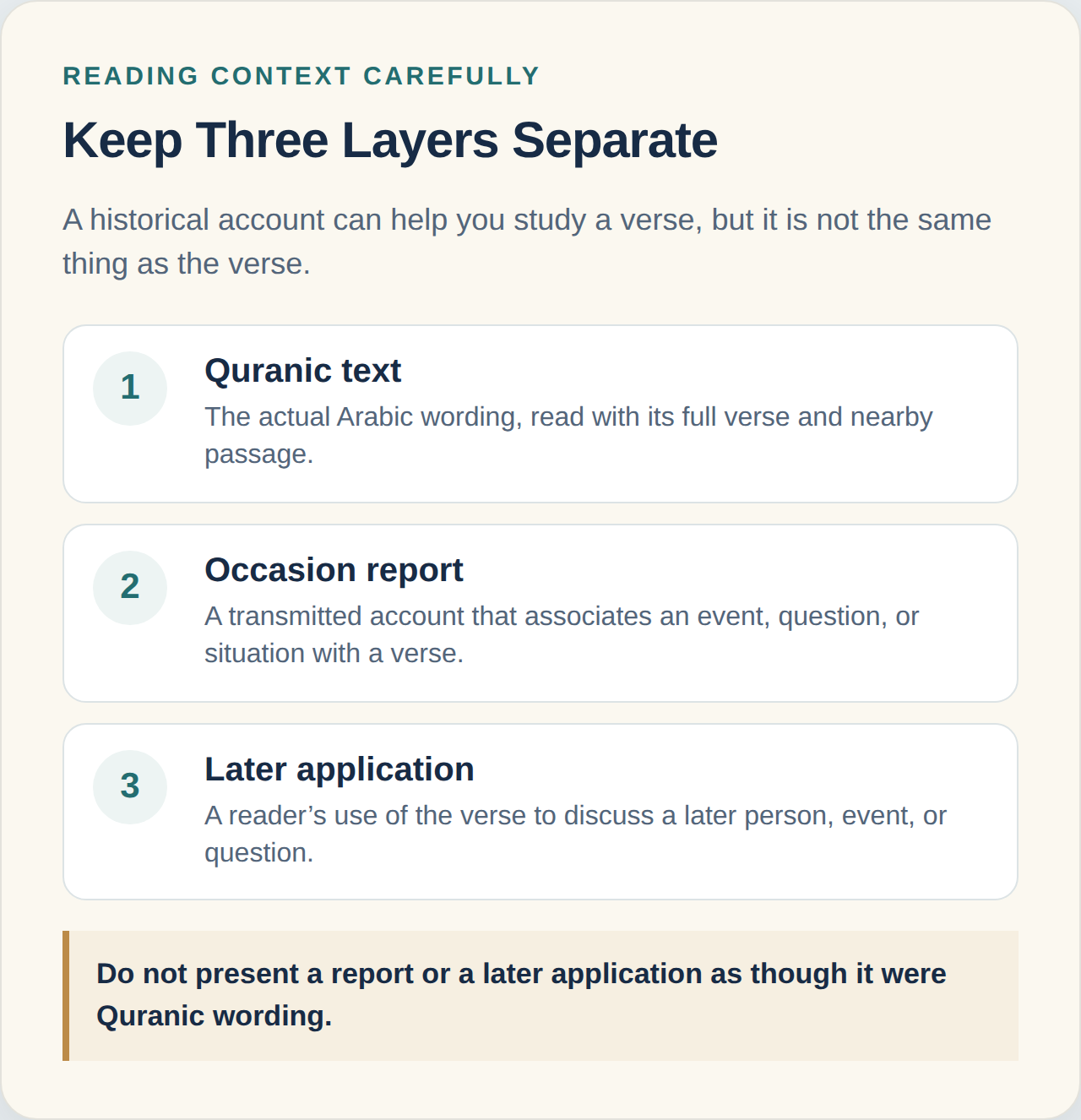
Start by separating three layers that are often blended in casual summaries:
- The Quranic text: the verse’s actual Arabic wording and its place in the surah.
- The reported occasion: an account transmitted by a source that associates an event or question with a verse.
- A later application: someone’s use of the verse to discuss a later situation.
A report may be relevant to understanding a verse without making the verse apply only to the people or event named in the report. Likewise, a later application may be thoughtful without being the original occasion. Use labels such as “the collection reports,” “one narration associates,” or “a later writer applies” rather than turning all three into the same historical claim.
Read the verse before reading the story
Confirm the reference, then read the full verse and nearby passage. A clipped quote or translation can hide a connector, pronoun, or qualification. For a repeatable verse-first method, see this guide to reading a Quran verse word by word while keeping context.
Check the wording before interpreting a report; a wrong verse number can connect it to the wrong passage. Use Quranytime’s verse-quote verification checklist and its surah index to confirm the reference.
Read the Arabic where possible. Compare translations to notice wording choices, but do not treat one English rendering as the full range of meaning. This method for choosing a Quran translation for Arabic learners can help you compare phrasing.
A worked example: Al-Baqarah 2:115
Al-Baqarah 2:115 begins: وَلِلَّهِ ٱلْمَشْرِقُ وَٱلْمَغْرِبُ فَأَيْنَمَا تُوَلُّوا فَثَمَّ وَجْهُ ٱللَّهِ. In plain English, it says that the east and west belong to Allah and wherever one turns, there is the Face of Allah. Read the full ayah and nearby passage before seeking a reported occasion.
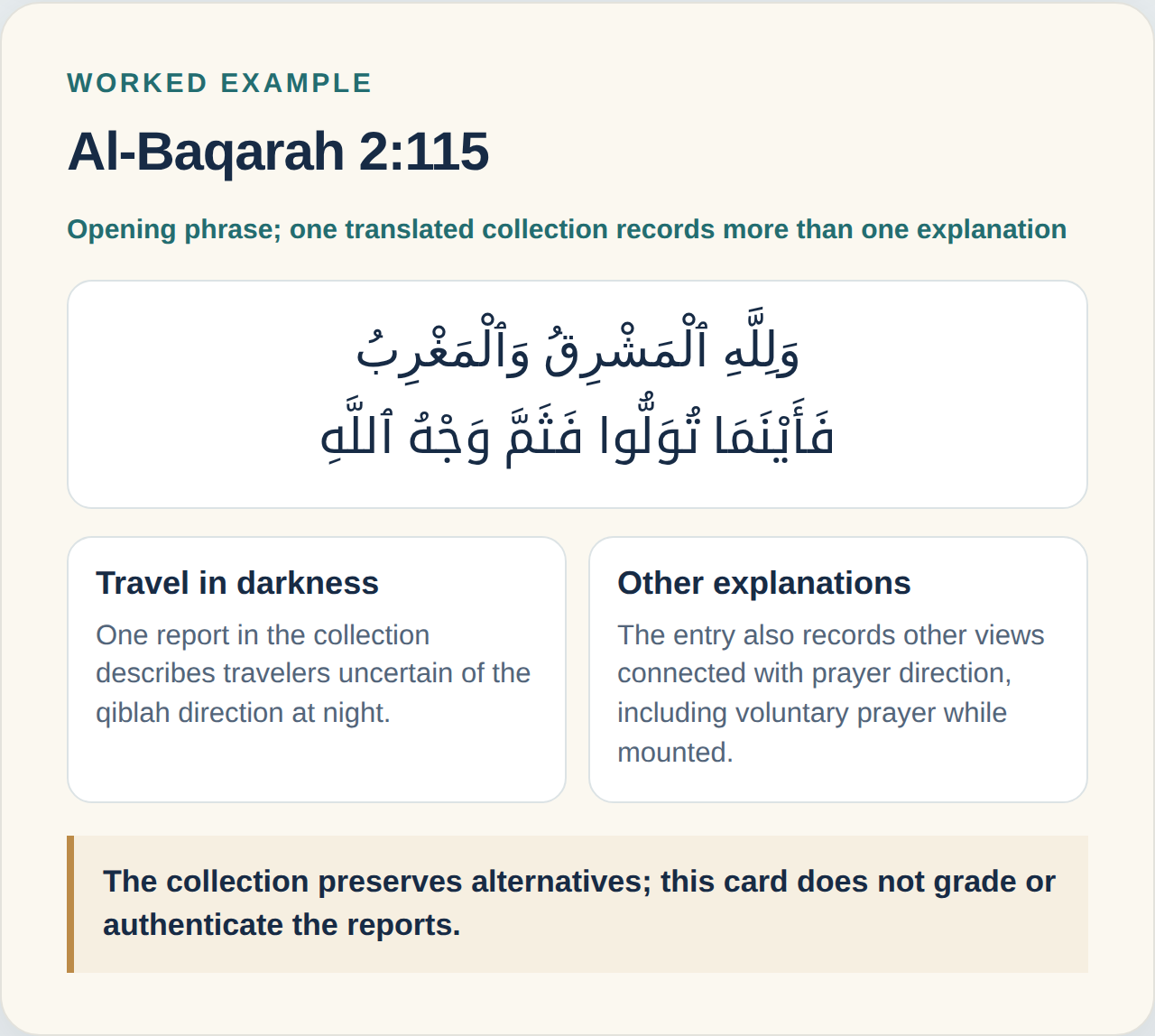
The same translated collection marks this verse as disputed and records several explanations, including accounts of travelers unsure of the qiblah in darkness. Its entry shows why alternatives should be noted rather than collapsed into one story; the cited introduction and verse entry are sources to examine, not automatic grading of each narration.
When reports differ, keep them separate. Note who is said to transmit each and whether qualified commentary evaluates its reliability. Say, “This collection records several explanations associated with 2:115,” not that one event is certainly the sole reason.
The short recitation below presents the verse in Arabic and English. Listen while following the wording, then return to the passage before considering any historical report.
How to examine a report responsibly
Before repeating a report, identify what its source claims and whether it presents a direct occasion, a related circumstance, or an explanation. A short summary may omit a qualification that affects how confidently the account should be shared.
- Identify the source. Is it a named collection, a scholarly commentary, a modern summary, or an unsourced social post? Record the title and the exact passage you consulted.
- Copy the claim accurately. Keep the source’s language such as “reported concerning” or “it is said” rather than strengthening it into “this definitely happened.” Do not remove a chain, attribution, or qualification just to make a shorter caption.
- Look for alternatives. Check whether the same source or other reliable commentaries mention another report, a different setting, or disagreement. Keep distinct accounts distinct.
- Ask about evaluation. A learner should not grade a narration from a translated paragraph alone. Use qualified scholarship for judgments about transmission, authenticity, chronology, or how a report relates to the verse.
- Separate text from inference. Mark which details are in the Quranic wording, which come from the report, and which are your own explanation. Quranytime’s guide to what is written, implied, and uncertain in Quranic Arabic offers a useful reminder not to present an inference as though it were explicit text.
If an Arabic phrase is central to the question, verify its words and grammatical form rather than relying only on a translation. The Quranic Arabic Corpus guide explains how learners can inspect Quran words and linguistic analysis; such tools help with language questions, but do not authenticate historical reports by themselves.
Specific occasion does not always mean exclusive meaning
A report can name the situation associated with a verse, but that alone does not show that the verse’s wording is restricted to that situation. Readers and scholars distinguish the occasion described by a report from the broader wording and application of a verse. Avoid claims such as “this verse only applies to that group” unless a qualified source explains why that conclusion follows.
Conversely, do not use a general reading to erase a specific historical account that a reliable source supports. The careful task is to state both accurately: what context is reported, and what the verse says in its full wording. When a passage contains an explicit restriction or qualification, explain it from the text and trusted commentary rather than from a story summary alone.
Once the text and report are kept distinct, a reader can reflect on meaning without pretending to know more history than the evidence supplies. Quranytime’s guide to exploring the wisdom of Quran verses can support that next step of reflective study.
A six-question checklist before you share a context claim
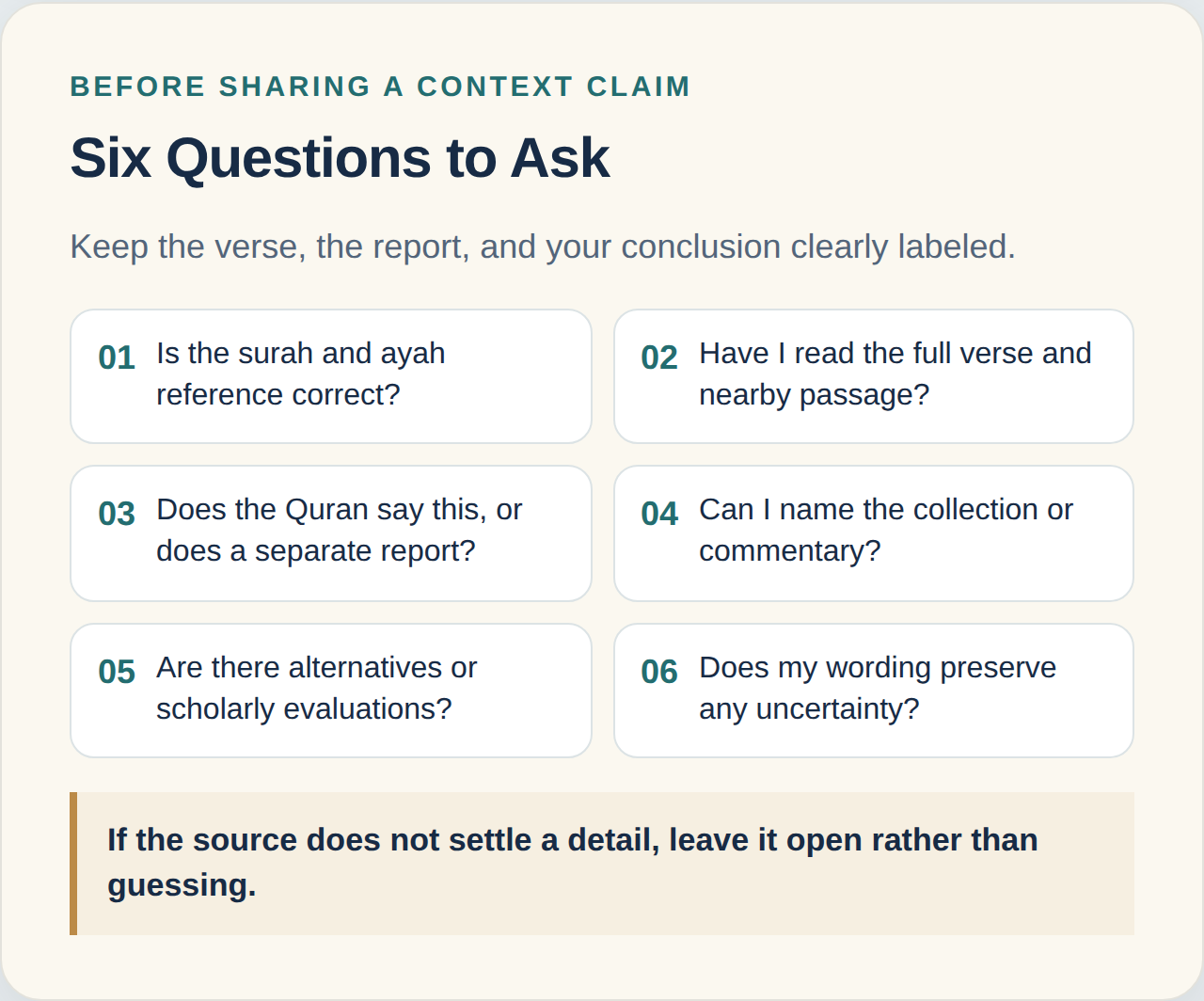
Before you repeat a story about why a verse was revealed, ask:
- Do I have the correct surah and ayah reference?
- Have I read the complete verse and its nearby passage?
- Does the Quran itself state this detail, or does a separate report state it?
- Can I name the collection or commentary rather than saying “scholars say” vaguely?
- Are there alternative reports or an evaluation I have not checked?
- Does my wording show uncertainty where the source does, without making the account more certain than it is?
If you cannot answer one of these questions, pause and narrow your claim. You might say, “A report in this collection associates the verse with this circumstance,” and then add that the account needs scholarly evaluation. If no reliable report is available, say that the context is not established in the source you checked; do not invent a cause to complete the story.
Study with humility and clear notes
A simple study note can use three headings: Quran text, reported context, and what remains uncertain. Under the first, copy the verse reference and read the whole passage. Under the second, summarize the report with its attribution and source. Under the third, list competing reports, missing details, or questions for a qualified teacher. This layout prevents a report from blending into the verse when you review your notes later.
The goal is not to turn every verse into a historical investigation. Many verses can be studied carefully without a known occasion report. Context is most useful when it clarifies a question, audience, event, or interpretive issue; it becomes misleading when a reader treats a weak or incomplete report as a complete explanation. Keep the wording of the Quran central, use sources transparently, and leave unresolved matters unresolved.
For guided practice reading a verse, checking its wording, and discussing the difference between text and interpretation, you can book your free Quran and Arabic trial class.
In summary
Asbāb al-nuzūl reports can help learners ask better questions about a verse’s setting, but they need to be handled as reports: identify the source, read the complete passage, compare alternatives, and avoid claiming more than the evidence supports. A respectful study keeps Quranic wording, transmitted context, and later application visible as separate layers.