

Quranic Arabic ellipsis can make a verse feel puzzling: is a word genuinely left unstated, or are you supplying something only because English sentences usually say it? A careful reader separates the Arabic text from a grammatical recovery and from a wider interpretation. That distinction helps you explain what the words support without presenting an inferred phrase as though it were written in the verse.
This guide gives you a practical evidence check. It is not a catalogue of every rhetorical device, a shortcut to tafsir, or a claim that one English translation settles all questions. Keep the complete Arabic passage in view, record the smallest supported recovery, and leave a question open when the text does not resolve it.
What does ellipsis mean in Quranic Arabic?
In ordinary language, ellipsis means that some material is left unstated while readers use available clues to understand the passage. In Quranic Arabic study, the word can refer to more than one kind of issue. Some implied elements are part of regular Arabic grammar; others are discussed at the level of connections across a text; still others are proposed in interpretation. Calling all of these “missing words” hides important differences.
Use three labels before you translate. Written means that the word or grammatical marker is visibly present. Grammatically recoverable means a construction or inflection licenses a limited understanding, even though the element is not a separate written word. Interpretive means that a fuller description depends on wider context, rhetorical analysis, translation choices, or tafsir. An interpretation may be well supported, but it should not be quietly promoted into the wording of the Arabic.
A broad Quranic Arabic sentence-parsing routine helps identify the clause and its visible roles first. Ellipsis analysis begins after that basic map, not instead of it.
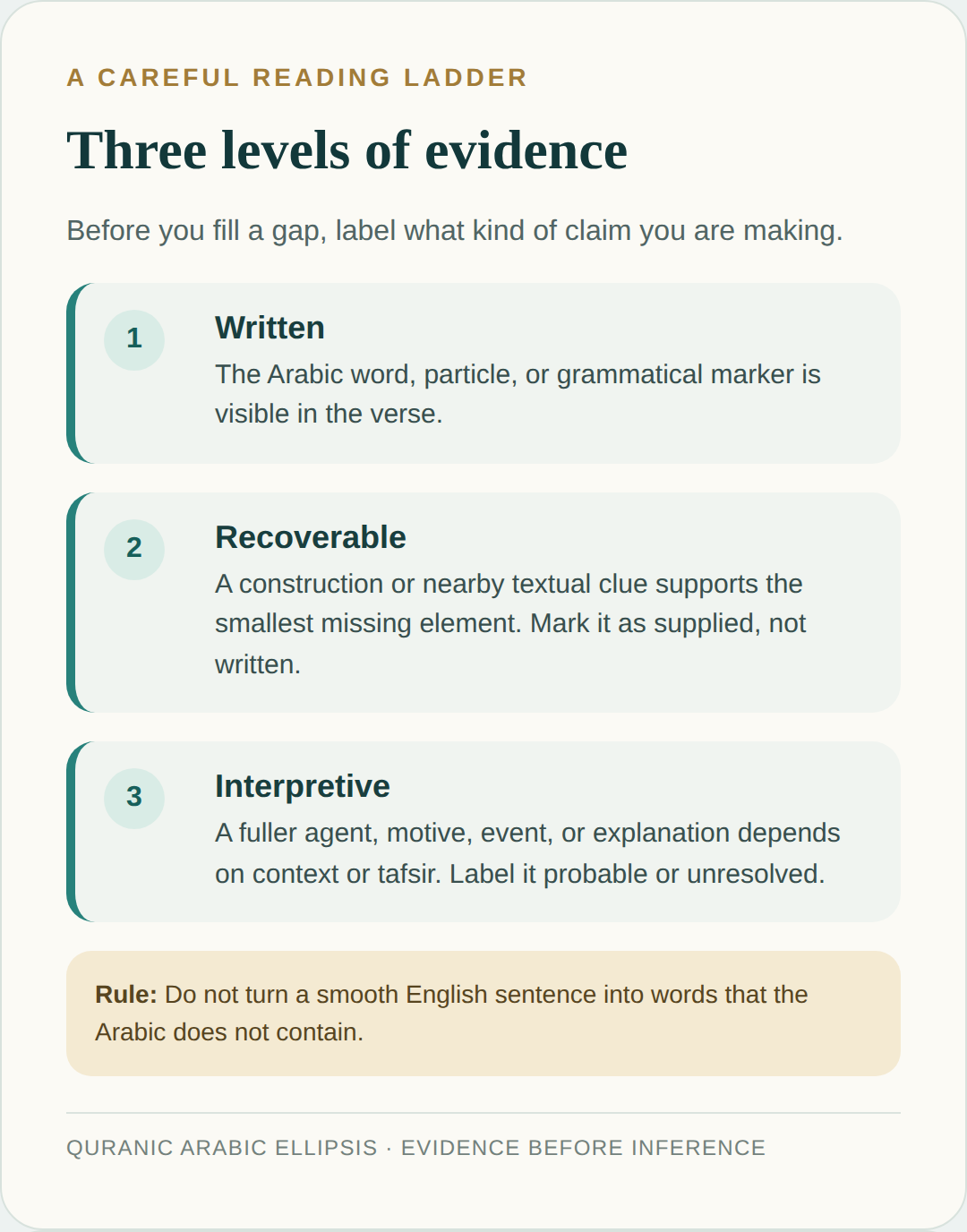
Do not mistake every understood element for ellipsis
Arabic verbs can carry person and number information in their forms. In Quran 112:1, قُلْ is an imperative addressed to one masculine singular addressee. The command itself signals “you” as the addressee; the reader does not need to imagine a separate Arabic word أَنْتَ before the verb. This is a regular grammatical subject, not permission to add an unstated motive or a whole sentence.
Similarly, a present-tense Arabic nominal sentence can express a relation without a written equivalent of the English verb “is.” Translators may supply “is” to make English natural, but that does not by itself prove that an Arabic verb has been omitted. Review the structure of Arabic nominal sentences in Quranic reading before naming a gap. The key question is not “What did the English add?” but “What does this Arabic construction require or leave open?”
Verb endings and attached pronouns also provide evidence. A verb may encode its subject, and an attached pronoun can mark a grammatical role; neither should be confused with an unnamed speaker in a story. A guide to Arabic verbal sentence roles and word order can help you distinguish the verb’s subject from the person who is speaking in the surrounding narrative. Even a fronted object such as iyyāka shows why an English subject-first expectation should not replace analysis of the Arabic form.
A verse-based example: what is explicit, and what is inferred?
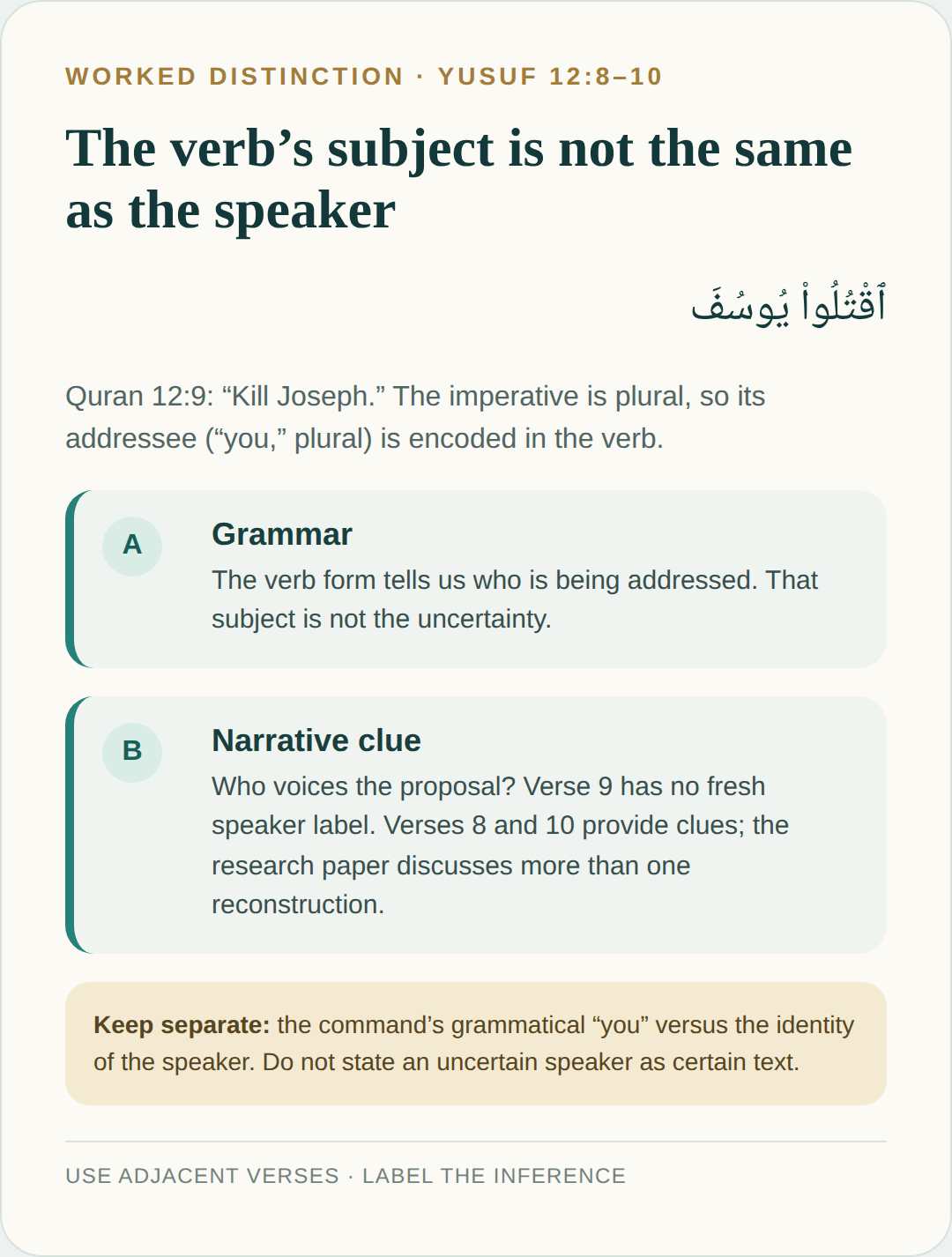
Consider the dialogue sequence in Surah Yusuf 12:8–10. In 12:8 the text says that the brothers spoke. The next verse begins with the command ٱقْتُلُوا۟ يُوسُفَ—“Kill Joseph”—and continues their proposal. The imperative is plural, so its grammatical addressee is already encoded in the verb. That is not the uncertain part of the example.
The narrower question is narrative attribution: who voices the proposal at that point? Verse 9 does not begin with a fresh, explicit “they said” or name an individual speaker. Verse 10 then says قَالَ قَائِلٌ مِّنْهُمْ—“a speaker among them said”—before offering a different proposal. In their study of ellipsis in the Quranic story of Joseph, Alamiri and Mickan treat the surrounding verses as textual clues and discuss more than one possible reconstruction for the earlier speech attribution. The lesson for a learner is modest: the passage supports a connection to the brothers, while the precise speaker of the first proposal should not be claimed as certain solely from the imperative form. Read Alamiri and Mickan’s study of text-based ellipsis in the Quranic story of Joseph for their defined scope and analysis.
Write the observation in layers: the command is explicit; its plural addressee is grammatical; the source or speaker of the line is a discourse-level question tested against nearby text. Do not confuse the command’s “you” with the narrator’s answer to “who said this?” That separation is useful in many passages where a line continues from one speaker, group, or scene into another.
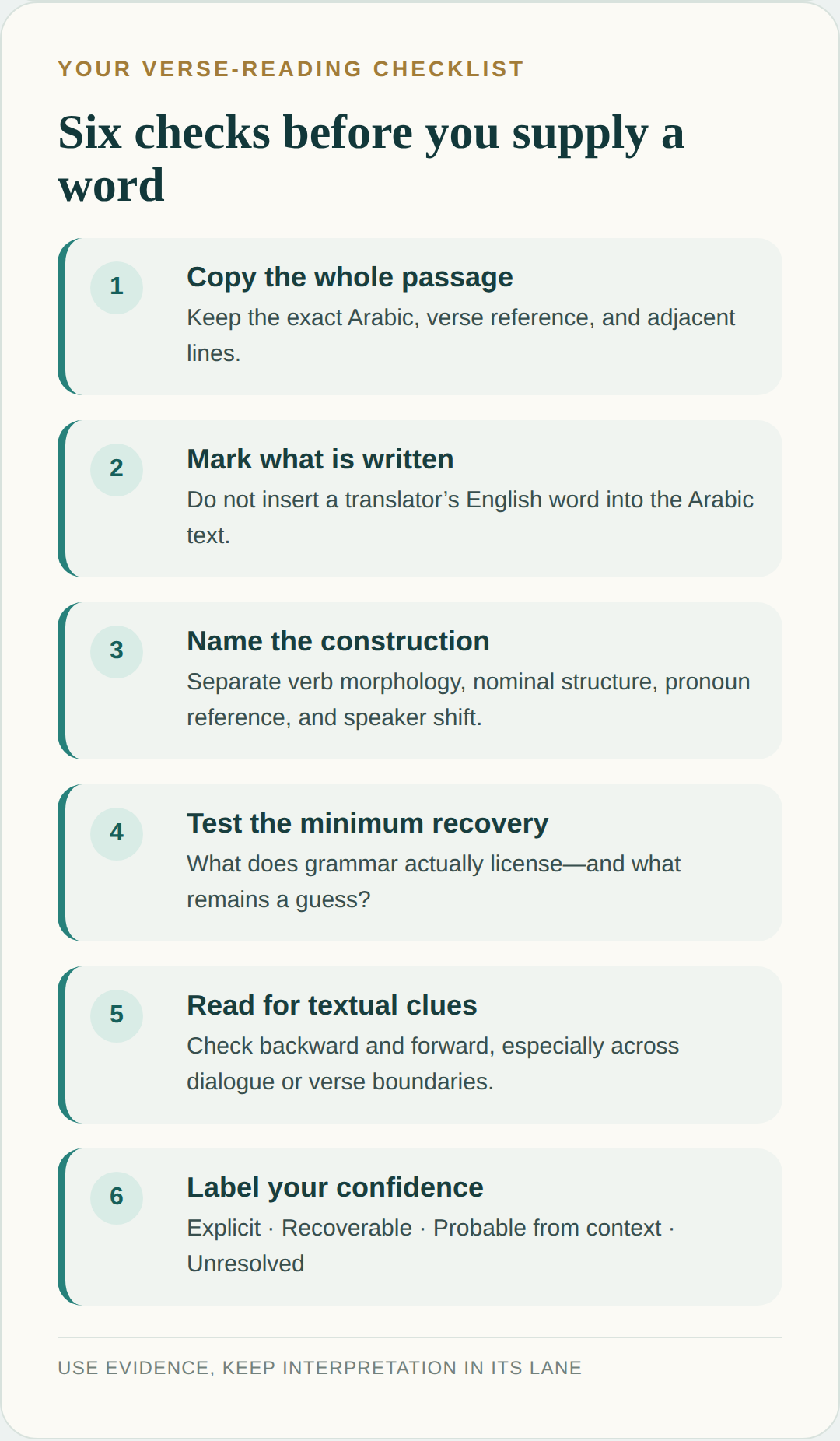
A six-step evidence check
- Copy the exact passage. Record the surah and verse, retain the Arabic spelling you are studying, and include the adjacent line or verse when dialogue or reference continues across a boundary.
- Mark only what is present. Underline the visible words, particles, pronouns, and endings. Do not write a supplied English word into the Arabic line.
- Identify the construction. Is the clue an imperative, a verb with a subject marker, a nominal sentence, a pronoun reference, or a shift in speaker? Keep those categories separate.
- Ask what the grammar actually licenses. If a verb form identifies person or number, record that. If the construction is complete without a separate copula, do not label an English “is” as a missing Arabic verb without further evidence.
- Look for textual clues. Read backward and forward. Is a speaker, noun, or idea mentioned nearby? Does a later line clarify an earlier reference? A word-by-word study that returns to the full verse is safer than deciding from a detached phrase.
- Write the smallest completion and a confidence label. Mark “explicit,” “grammatically recoverable,” “probable from context,” or “unresolved.” If two readings remain possible, list both briefly rather than choosing one to make the English smoother.
How to check your analysis without overclaiming
Use references to test a grammatical observation, not to replace the verse. A Quranic Arabic corpus guide can help you inspect word forms and tags, but a tag alone does not decide speaker attribution, rhetoric, or tafsir. Compare the exact passage, then return to the complete context. If a proposed reading depends on endings, remember that case endings are useful clues, but they do not answer every discourse question.
Keep a short study note with four columns: Arabic text, evidence visible in the passage, minimal recovery, and what remains uncertain. If an English translation adds a subject or verb, compare the translation’s wording with the Arabic rather than assuming the addition is a separate source word. A structured Arabic reading-comprehension routine can help you slow down and record evidence before deciding what a line means.
Common mistakes to avoid
- Calling every unspoken subject an ellipsis. A verb may carry an ordinary subject pronoun in its form. Record the morphology before moving to a textual or rhetorical claim.
- Letting English grammar dictate Arabic grammar. Translation may add words for fluency. That is not automatic proof of an omitted Arabic word.
- Choosing an agent from the nearest noun alone. Agreement, clause structure, and discourse continuity all matter. If they point in different directions, preserve the uncertainty.
- Confusing a grammatical subject with a speaker. An imperative can address a plural “you” while the identity of the person uttering it remains a separate narrative question.
- Expanding a small clue into a full interpretation. A text may identify a relation without specifying every motive, event, or theological implication a reader might add.
- Quoting a clipped phrase as if it settled the matter. Include the adjacent verse when the clue crosses a verse boundary, and keep the source reference with your note.
What should you do when the evidence is not decisive?
“Uncertain” is a useful reading result, not a failure. Separate what the morphology establishes from what a textual clue suggests, and separate both from interpretation. If a second analysis is possible, record it and ask what evidence would distinguish the options. Do not report an unresolved reconstruction as the only meaning just because one translation chooses a smooth English sentence.
For a final check, ask: Can I point to the exact written words? Can I explain which grammatical feature permits a recovery? Have I read the surrounding text? Am I labeling an interpretation as interpretation? These questions make the reasoning visible to another reader and reduce the temptation to fill every gap with a guess.
Optional video: a deeper look at omission and translation
The lecture below discusses omission in Quran translation and why an added English word can affect a rendering. It is an advanced perspective, not a substitute for checking the Arabic construction or the full verse. Use it as a prompt to ask what the source text states, what the translation supplies, and where more than one reading remains possible.
Ellipsis analysis is a careful reading skill, not an invitation to invent text. Preserve the words on the page, show the evidence behind any recovery, and leave disputed interpretation to qualified sources. If you would like guided feedback on reading Arabic and Quranic grammar, you can book a free Quran and Arabic trial class.