
Seeing الم or طه at the opening of a surah can make a new Quran reader pause: should the letters be sounded like a word, or named one by one? These openings are the Huroof al-Muqatta’at (also written Huruf Muqatta’at), and the key recitation habit is simple: say the name of each letter in order, then give its madd the length taught for that letter in your recitation tradition.
This guide focuses on pronunciation and practice, not on guessing what the letters mean. It walks through familiar examples, explains why some names are held longer than others, and gives you a short routine to try with a teacher or a trusted recording.
What are the Huroof al-Muqatta’at?
They are letter groups that occur at the beginning of 29 Quranic surahs. Across those groups are 14 distinct Arabic letters. Some openings contain one letter, some two, and others longer sequences. A group may look like a word on the page, but in recitation its letters are spoken by their names, separately and in order.
For example, الم is read Alif, Lām, Mīm; it is not blended into a made-up word such as “alam.” Likewise, طه is Ṭā, Hā, not an ordinary two-syllable word. The AboutTajweed guide to the Huroof al-Muqatta’at and their Tajweed rules gives a compact overview of this letter-name approach and the main length categories.
You do not need to settle questions of interpretation before learning to recite the openings. This article stays with what a learner can practise audibly: identify the sequence, say each letter name clearly, and time its length without rushing or exaggerating.
Start by saying each letter’s name
Look at the opening from right to left, as you would any Arabic text. Identify the individual letters, then say their conventional Arabic names. The target is not to read the consonant alone—such as “m”—or to attach a short vowel that is not written. The name Mīm is a complete letter name; it is not simply the sound /m/.
Try these three beginnings slowly:
- الم — Alif, Lām, Mīm (Al-Baqarah 2:1)
- طه — Ṭā, Hā (Ta-Ha 20:1)
- حم — Ḥā, Mīm (Ghafir 40:1)
Keep the sequence distinct. Do not insert a new vowel between the names, and do not turn a long letter name into a string of separate syllables. If you are still building confidence with Arabic letter forms and sounds, review the beginner’s guide to Quran Tajweed rules alongside your mushaf.
Why do some letter names last longer?
The length belongs to the spelled-out letter name, not to the number of letters you see in the opening group. Tajweed learners often meet two useful patterns: some letter names are held for about two counts, while many names that contain a madd letter followed by a fixed sukun are held for six counts under Madd Lazim Harfi. These counts are measured beats in recitation, not seconds on a clock.
In the common Hafs reading, the mnemonic Hayyun Ṭahur (حي طهر) helps learners remember five names commonly taught with a two-count length: Ḥā, Yā, Ṭā, Hā, and Rā. Many other opening-letter names—such as Lām and Mīm in الم—carry a six-count madd. The written opening may show only one compact cluster, but your voice gives each named letter its own measured shape.
In الم, Alif is read plainly without an added madd. Lām is lengthened, and its final mīm sound meets the next letter name, Mīm; in connected recitation those matching sounds merge rather than being separated by a fresh vowel. The Mīm name that follows is then given its own measured length. This is why a short sample from a qualified reciter can help: the written letters tell you what to name, while listening helps you hear how the transitions fit together.
For طه, Ṭā and Hā are each held for two counts. For حم, Ḥā is held for two counts and Mīm for six. Treat these as practice examples, not a replacement for a teacher’s correction. Detailed lessons may cover special timing, including the letter ʿAyn; follow the reading and count taught for your riwayah rather than choosing a length by guesswork. If madd itself is unfamiliar, the site’s guide to Madd letters, counts, and types explains the broader idea before you return to these openings.
A quick reading card: names and measured lengths
Use this small comparison as a prompt before you listen. Read the Arabic group from right to left, name each letter, and keep the counts even. The practice card uses the opening verses of Al-Baqarah, Ta-Ha, and Ghafir.
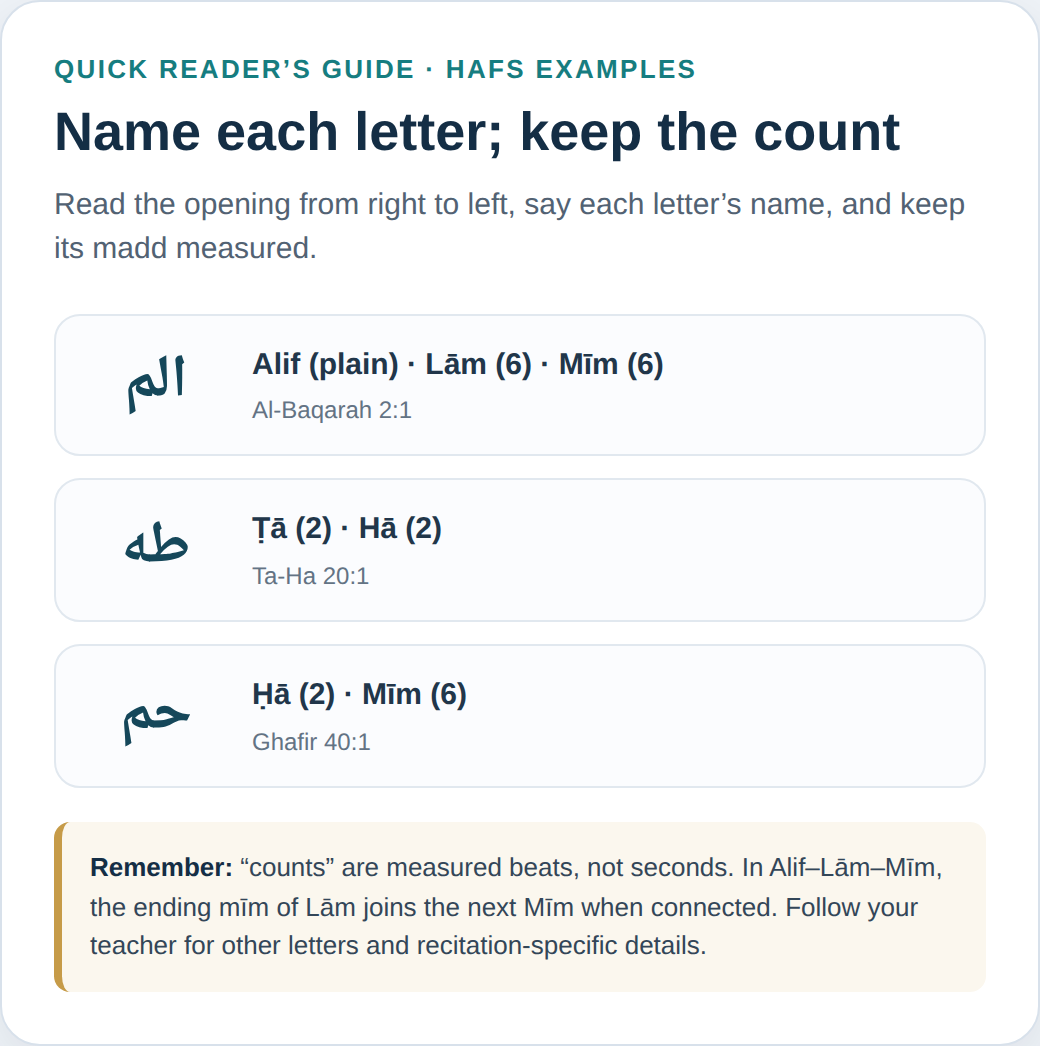
The numbers are rhythmic counts, not exact seconds. Your pace changes their duration, so keep the count proportional to your normal recitation. A Tajweed rules chart with Quran examples can help you review terms such as madd and sukun, but listen to a qualified reciter for the sound itself.
Common mistakes to watch for
- Blending the group into a word. Remember that الم is Alif, Lām, Mīm, not “Alam.” Name what is written.
- Reading only the consonant. Say the letter name fully—Mīm, not just /m/—while keeping its taught length.
- Giving every letter the same count. The sequence may mix different lengths. Do not stretch every name because the opening looks important, and do not shorten a six-count madd to match a two-count name.
- Adding a vowel between names. Keep the transition clean. Do not insert an “uh” or another extra syllable to make the sequence easier.
- Confusing a written group with a meaning you can pronounce. Learning the recitation form does not require making an interpretation. Stay with the letter names and the reading you have been taught.
When you hear a difference between your attempt and a trusted reciter, note the exact letter and count instead of repeating the whole passage faster. A simple listen–pause–check practice method can help you isolate one sound at a time.
A short practice routine
- Choose one opening. Start with Alif-Lām-Mīm or Ṭā-Hā rather than attempting every combination at once.
- Read the names silently first. Point to each Arabic letter and say its name in order before adding length.
- Listen to a reliable model. Hear one complete recitation, then repeat the same opening at a comfortable pace. Do not try to imitate melody before the names and counts are clear.
- Record one attempt. Compare the sequence and length, not your voice quality. Ask a qualified teacher to correct any uncertain transition; the guide on recording recitation for useful teacher feedback explains how to make that review practical.
- Repeat later, then stop. A few attentive repetitions are more useful than many rushed ones. Write the correction in your Quran lesson notes and bring it to your next practice.
For an English demonstration of Huroof al-Muqatta’at in Alif-Lām-Mīm, watch this short lesson, then return to the card and try the same sequence yourself:
If you are practising without a teacher beside you, the site’s guide to Tajweed practice at home between lessons offers a structure for short, focused sessions. For questions about your own reading, take a recording to a qualified teacher rather than relying on a written guide alone.
Frequently asked questions
How many Huroof al-Muqatta’at are there?
There are 14 distinct letters used in these Quranic openings, appearing in combinations at the start of 29 surahs. A single letter may occur in more than one surah, so the number of openings is not the same as the number of unique letters.
Do I read Alif-Lām-Mīm as one word?
No. Name the letters in sequence: Alif, Lām, Mīm. Do not pronounce the group as an ordinary word or replace each name with only its first consonant.
Are all the opening letters stretched for six counts?
No. The length varies by letter name. For example, Ṭā-Hā is commonly taught with two counts on each name, while Lām and Mīm in Alif-Lām-Mīm receive six-count madd in the Hafs recitation. Learn the pattern with a teacher and follow the transmission you recite.
Do we know what these letters mean?
This pronunciation guide does not assign meanings to them. Their interpretation is a separate subject of tafsir; for recitation practice, focus on the transmitted letter names and their measured length rather than guessing.
Can I learn the timing from a written chart alone?
A chart can help you remember which names to review, but it cannot demonstrate the sound, articulation, or transition. Listen to a qualified reciter and ask a teacher to check your attempt. If you are choosing a structured study option, the guide to ways to learn Tajweed online explains what to look for in lessons.
With a clear letter-name sequence and a measured count, the Huroof al-Muqatta’at become less intimidating. Begin with one opening, listen carefully, and let a qualified teacher confirm your pronunciation before you move on to more complex combinations.