
Lost and Found in Arabic: Describe an Item and Ask for Help
Three bags are on a desk. Two are blue, two are small, and two have a white circle on them. You have lost a small blue bag with a white circle. Saying “the blue bag” will not identify it. This is a useful Arabic learning problem: you need enough description to distinguish an object, then you need to understand a question and confirm whether the object is yours.
This lesson follows one lost-and-found case from the first request for help to the final confirmation. It uses original Modern Standard Arabic practice examples, not Quran quotations. The goal is a clear description and a successful exchange, rather than a long vocabulary list. Procedures for real lost property depend on the venue; the dialogues below teach language, not a universal collection policy.
The case: which bag belongs to the learner?
Imagine these three practice objects. Bag A is blue and small, with a white circle. Bag B is blue and large, without a white circle. Bag C is black and small, with a white circle. Your target is Bag A. Keep the diagram visible for the first activity, then cover it when you practise speaking.
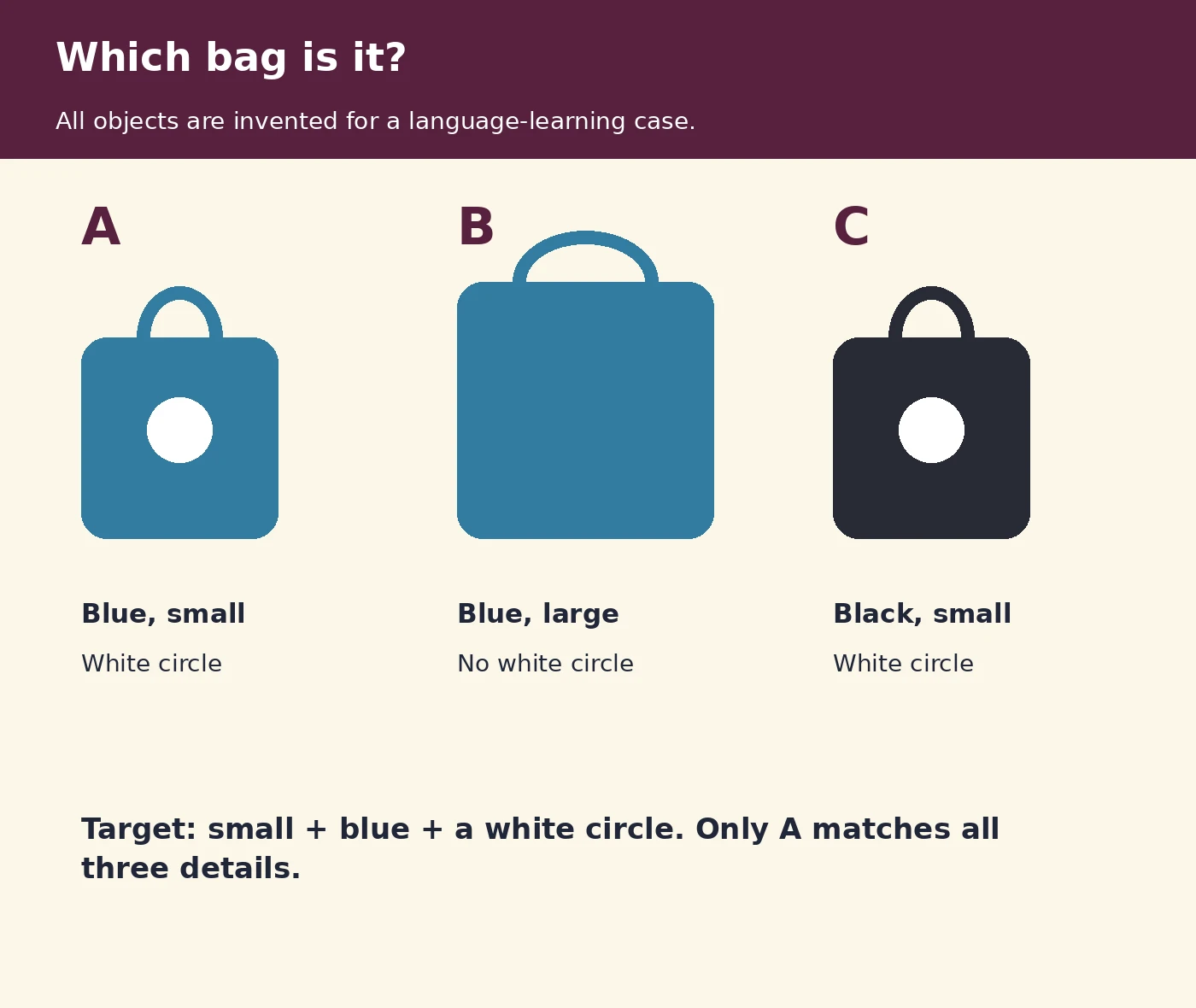
How much information do you need? “Small” leaves A and C. “Blue” leaves A and B. “Small and blue” identifies A in this particular set. The white circle is an extra confirming detail. In a different collection, the same description might still match several bags. Choose a description by looking at what distinguishes your item, not by counting how many adjectives you can remember.
Try the reasoning in English first. Then use Arabic to communicate the same distinctions. If you cannot decide which bag a description selects even in English, adding more Arabic vocabulary will not solve the underlying task.
Open with the problem and one useful request
أَضَعْتُ حَقِيبَتِي — aḍaʿtu ḥaqībatī — means “I lost/misplaced my bag.” The final تُ marks “I” in this verb form. A male or female speaker can use this same first-person form. You can follow it with أَيْنَ مَكْتَبُ الْمَفْقُودَاتِ؟ — ayna maktabu al-mafqūdāt? — “Where is the lost-and-found office?”
These two sentences have different jobs. The first states the problem; the second asks where to get help. If you are already speaking to the appropriate staff member, you may not need the location question. A short opening is easier to adapt than a memorised speech containing details that the listener has not asked for.
For a small classroom role-play, replace حقيبتي with كتابي — “my book” — or قلمي — “my pen.” Keep the rest of the task manageable. You are practising reporting a missing object, so do not turn the first round into an unfamiliar story about an entire journey.
Build the description around the noun
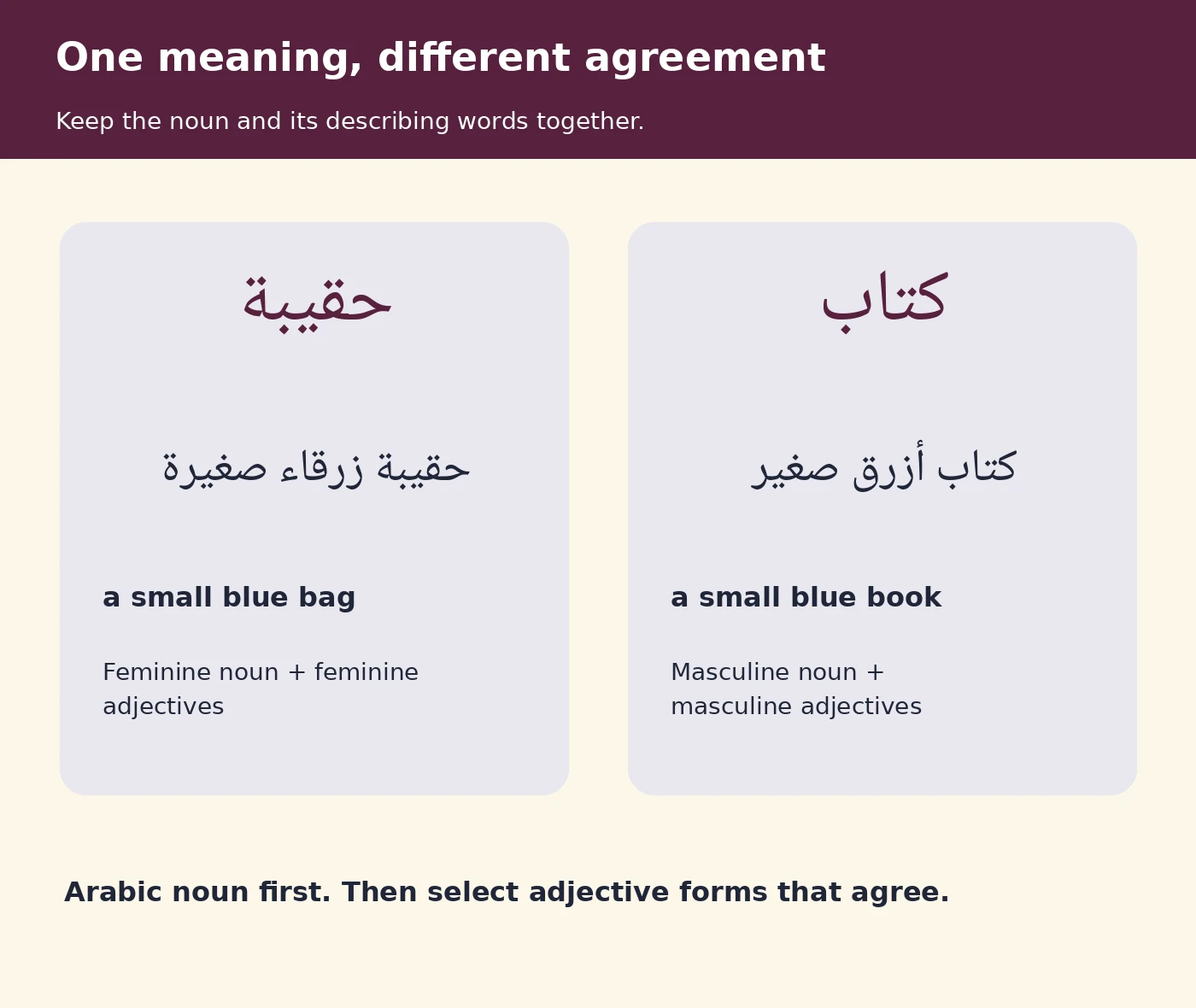
For Bag A, begin with حقيبة — “a bag.” Add زرقاء — “blue” — and صغيرة — “small”: حَقِيبَةٌ زَرْقَاءُ صَغِيرَةٌ. This means “a small blue bag.” The Arabic noun comes before the adjectives. English often puts them before the noun, so translating the English sequence word by word can give you the wrong starting point.
The noun حقيبة is feminine. Use زرقاء with it, rather than the masculine أزرق. The adjective صغير becomes صغيرة in this example. Color adjectives do not all form their feminine by simply adding ة: compare أزرق and زرقاء, or أبيض and بيضاء. Michigan State University’s Arabic noun-and-adjective lesson provides a color table and simple agreement examples.
For more examples in your own study, use Quranytime’s Arabic colors guide. Then return to the case: the color is useful only when it helps the listener identify the right object. You do not need to recite every color you know.
Compare a masculine object: كِتَابٌ أَزْرَقُ صَغِيرٌ — “a small blue book.” The meaning of blue and small stays similar, but the forms change with the noun. If agreement is a recurring difficulty, our Arabic adjective agreement lesson explains the wider pattern. For this role-play, practise just the two accurate noun phrases before making new ones.
Add a visible feature in a new sentence
عَلَيْهَا دَائِرَةٌ بَيْضَاءُ means “There is a white circle on it.” The ending ها in عليها refers back to the feminine bag. Rather than packing every detail into one complicated phrase, you can give two short sentences: حقيبتي زرقاء وصغيرة. عليها دائرة بيضاء. “My bag is blue and small. There is a white circle on it.”
Be precise about the relationship. “On it” describes a visible exterior marking. فِيهَا كِتَابٌ — “There is a book inside it” — describes contents. A listener who is looking at the outside of a bag may be able to check one detail immediately and need a different process for the other. Our Arabic prepositions guide can help you keep في and على connected to their meanings in a sentence.
For the classroom case, use only the features shown in the diagram. Do not add a brand, pocket or name label that the picture does not establish. In real communication, accurate details are more useful than vivid invented ones.
Keep “my,” “your” and “this” separate
حقيبتي means “my bag.” حقيبتك can mean “your bag,” with the final vowel distinguishing the person addressed in fully vocalised MSA: حَقِيبَتُكَ to a man, حَقِيبَتُكِ to a woman. The owner’s gender does not change حقيبتي. A male learner can own a feminine-noun bag; grammatical gender belongs to the noun, not to the person holding it.
هَذِهِ حَقِيبَتِي means “This is my bag.” In contrast, هَلْ هَذِهِ حَقِيبَتُكَ؟ asks a man, “Is this your bag?” Change the final vowel to ـكِ when addressing a woman. In ordinary unvocalised writing both suffixes look like ك, so context and speech matter. For more practice, see our attached possessive pronouns lesson.
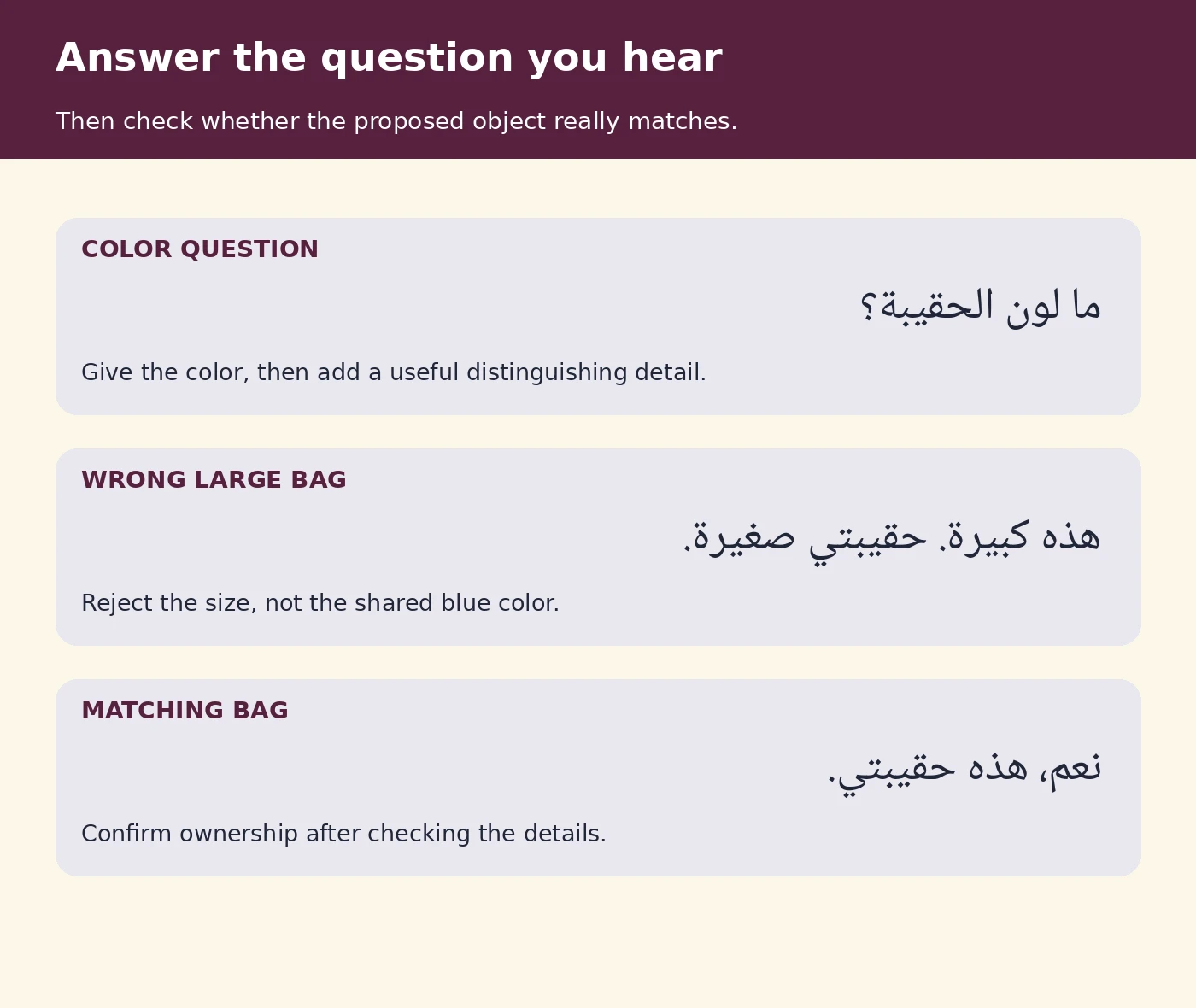
A useful response is لا، هذه ليست حقيبتي — “No, this is not my bag.” Follow it with a discriminating detail: حقيبتي صغيرة — “My bag is small.” This is better than simply repeating “no” while the staff member tries to guess which feature was wrong.
A pronunciation check that protects the meaning
Notice the difference between حقيبة and حقيبتي. When حقيبة stands alone at a pause, a beginner pronunciation aid is ḥaqība. In حقيبتي, the attached ending brings out the t: ḥaqībatī, “my bag.” Do not learn the second expression by simply adding an English “ee” sound to a memorised pronunciation of the first. Practise the complete Arabic word and listen for the connection before the suffix.
Use three separate prompts: “a bag,” “my bag,” and “this is my bag.” Your answers are حقيبة, حقيبتي, and هذه حقيبتي. Point to a drawing as you say each answer. Then ask a partner to select a prompt in an unpredictable order. If you can produce the longest sentence only after saying the first two, you still rely on a rehearsed chain. Return to the individual meaning cues and shorten the pause gradually.
For a listening check, have a partner alternate حقيبتي and حقيبتك. Identify whether the speaker is talking about their own bag or asking about yours. You can point to “speaker” or “listener” cards before replying. Do not judge this round by how many sentences you produce; judge whether ownership stays clear. Once the contrast is reliable, combine it with the color question in the dialogue.
Transliteration is only a temporary aid here. Keep the Arabic visible during the first reading, then use meaning or picture prompts for retrieval. A spelling invented in English cannot fully represent Arabic sounds or the different endings you need to hear.
Listen to the question before choosing a detail
مَا لَوْنُ الْحَقِيبَةِ؟ asks “What color is the bag?” أَيْنَ كَانَتِ الْحَقِيبَةُ؟ asks “Where was the bag?” مَتَى؟ asks “When?” A color answer cannot replace a time answer. In role-play, let your partner rearrange the questions so that you must understand the cue rather than recite a description in a fixed order.
For the invented case, you might answer the location question with كانت في المكتبة — “It was in the library.” You can supply a simple time such as اليوم صباحًا — “this morning.” Do not automatically say where the bag is now when the question asks where you last had it. That distinction is part of understanding the exchange.
If the timing matters, name a day or date accurately. Our Arabic days and dates lesson helps with calendar expressions, while the telling-time guide supports clock times. For beginner practice, a clear approximate time is enough unless the task asks for an exact one.
Follow the desk conversation
Read the exchange once with its meanings. Then hide the learner’s lines and answer from the staff member’s prompts. The question about ownership below addresses a male learner; a teacher can change the final suffix vowel for a female learner.
المتعلم: مرحبًا، أضعت حقيبتي.
الموظف: ما لون الحقيبة؟
المتعلم: حقيبتي زرقاء وصغيرة. عليها دائرة بيضاء.
الموظف: هل هذه حقيبتك؟
المتعلم: لا، هذه كبيرة. حقيبتي صغيرة.
الموظف: وهذه؟
المتعلم: نعم، هذه حقيبتي. شكرًا.
The learner reports losing a bag. When asked about its color, the learner gives color, size and a marking. The staff member first offers the large blue bag, B. The learner rejects it specifically because it is large. When offered A, the learner confirms. The exchange succeeds because each new line responds to the previous turn.
For a different round, have the staff member offer C first. The learner should now reject the color rather than the size: لا، هذه سوداء. حقيبتي زرقاء — “No, this one is black. My bag is blue.” Keeping the same answer when the wrong object changes would show that the script has been memorised without the distinctions.
Three case challenges
Challenge one: eliminate, then explain
You hear حقيبة صغيرة عليها دائرة بيضاء — “a small bag with a white circle.” Which bags remain possible? What single question would separate them?
Answer: A and C remain possible. Ask ما لون الحقيبة؟ — “What color is the bag?” Blue selects A; black selects C. The description did not mention color, so selecting A immediately would add information that the speaker never gave.
Challenge two: change the object
Change حقيبة زرقاء صغيرة into a phrase describing a small blue book. Keep the meaning, but update the noun and adjective forms before checking your answer.
Answer: كتاب أزرق صغير. Merely changing حقيبة to كتاب leaves two agreement problems if زرقاء and صغيرة remain. Say both complete phrases in turn so you practise the relationship, not just isolated endings.
Challenge three: correct the useful detail
The staff member offers Bag B. A learner answers “No, my bag is blue.” Why does this fail to identify the problem? Give a better Arabic response using a distinction already taught.
Answer: B is blue too, so color does not distinguish it from A. A useful correction is لا، هذه كبيرة. حقيبتي صغيرة — “No, this one is large. My bag is small.” A different accurate response could mention the missing white circle. Choose the feature that actually differs.
Make the next attempt less scripted
After solving the case, draw three new objects with only two or three controlled differences. Let one partner choose a target secretly. The other asks questions, proposes an object and listens to the correction. Switch roles after a complete exchange, rather than correcting every word in the middle of the learner’s first attempt.
Ask for feedback on one point: whether the description distinguished the object, whether agreement was clear, or whether the reply matched the question. Our beginner conversation practice guide offers ways to move from scripts to short cues. Keep the lost-and-found goal while reducing the amount of written support.
For teacher feedback, Book a Free Trial Class and bring a drawing of three similar objects. Ask your teacher to change which item is offered first. A strong final test is not reciting the model perfectly: it is noticing why the offered object is wrong, explaining the difference, and confirming the matching item in your own short Arabic sentences.