
Quranic Arabic Pronouns and Antecedents: A Practical Guide
Recognizing a pronoun is only the first step. In Quranic Arabic, a reader must also ask who or what it refers to—and whether the verse gives enough evidence to answer confidently. This guide offers a careful way to track Quranic Arabic pronouns and antecedents across a complete verse or short passage without automatically choosing the nearest noun, treating an English translation as proof, or turning a grammatical clue into a tafsir ruling.
A pronoun’s form tells you something about person, number, gender, and grammatical role. Its reference is the person, group, or thing it points to in context. These are related questions, but they are not the same question. A chart of pronoun forms is a useful starting point; a passage-level decision needs more evidence. If you need a form refresher first, see our guide to Arabic pronouns used in Quranic reading.
What counts as an antecedent?
An antecedent is an expression that a pronoun refers back to. In a short sentence, it may be easy to spot. In a longer Quranic passage, the referent may be introduced in an earlier clause or verse, repeated through several attached pronouns, or supplied by the larger discourse. In some constructions, the wording that clarifies a pronoun may follow it. So “find the closest noun” is not a reliable rule.
First identify the pronoun as it appears in Arabic. It may stand independently, such as هُوَ, or attach to another word, as in a possessive ending or an object ending. Do not assume every attached ending has the same job: a suffix can belong to a noun, verb, or preposition. Our explanation of attached pronouns and the words they attach to helps with that first grammatical distinction. Relative pronouns such as الذي introduce a different kind of relationship; they are covered in our guide to recognizing Quranic Arabic relative pronouns.
A six-step method for tracing a Quranic pronoun
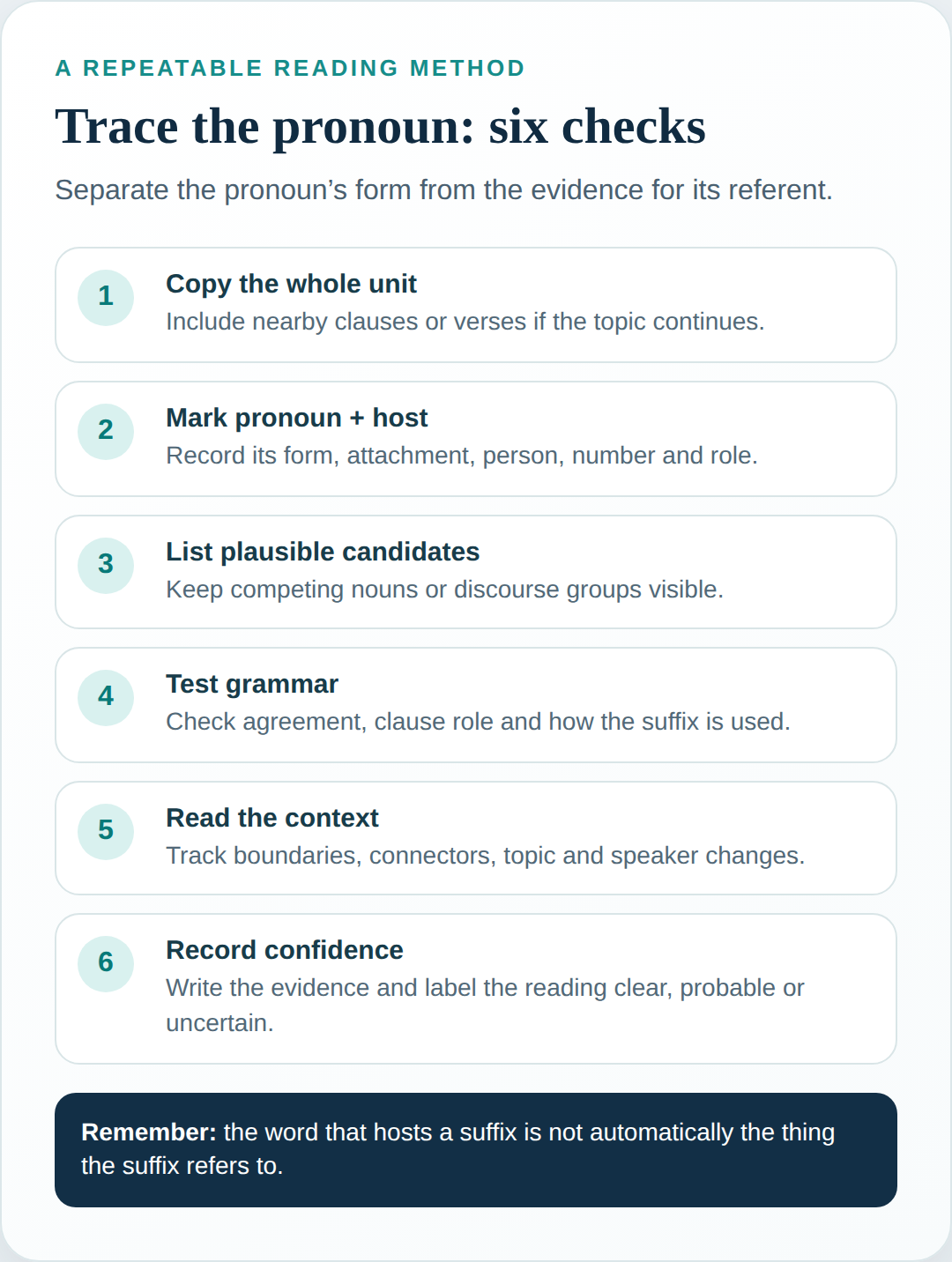
- Copy the full unit. Start with the whole verse, and include the preceding or following verse when a reference crosses a boundary. Do not begin from a cropped quote that has removed possible evidence.
- Mark the pronoun and its host. Record the exact Arabic form, whether it is attached or independent, and the word it belongs to. Note person, number, and gender where relevant. This describes the form; it does not yet identify the referent.
- List plausible candidates. Look for compatible nouns or groups in the same clause and nearby discourse. Keep more than one candidate on the page if both are possible. Do not select a noun merely because it is physically closest.
- Test agreement and role. Ask whether each candidate fits the pronoun’s grammatical features and the role required by the clause. Check whether the suffix is possessive, object, or governed by a preposition. A candidate that fails agreement or the clause’s structure should not be retained without a reason.
- Trace the discourse. Mark clause boundaries, connectors, and changes of speaker or topic. Then read the passage aloud or listen to it. A pronoun may resume an earlier topic after another noun has intervened. A conjunction can help show how clauses relate; our lesson on Quranic Arabic conjunctions explains why that relationship matters.
- State your confidence. Write “clear,” “probable,” or “uncertain,” and note the evidence. If the local wording does not settle the question, keep the uncertainty instead of filling it with a guess.
This process fits inside a broader sentence analysis, but it has one specific goal: identify the strongest supported referent and record what remains unresolved. For a fuller clause-by-clause method, use our step-by-step guide to parsing Quranic Arabic sentences. For practice connecting grammar to meaning, continue with Quranic Arabic reading-comprehension exercises.
Worked example: follow the referent across a verse boundary
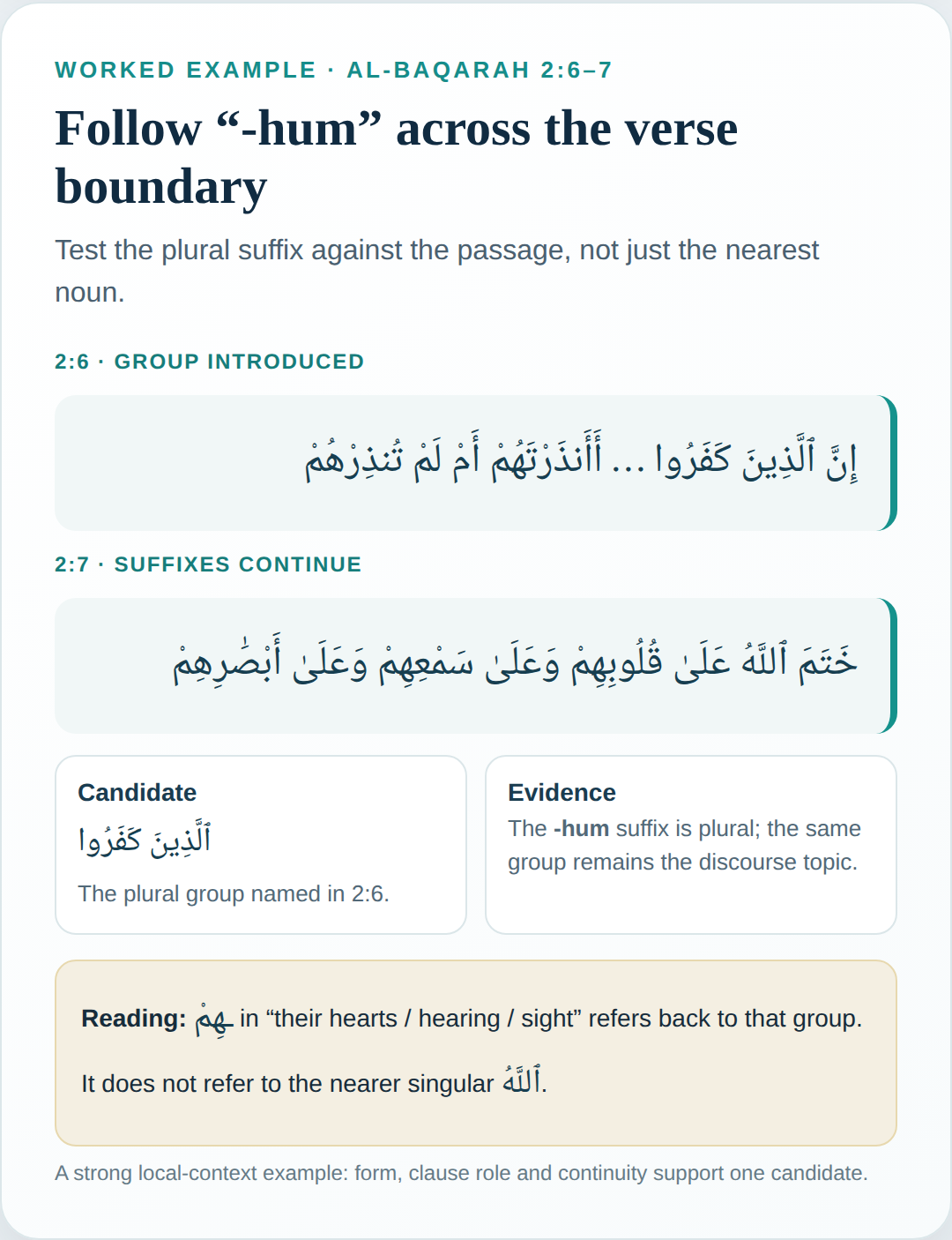
Consider the movement from Al-Baqarah 2:6 to 2:7. Verse 2:6 introduces الَّذِينَ كَفَرُوا (“those who disbelieve”) and uses attached ـهُمْ endings in أَأَنذَرْتَهُمْ and تُنذِرْهُمْ. Verse 2:7 then says, in part, خَتَمَ اللَّهُ عَلَىٰ قُلُوبِهِمْ وَعَلَىٰ سَمْعِهِمْ وَعَلَىٰ أَبْصَارِهِمْ. The same plural ending appears on “their hearts,” “their hearing,” and “their sight.”
To identify the referent, do not stop at the nearest noun in 2:7. The clause names اللَّهُ before the suffixes, but the plural ـهِمْ does not refer to that singular noun. Reopen 2:6: the people introduced by الَّذِينَ كَفَرُوا are the compatible group, and the repeated “them” endings carry that group forward. The verse boundary does not erase a discourse link. Agreement, grammatical role, and continuity all support the same reading.
This is a strong local-context case, not a license to force every pronoun into the nearest previous phrase. In your notes, you could record: “Candidate: the group introduced in 2:6; plural agreement fits; the passage continues the same topic; confidence: clear in this context.” If the syntax or topic changed, the confidence label would need to change too.
When the local verse does not name the referent
Not every reference is resolved by finding an earlier noun in the same verse. In Al-Ikhlas 112:1, the recited wording begins قُلْ هُوَ اللَّهُ أَحَدٌ. The independent pronoun هُوَ appears before the explicit name in the clause. That is a reminder to examine the whole construction and discourse rather than searching mechanically for a noun immediately before it. Do not label every such case “unclear”; instead, state what the wording supplies, what the surrounding context contributes, and what level of analysis you are making.
Research on Quranic pronominal reference describes both attached and independent pronouns and notes that a referent may be introduced earlier in the discourse or depend on wider context. Sharaf and Atwell’s QurAna paper on Quranic pronoun annotation is a neutral research source for that distinction. The practical lesson is modest: grammar can narrow candidates, but a reader should not claim more certainty than the text and the chosen interpretive method support.
It also helps to keep pronoun reference separate from omitted wording. A pronoun is present in the Arabic text; an ellipsis question asks whether some material is left unexpressed. Likewise, a grammatical subject is not automatically the same as the topic of the whole passage. If you are unsure, note the form and its host, list the candidates, and ask what additional context would be needed.
Use a confidence scale, not a forced answer
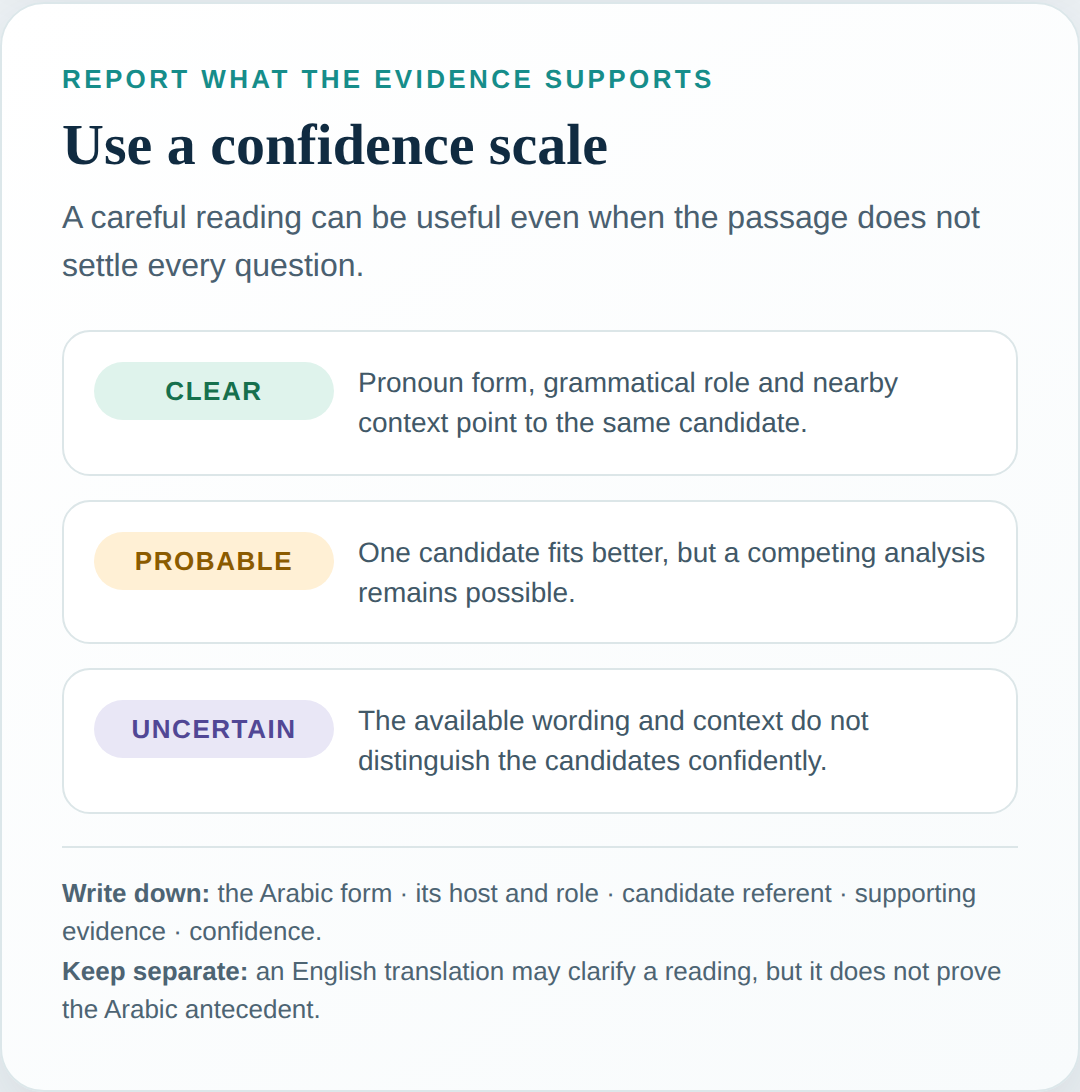
For a clear reference, the form, clause role, and nearby discourse point to the same candidate. For a probable reference, one reading fits better, but a competing analysis remains. For an uncertain reference, the available grammatical and contextual evidence does not distinguish the candidates confidently. This is a study note, not a judgment on the verse’s full interpretation.
Keep your translation in a separate column. Translators often make a reference explicit in English for readability, but the English pronoun or noun does not prove which Arabic expression is the antecedent. A translation is useful as a comparison; return to the Arabic wording and clause structure for the grammatical check. If a passage has a verbal predicate, a refresher on Quranic Arabic verbal sentences and their roles may help. If it is a nominal clause, review our guide to Quranic Arabic nominal sentences.
Listen to the passage, then verify the text
Listen to this complete recitation of Surah Al-Ikhlas while following the displayed Arabic. Verse 112:1 lets you notice هُوَ in a complete recited clause. Use the video to hear the passage and follow its wording; use the written Arabic and your grammar notes to test a pronoun-reference claim.
Common mistakes to avoid
- Choosing the nearest noun automatically. First check whether its number, gender, and grammatical role fit. If another group has remained the discourse topic, test it too.
- Confusing the suffix’s host with its referent. In قُلُوبِهِمْ, the suffix attaches to “hearts,” but the hearts are not the people being referred to. The host word and the referent answer different questions.
- Using a translation as proof. English may supply a noun to make the sentence smoother. Record it as a translation choice, then verify the Arabic evidence independently.
- Collapsing grammar and tafsir. A grammatical candidate can be strong without settling every theological, rhetorical, or interpretive question about a passage.
- Hiding uncertainty. A careful note such as “likely refers to the earlier group; wider context matters” is more useful than an unqualified answer with no evidence.
A practical study habit
When you meet a pronoun, write down the Arabic form, its host and role, two or more plausible referents if needed, and the evidence that supports your preferred reading. Then reread the complete clause and surrounding verses. This makes Quranic Arabic pronouns and antecedents a tractable reading task rather than a guessing game. If you would like individual feedback while practicing, you can book a free Quran and Arabic trial class.
For every passage, separate what the text states from what you infer. A disciplined reference check can improve comprehension, but a confidence label keeps the conclusion honest.