
The Arabic word ما (mā) is short, but it does not have one fixed job. In Quranic Arabic it can ask “what?”, negate a statement, mean “what/whatever,” or help introduce a condition. A translation gives you the sense of a phrase; the surrounding sentence helps you decide how ما is working.
This guide gives you a practical first-pass method for the meanings of ما in Quranic Arabic. It is a grammar-reading aid, not tafsir. When a verse’s meaning needs deeper explanation, consult a trusted translation, tafsir, or qualified teacher.
Why the same spelling can do different jobs
In an unvowelled line, ما may look the same each time, even when its grammatical role changes. It can function as a question word, a relative pronoun, a negative particle, or a conditional noun. It can also appear joined to other letters, as in وما, فما, بما, and إنما. Those combinations should be read as part of the full phrase rather than translated letter by letter.
Grammar is about relationships: what connects to what, which clause is a question, and whether a second clause gives a condition’s result. The Quranic Arabic Corpus explains how traditional iʿrāb and dependency relationships are used to represent Quranic syntax. That is why a good first question is not “What English word always equals ما?” but “What role does it play in this sentence?”
A context-first way to read ما
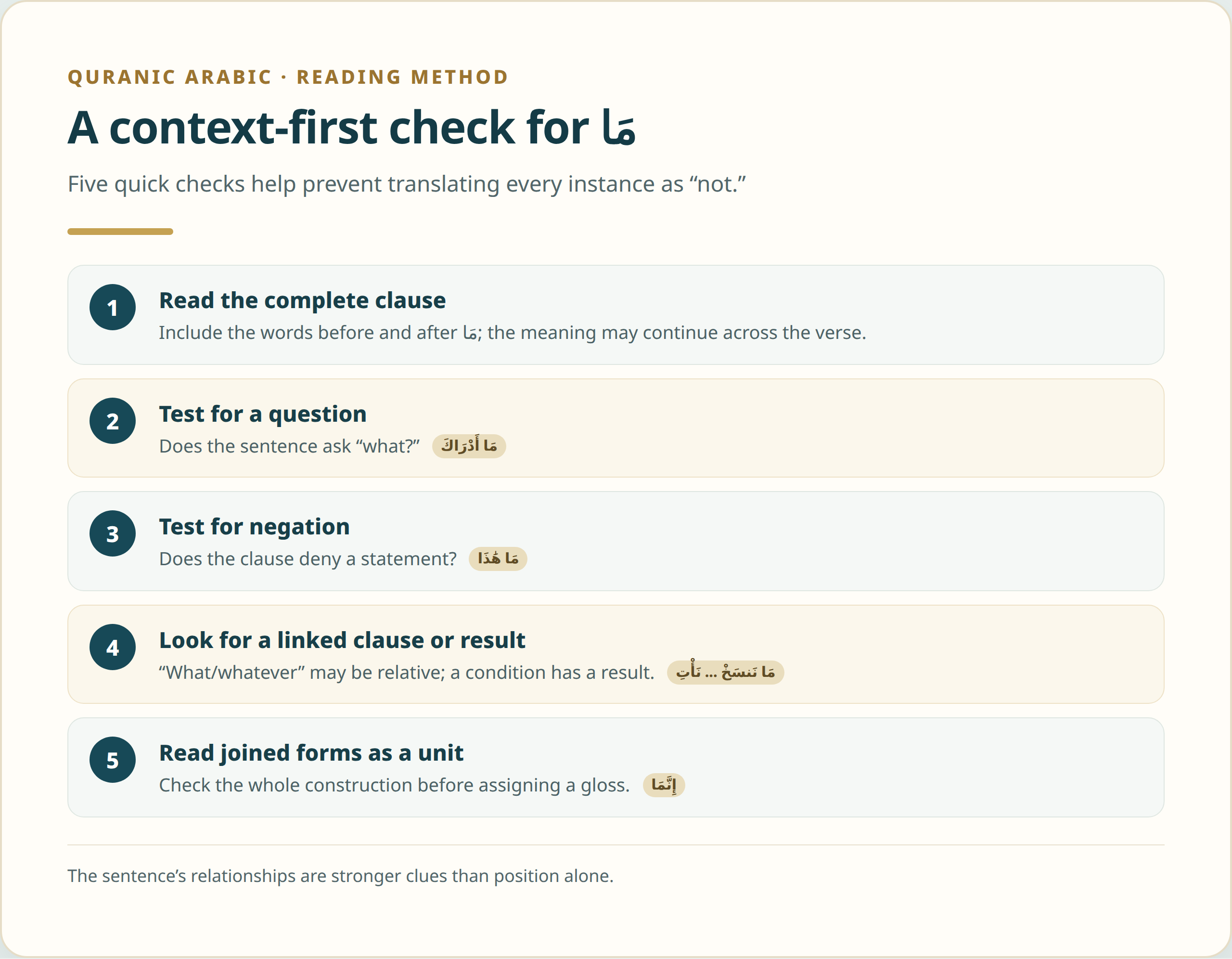
Use these checks in order. They do not replace a full grammatical analysis, but they stop the most common guess: treating every ما as “not.”
- Read the whole clause. Include the words before and after ما. A phrase may continue into the next part of the verse.
- Ask whether the clause is a question. If the sentence asks for an identity or explanation, interrogative mā (“what?”) may fit. Review Arabic question words for Quranic reading for related forms.
- Test for negation. Does the sentence deny a statement, like “this is not …”? If so, mā al-nāfiyah may be the answer. Compare the examples in our guide to negation in Quranic Arabic.
- Look for a clause that supplies “what” or “whatever.” A relative ما introduces a clause that identifies the thing meant. Our guide to relative pronouns in Quranic Arabic explains how that link works.
- Look for a condition and a result. If one clause sets up “whatever happens” and another tells what follows, conditional mā may be present. See the examples in Quranic Arabic conditional sentences.
Do not decide from position alone. ما can begin a sentence as a question word, as well as in some negative constructions. A word’s connection to the clause is a stronger clue than whether it appears at the beginning or middle of an āyah.
Four common patterns in Quranic examples
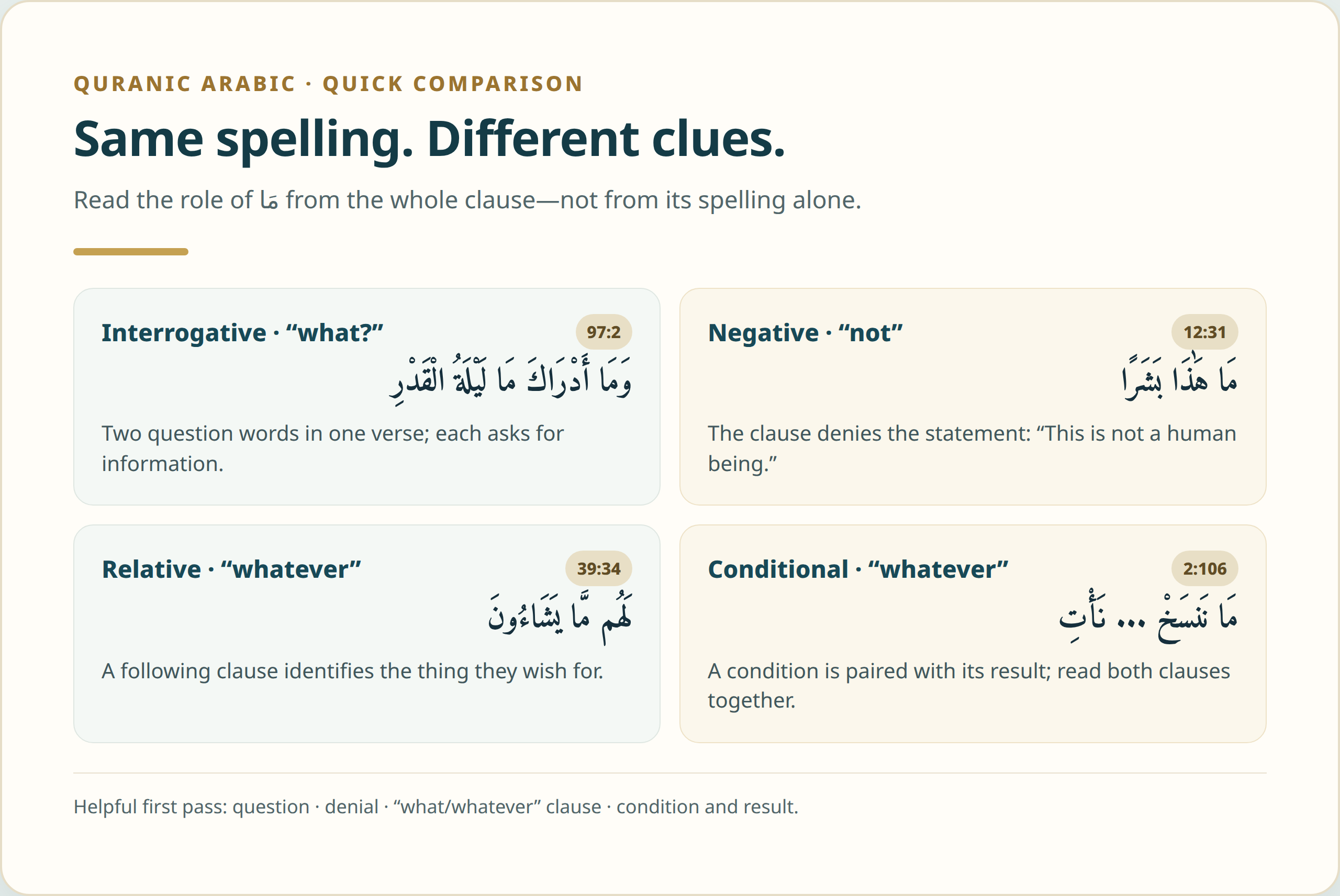
1. Interrogative ما: “what?”
In Surah Al-Qadr 97:2, the verse reads: وَمَا أَدْرَاكَ مَا لَيْلَةُ الْقَدْرِ — “And what can make you know what the Night of Decree is?” The verse contains ما twice, and both occurrences are interrogative. The first belongs with “can make you know”; the second asks what the Night of Decree is. Notice that the same word can have the same broad function twice in one line while linking to different parts of the sentence.
2. Negative ما: “not”
In Surah Yusuf 12:31, the women say: مَا هَٰذَا بَشَرًا إِنْ هَٰذَا إِلَّا مَلَكٌ كَرِيمٌ — “This is not a human being; this is only a noble angel.” Here ما negates a nominal sentence: it is followed by “this” and a predicate, not by a verb. That is a useful reminder that “negative ما” is not limited to the pattern “ما + verb.” In the same quotation, إِلَّا contributes an exclusive sense, so read the whole expression rather than making ما carry every part of the translation. For more on subject-and-predicate patterns, see Arabic nominal sentences in Quranic reading.
3. Relative ما: “what” or “whatever”
Surah Az-Zumar 39:34 says: لَهُم مَّا يَشَاءُونَ عِندَ رَبِّهِمْ — “They will have whatever they wish with their Lord.” The clause يَشَاءُونَ (“they wish”) follows ما. The word ما stands for the thing they wish for; English supplies “whatever” to make the relationship clear. This is different from a question: the verse is not asking what they wish, but referring to whatever it is that they wish.
4. Conditional ما: “whatever” with a result
In Surah Al-Baqarah 2:106, the phrase begins: مَا نَنسَخْ مِنْ آيَةٍ أَوْ نُنسِهَا نَأْتِ بِخَيْرٍ مِّنْهَا أَوْ مِثْلِهَا. Here ما introduces a condition, followed by its result: “Whatever verse We replace or cause to be forgotten, We bring one better than it or similar to it.” The paired structure matters: read the first clause together with نَأْتِ, the result. The jussive verb forms are another grammatical clue, though you should still read the meaning of the complete clause. Our guides to case endings and iʿrāb and Quranic Arabic conjunctions can help you follow those relationships.
Time phrases and joined forms need the full phrase
Some expressions are easier to recognize as a unit. In Surah Maryam 19:31, مَا دُمْتُ حَيًّا means “as long as I am alive.” At a first-pass reading level, the whole phrase sets a time span. Advanced grammar books may label the construction differently, so focus first on its role in the sentence and use one consistent grammar reference when you need a technical label. For related building blocks, see our guides to common Arabic prepositions and how they attach to nearby words.
Another useful combined form is إِنَّمَا. In Surah Al-Hujurat 49:10, إِنَّمَا الْمُؤْمِنُونَ إِخْوَةٌ is commonly translated, “The believers are but brothers.” Traditional grammar often calls the ما here mā al-kāffah, because the combined form affects how إنَّ behaves. For a learner, the main point is simpler: do not pull ما out of إنما and assign it the standalone meaning “what” or “not.” Other terms such as mā al-maṣdariyyah also describe particular constructions; their meaning depends on the clause they introduce, not on a one-word English substitute.
Practice: identify the clue before the translation
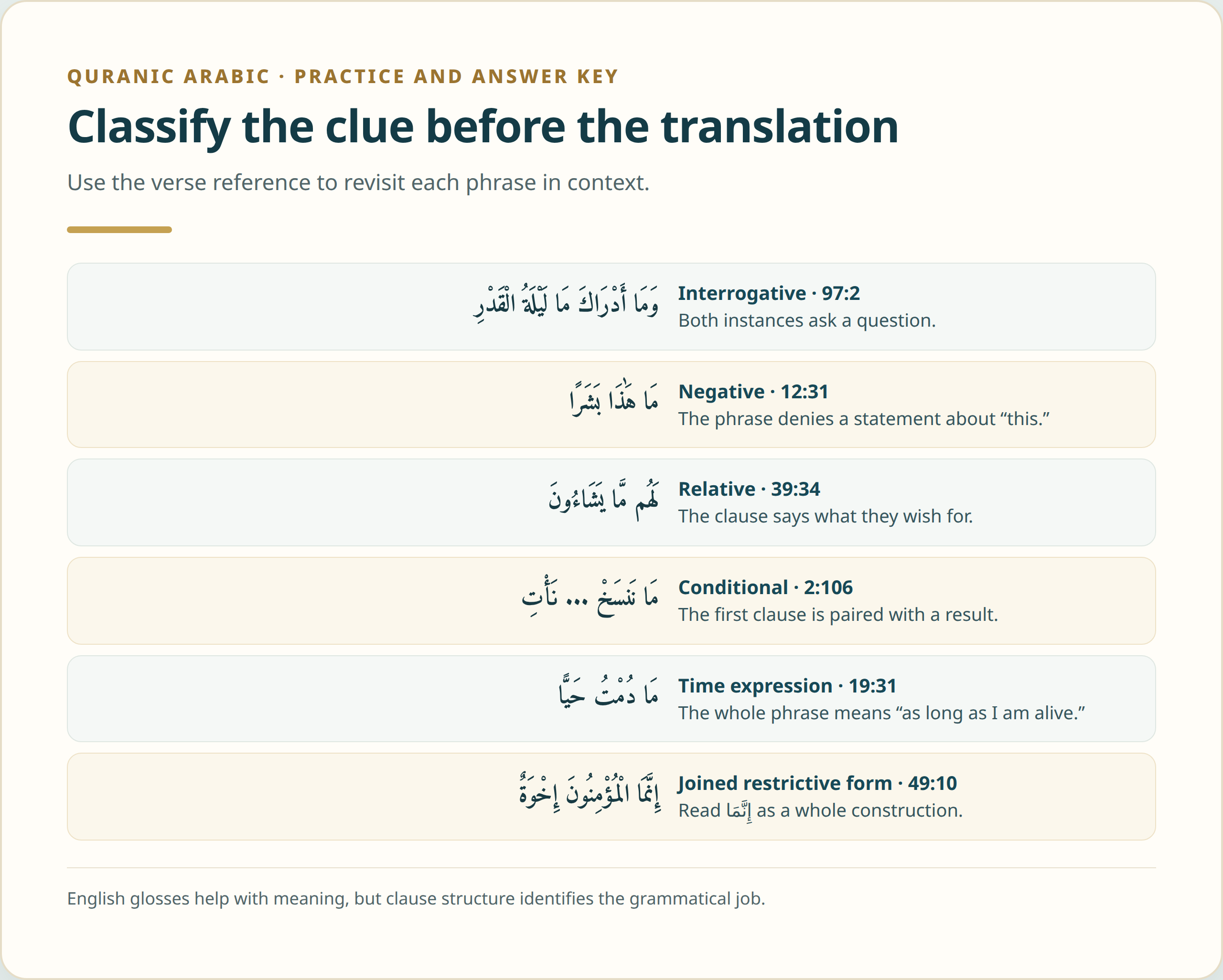
Try each phrase before reading the answer. Say what the surrounding structure is doing, then choose a grammatical label.
- وَمَا أَدْرَاكَ مَا لَيْلَةُ الْقَدْرِ (97:2): both occurrences are questions.
- مَا هَٰذَا بَشَرًا (12:31): a negative statement about “this.”
- لَهُم مَّا يَشَاءُونَ (39:34): a clause identifies what they wish for.
- مَا نَنسَخْ … نَأْتِ (2:106): a condition is followed by a result.
- مَا دُمْتُ حَيًّا (19:31): the phrase expresses duration.
- إِنَّمَا الْمُؤْمِنُونَ إِخْوَةٌ (49:10): read the joined restrictive form as a whole.
When you check your answers, notice that “what” can point to a question or a relative clause, while “whatever” can appear in both relative and conditional structures. The English gloss is helpful, but it does not decide the Arabic grammar by itself.
Use a repeatable method, not a guess
Keep a small notebook with three columns: the verse phrase, the clue you used, and the label your grammar reference gives it. Begin with clear examples, such as the question in 97:2, the negative statement in 12:31, the relative phrase in 39:34, and the condition in 2:106. Then compare a more advanced expression like ما دمت حيًّا. If two references use different labels, record the difference and ask a teacher; do not assume one translation proves the full parse.
To hear the Yusuf example in context, listen to this recitation of Surah Yusuf 12:30–42. The phrase مَا هَٰذَا بَشَرًا is heard around 1:23. Follow the Arabic text and notice how the negative ما sits inside a complete spoken sentence.
If you would like a teacher to help you parse Quranic Arabic examples step by step, you can book a free Quran and Arabic trial class and bring a verse or grammar question to discuss.