
Learning food and drinks in Arabic is easier when you learn words in useful groups and then put them into a short order. Start with everyday nouns such as خُبْز (khubz, bread), دَجَاج (dajāj, chicken), مَاء (māʾ, water), and قَهْوَة (qahwah, coffee). Then practise asking what is available, saying what you would like, and requesting the bill. This guide uses a clear Modern Standard Arabic (MSA) starting point, labels Egyptian examples separately, and builds toward a simple restaurant dialogue. If you are still collecting everyday expressions, Quranytime’s Arabic phrases guide offers a broader beginner reference.
Learn the register before you order
MSA is a clear starting point for reading and study, while restaurant speech often uses a local dialect. Neither is wrong, but label the form you learn. Michigan State University’s open textbook marks its restaurant vocabulary and dialogue as Egyptian Arabic, with عَايِز (ʿāyiz, “I want,” masculine) and عَايْزَة (ʿāyza, “I want,” feminine). We will start with MSA and keep Egyptian examples distinct.
Food and drinks in Arabic: a starter vocabulary
Learn a short list you can actually reuse. Say each Arabic word aloud, cover the English meaning, and try to recall it. The transliteration is a reading aid: ḥ represents a deeper “h” sound, kh is the sound in “Bach,” and ʿ marks the Arabic letter ʿayn. Pronunciation varies, so the Arabic script remains the most reliable form to learn.
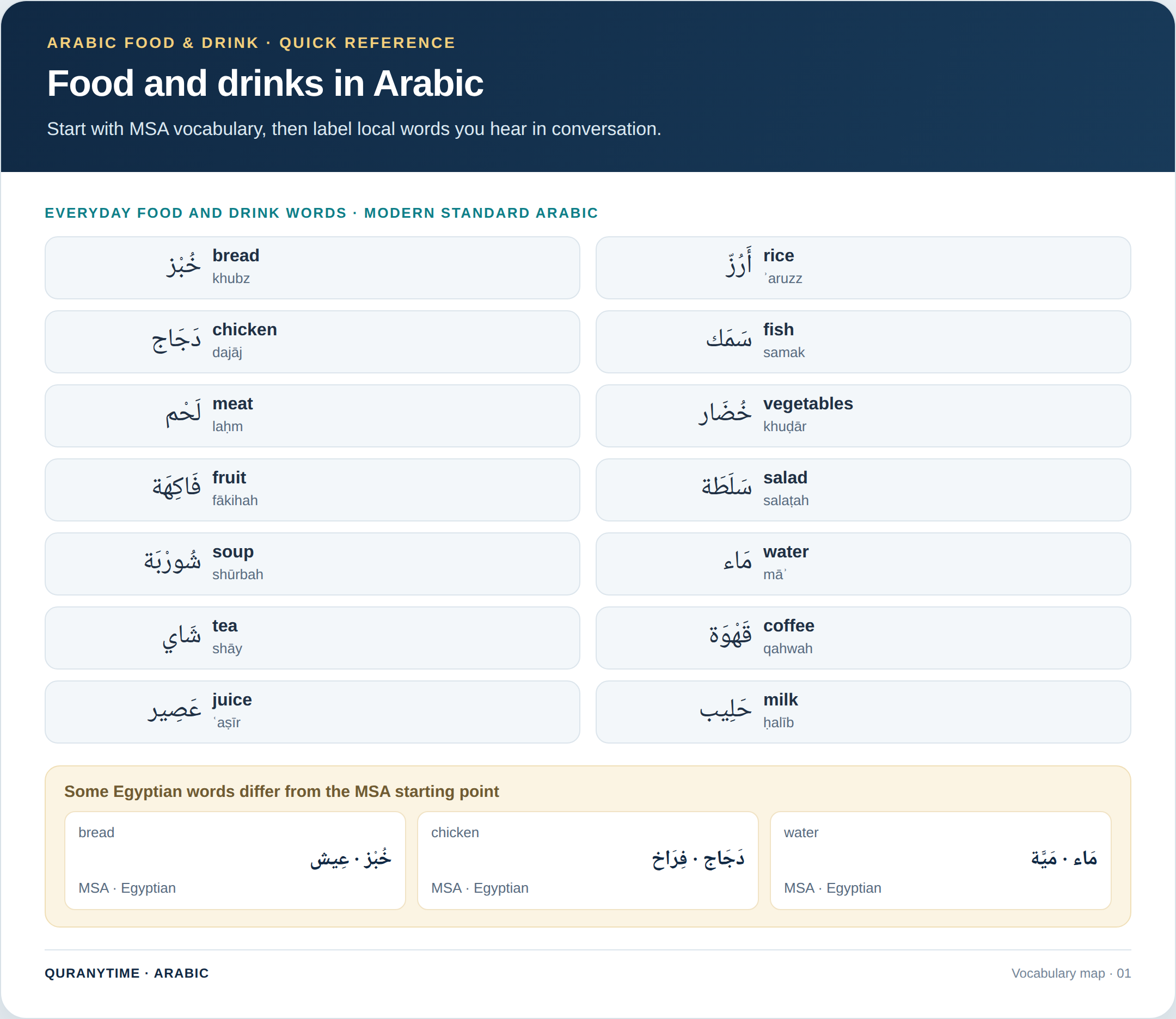
| Arabic | Pronunciation | Meaning |
|---|---|---|
| خُبْز | khubz | bread |
| أَرُزّ | ʾaruzz | rice |
| دَجَاج | dajāj | chicken |
| سَمَك | samak | fish |
| لَحْم | laḥm | meat |
| خُضَار | khuḍār | vegetables |
| فَاكِهَة | fākihah | fruit |
| سَلَطَة | salaṭah | salad |
| شُورْبَة | shūrbah | soup |
| مَاء | māʾ | water |
| شَاي | shāy | tea |
| قَهْوَة | qahwah | coffee |
| عَصِير | ʿaṣīr | juice |
| حَلِيب | ḥalīb | milk |
Turn isolated words into phrases: مَاءٌ بَارِدٌ (māʾun bāridun, cold water) and شُورْبَةٌ لَذِيذَةٌ (shūrbah laḏīḏah, tasty soup). Both show an adjective following its noun.
Menu words and the “the” in Arabic
A menu is قَائِمَةُ الطَّعَامِ (qāʾimat al-ṭaʿām, literally “the food list”). Other helpful menu headings are مُقَبِّلَات (muqabbilāt, appetizers), أَطْبَاقٌ رَئِيسِيَّةٌ (aṭbāqun raʾīsiyyah, main dishes), مَشْرُوبَات (mashrūbāt, drinks), and حَلَوِيَّات (ḥalawiyyāt, desserts). A waiter may be called نَادِل (nādil); the word for a bill or check is often حِسَاب (ḥisāb), though local wording varies.
Notice the article الـ (al-) in الطَّعَام (“the food”). It helps make a noun specific, as in “the menu” or “the dish.” A menu heading may omit some grammatical endings, so do not worry if a written sign looks simpler than a fully vocalized textbook example. Quranytime’s guide to definite and indefinite nouns explains the contrast in more detail.
To ask what a dish contains, you can say مَاذَا فِي هَذَا الطَّبَقِ؟ (māḏā fī hāḏā al-ṭabaqi?, What is in this dish?) or, more explicitly, هَلْ يَحْتَوِي هَذَا الطَّبَقُ عَلَى …؟ (hal yaḥtawī hāḏā al-ṭabaqu ʿalā …?, Does this dish contain …?). Fill the pause with a word you know, such as لَحْم (meat). For questions such as “what?”, “which?”, or “how much?”, review Quranytime’s Arabic question words.
Build a polite order with one simple frame
Use this pattern: أُرِيدُ + item + مِنْ فَضْلِكَ (urīdu + item + min faḍlika, I would like + item + please). For instance, أُرِيدُ قَهْوَةً، مِنْ فَضْلِكَ. means “I would like a coffee, please.” When speaking to a woman, the final address form is commonly written مِنْ فَضْلِكِ (min faḍliki); to a group, use مِنْ فَضْلِكُمْ (min faḍlikum). These are formal learning forms; in everyday speech, a local dialect may sound more natural.
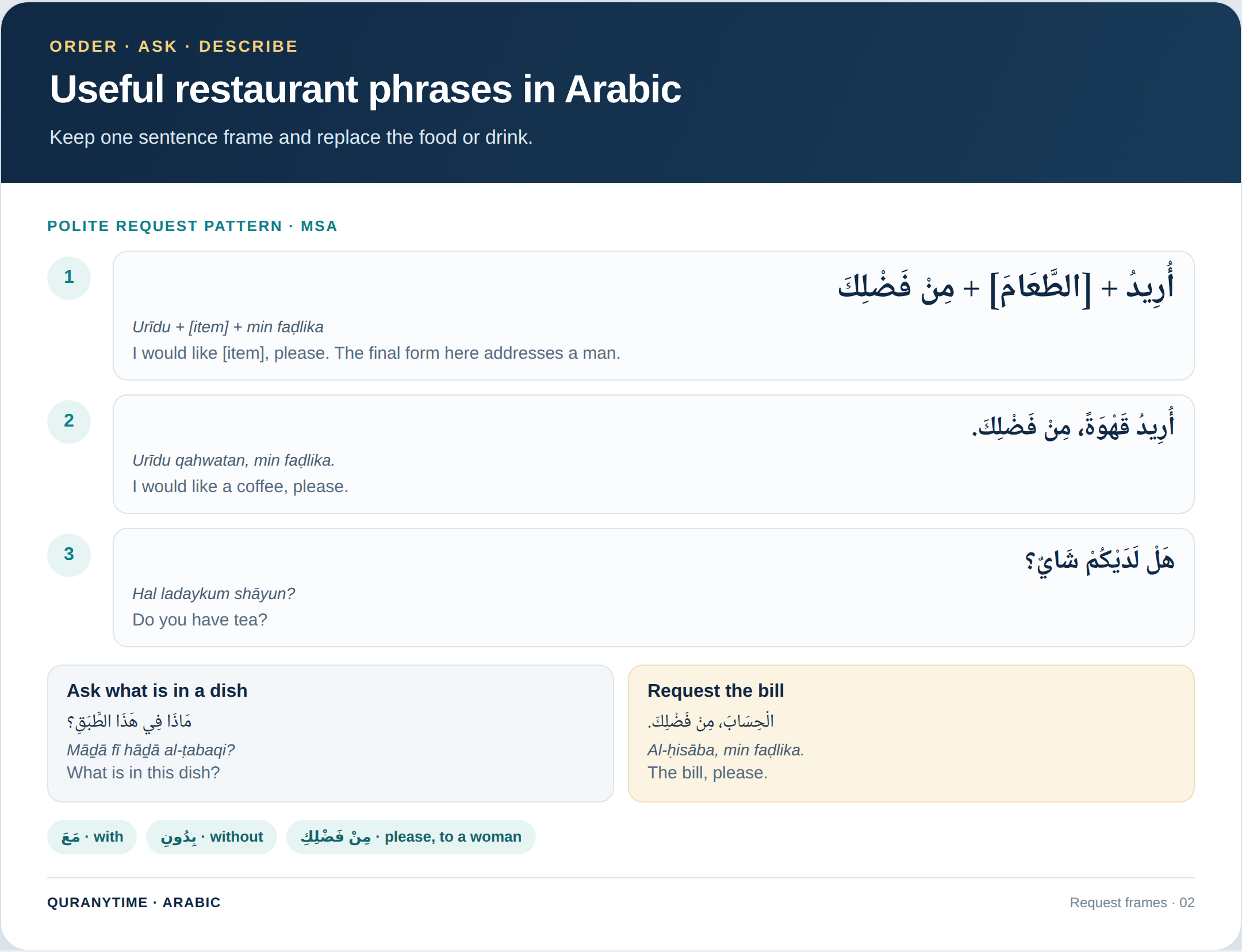
Other useful requests include هَلْ لَدَيْكُمْ شَايٌ؟ (hal ladaykum shāyun?, Do you have tea?), مَاءٌ بِدُونِ ثَلْجٍ، مِنْ فَضْلِكَ. (māʾun bidūni thaljin, min faḍlika, water without ice, please), and الْحِسَابَ، مِنْ فَضْلِكَ. (al-ḥisāba, min faḍlika, the bill, please). The word بِدُونِ means “without,” while مَعَ means “with”: قَهْوَةٌ مَعَ الْحَلِيبِ is coffee with milk. For a little more practice with words like “in,” “with,” and “to,” see the guide to Arabic prepositions.
If you want to say “my order,” use طَلَبِي (ṭalabī): the final ـي means “my.” The same suffix appears in قَهْوَتِي (qahwatī, my coffee). Quranytime’s lesson on attached possessive pronouns shows how these endings connect to nouns.
Describe food with matching adjectives
Arabic adjectives follow the noun and match its gender. مَاءٌ بَارِدٌ (māʾun bāridun, cold water) is masculine, while قَهْوَةٌ سَاخِنَةٌ (qahwatun sākhinatun, hot coffee) is feminine. Likewise, سَلَطَةٌ طَازَجَةٌ (salaṭatun ṭāzajatun) means fresh salad.
Useful descriptions include لَذِيذ (delicious), حُلْو (sweet), مَالِح (salty), سَاخِن (hot), and بَارِد (cold). “Hot” can refer to temperature or spicy food, depending on context. Quranytime’s adjective-agreement guide explains how the endings match.
For prices, ask كَمْ ثَمَنُ هَذَا؟ (kam thamanu hāḏā?, How much is this?). Number forms can change with the counted noun, so review the Arabic numbers guide for counting and prices.
Say what you like and make a simple request
أُحِبُّ … (uḥibbu …) means “I like …,” and أُفَضِّلُ … (ufaḍḍilu …) means “I prefer ….” For example, أُفَضِّلُ الشَّايَ means “I prefer tea.” To say “I do not eat meat,” use لَا آكُلُ اللَّحْمَ. Adapt requests with مَعَ (“with”) or بِدُونِ (“without”): شَايٌ بِدُونِ سُكَّرٍ (tea without sugar). Quranytime’s existing Arabic prepositions lesson explains these connecting words.
A short restaurant dialogue in Arabic
Read this MSA practice dialogue slowly, then swap in words from the table. It is a learning model, not a claim that every restaurant worker speaks in MSA. To practise greetings before ordering, see Quranytime’s Arabic greetings and introductions guide.
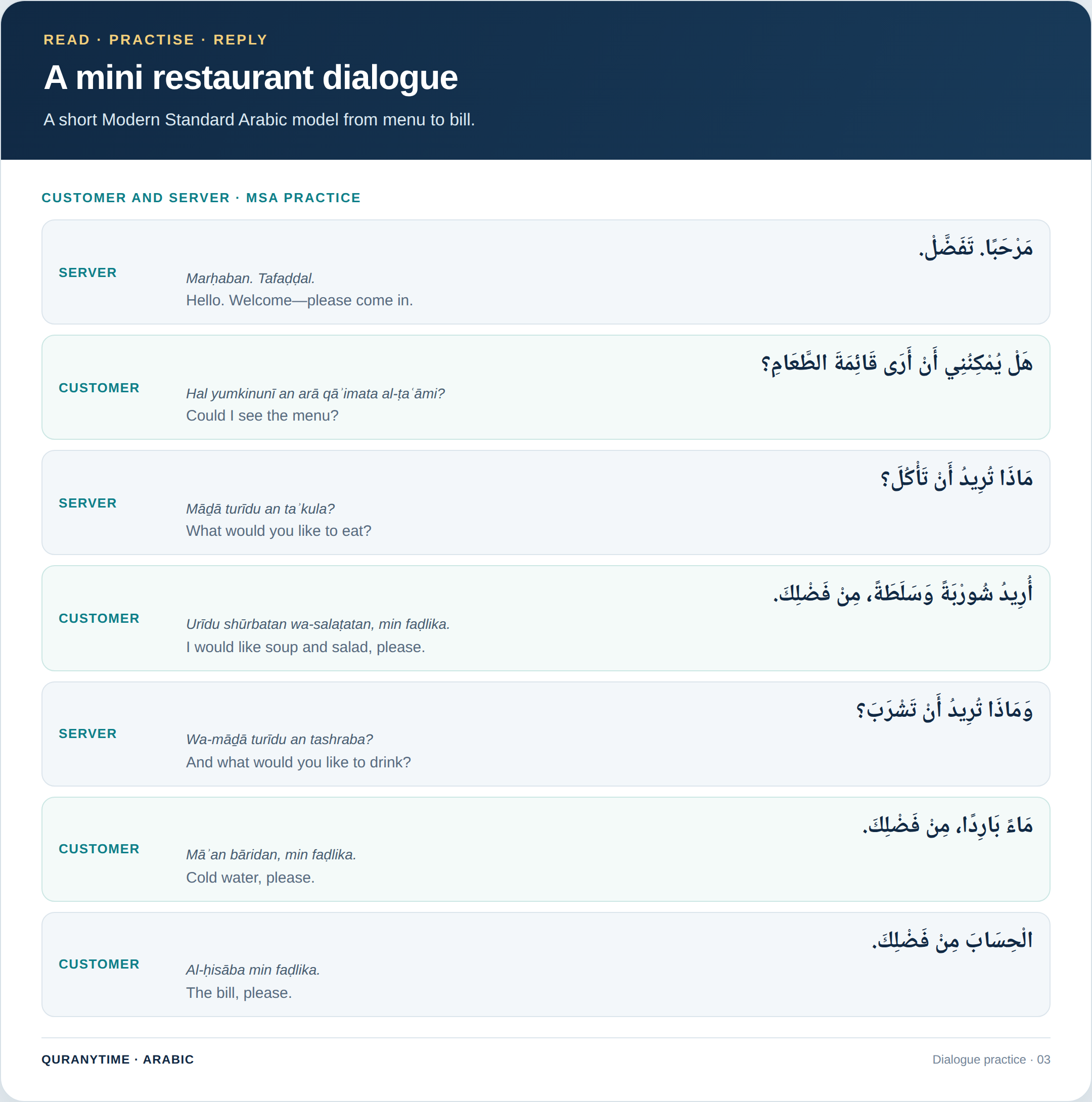
Server: مَرْحَبًا. تَفَضَّلْ.
Marḥaban. Tafaḍḍal.
Hello. Welcome—please come in.
Customer: هَلْ يُمْكِنُنِي أَنْ أَرَى قَائِمَةَ الطَّعَامِ؟
Hal yumkinunī an arā qāʾimata al-ṭaʿāmi?
Could I see the menu?
Server: تَفَضَّلْ. مَاذَا تُرِيدُ أَنْ تَأْكُلَ؟
Tafaḍḍal. Māḏā turīdu an taʾkula?
Here you are. What would you like to eat?
Customer: أُرِيدُ شُورْبَةً وَسَلَطَةً، مِنْ فَضْلِكَ.
Urīdu shūrbatan wa-salaṭatan, min faḍlika.
I would like soup and salad, please.
Server: وَمَاذَا تُرِيدُ أَنْ تَشْرَبَ؟
Wa-māḏā turīdu an tashraba?
And what would you like to drink?
Customer: مَاءً بَارِدًا، مِنْ فَضْلِكَ.
Māʾan bāridan, min faḍlika.
Cold water, please.
Server: هَلْ تُرِيدُ شَيْئًا آخَرَ؟
Hal turīdu shayʾan ākhar?
Would you like anything else?
Customer: لَا، شُكْرًا. الْحِسَابَ مِنْ فَضْلِكَ.
Lā, shukran. Al-ḥisāba min faḍlika.
No, thank you. The bill, please.
Notice how مَاذَا asks “what?”, أُرِيدُ states a request, and مِنْ فَضْلِكَ softens it. In a real conversation, the waiter may use a regional pronunciation or a different greeting, but the exchange still follows a clear order: greeting, menu, food, drink, and bill.
Practise with a four-step routine
- Pick five words. Choose two foods, one drink, and two taste or temperature words. Read the Arabic first, then check the transliteration.
- Build a request. Say أُرِيدُ … مِنْ فَضْلِكَ and replace the blank with a food or drink.
- Ask one follow-up. Try هَلْ لَدَيْكُمْ …؟ (“Do you have …?”) or مَاذَا فِي هَذَا الطَّبَقِ؟ (“What is in this dish?”).
- Role-play both sides. Read the dialogue once as the customer and once as the server. Then replace soup, salad, and water with different menu items.
The embed begins at 0:12 after the opening title card, as the friends plan lunch; jump to 2:07 for the restaurant scene with its menu, food, drinks, and bill.
One neutral university resource for further comparison is Michigan State University’s open textbook lesson on ordering food in Egyptian Arabic, which groups food-and-drink vocabulary with a restaurant dialogue and role-play. Keep its Egyptian forms distinct from the MSA examples above. This is the article’s only external source citation.
Common questions about food and drinks in Arabic
How do I say “food” in Arabic?
A common MSA word is طَعَام (ṭaʿām, food). You can also hear أَكْل (ʾakl, food/eating), depending on context and variety. A restaurant menu may use قَائِمَةُ الطَّعَامِ for “menu.”
How do I say “I would like” in Arabic?
Use أُرِيدُ (urīdu) as a clear MSA request frame, then add the item and مِنْ فَضْلِكَ (“please,” when addressing a man): أُرِيدُ شَايًا، مِنْ فَضْلِكَ. means “I would like tea, please.” Egyptian speakers may use a different everyday form, such as عَايِز or عَايْزَة, depending on the speaker.
Are MSA food words the same as everyday dialect words?
Not always. For example, MSA commonly uses خُبْز for bread, while the Michigan State University Egyptian Arabic lesson uses عِيش. MSA مَاء is “water,” while the Egyptian lesson gives مَيَّة. Learn the form you need and label the variety clearly; local words and pronunciation can differ.
Start with a small vocabulary set, practise one request frame, and listen to a complete exchange. If you want an instructor to assess your Arabic reading or Quran-learning goals, you can book a free Quran and Arabic trial class.