

Arabic exception in Quranic Arabic becomes much easier when you stop treating illā (إلا) as a word that always produces one automatic ending. In the Quran, illā introduces an exception or restriction, but the visible case of the following word depends on the sentence around it. The most useful habit is to identify the structure first and read the ending second.
This article focuses on illā, the most common exception tool in Quranic Arabic. It gives you a practical way to distinguish four closely related patterns, using verified Quran examples rather than translation guesses. The aim is grammar parsing: it is not a tafsir lesson, and it is not an instruction to alter a familiar recitation.
What an exception structure contains
An exception normally has three parts. The exception tool is illā. The larger set or group from which something is excluded is called the al-mustathnā minhu. The excluded item is the al-mustathnā. For example, in “the students arrived except one,” “the students” names the main set and “one” is the excluded item.
In connected (muttaṣil) exception, the excluded item and the named set are the same kind of thing. In disconnected (munqaṭiʿ) exception, they are not the same kind. A third label, mufarragh, is used when the main set is not named. That missing-set pattern is especially important because illā does not impose a special case ending there; the word after it takes the ordinary syntactic role required by the clause.
For a concise technical reference, see the Quranic Arabic Corpus guide to exception grammar. Its terminology helps connect the classroom labels to actual Quranic parsing.
The beginner-friendly decision sequence
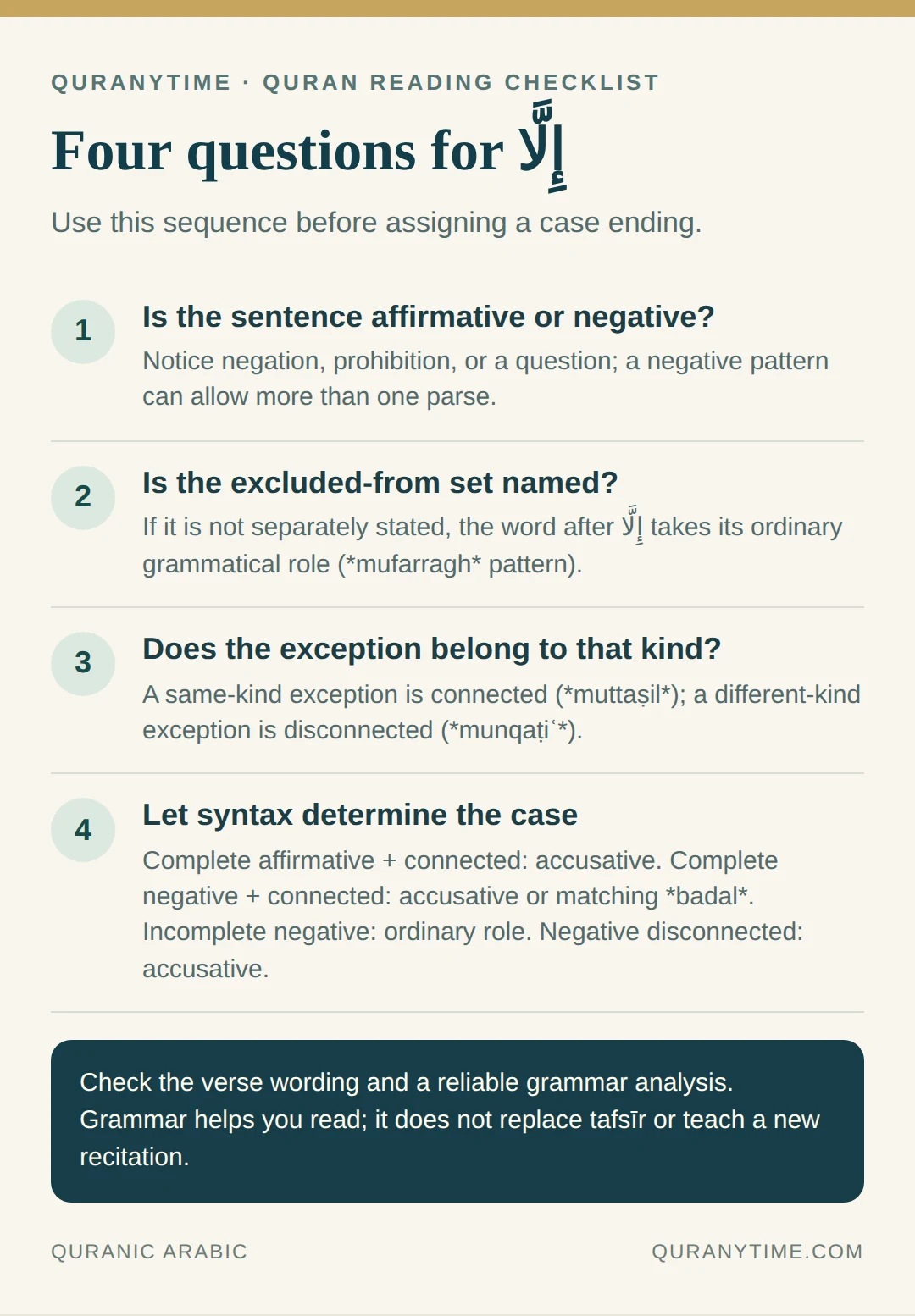
When you meet illā, ask these questions in order:
- Is the sentence affirmative or negative? Look for a negator such as mā, while remembering that the whole clause—not an isolated word—matters.
- Is the main set explicitly stated before illā? If it is absent, you may be looking at a mufarragh construction.
- Is the excluded item the same kind as that set? If yes, the exception is connected; if no, it is disconnected.
- What case does the syntax require? Only now decide whether the noun is accusative, nominative, genitive, or otherwise governed by its ordinary role.
This sequence prevents a common error: memorising “after illā comes fatḥah.” A final fatḥah is not universal. Case endings also vary with word type, grammatical position, definiteness, and the particular reading. Translations cannot establish a case rule because an English “except” does not show Arabic inflection.
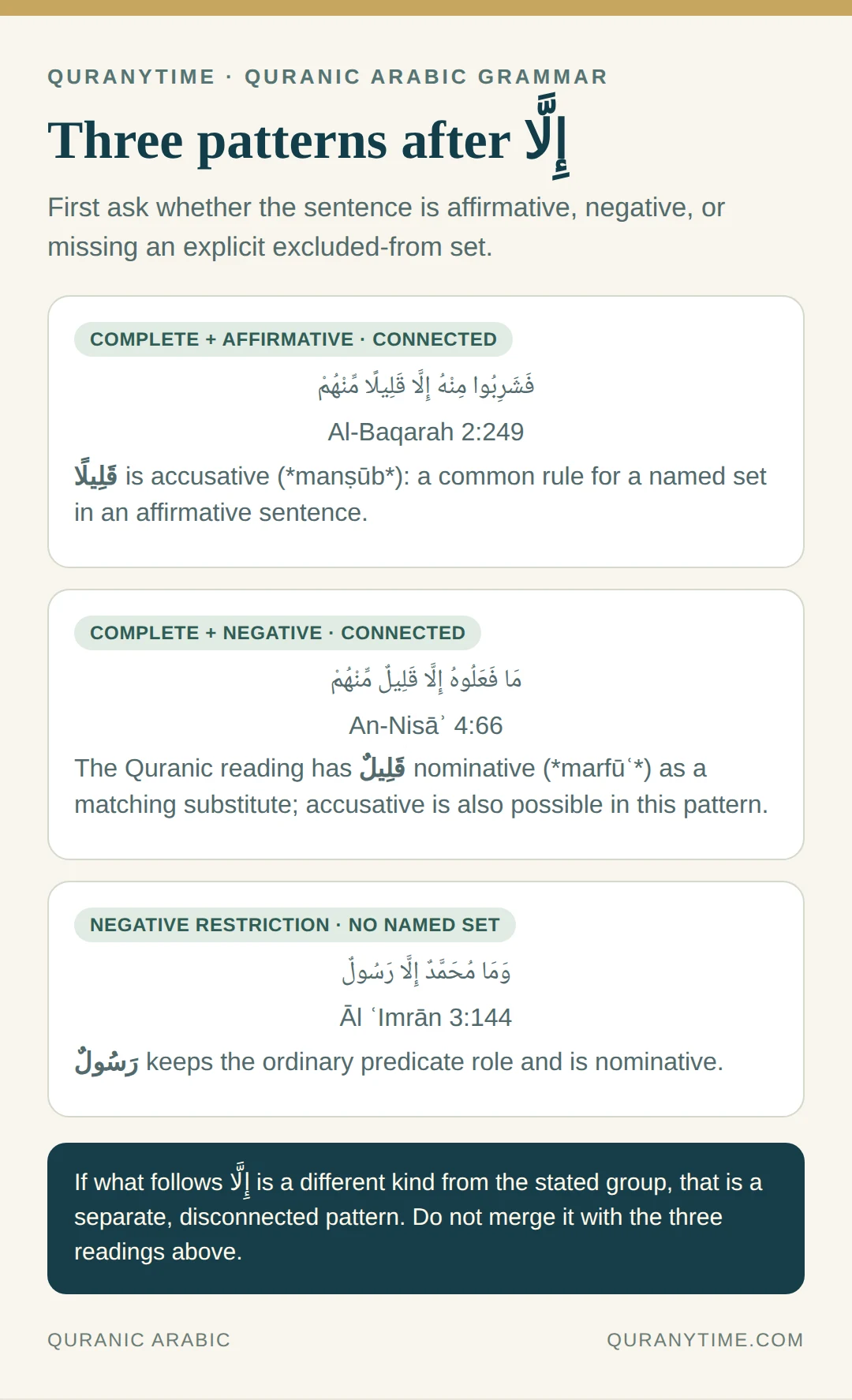
Pattern 1: affirmative, complete, and connected
In a positive sentence where the main set is named and the excluded item belongs to that set, the excluded noun is accusative. This is the clearest of the Arabic exception structures in the Quran.
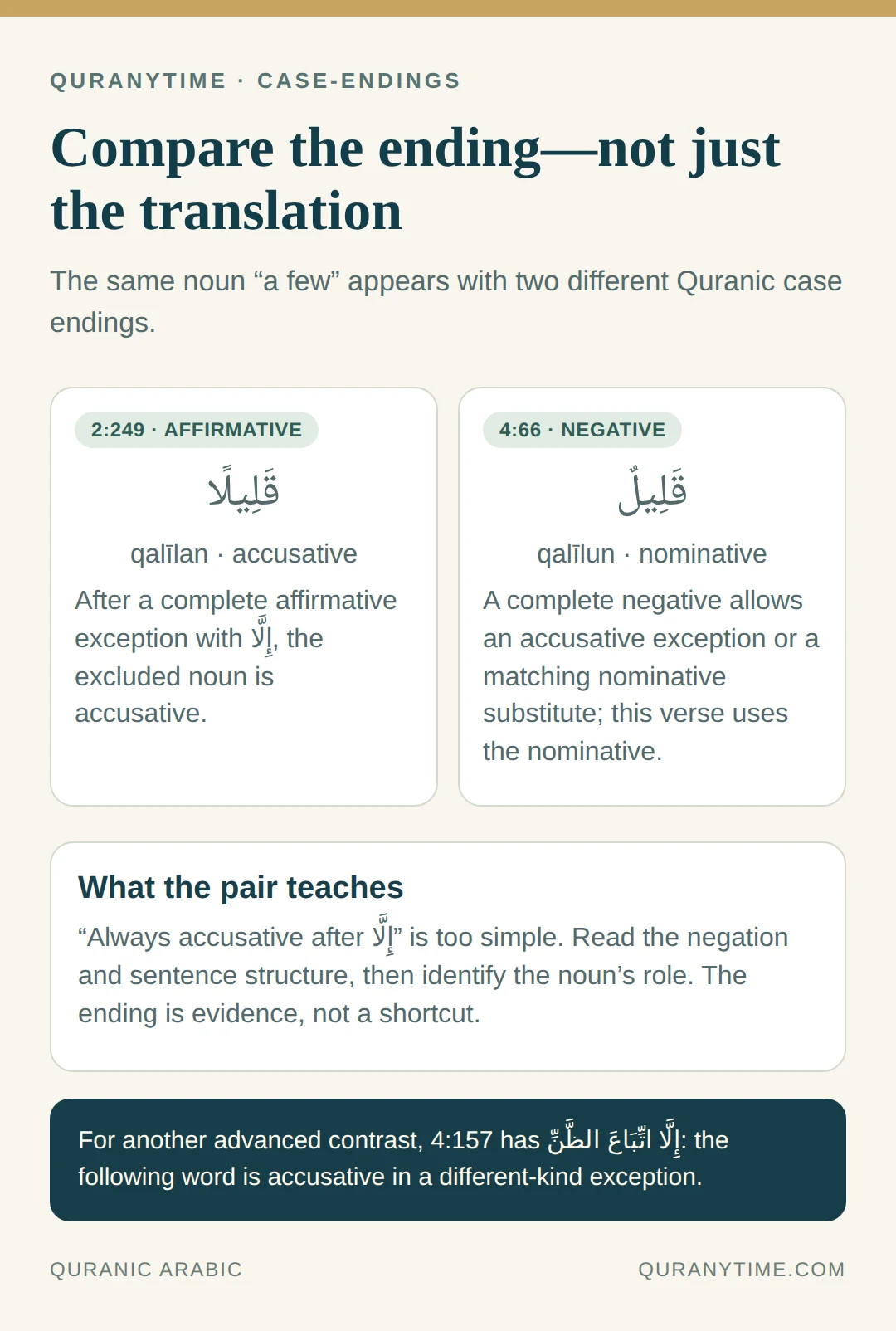
Quran 2:249 gives the example: فَشَرِبُوا مِنْهُ إِلَّا قَلِيلًا مِّنْهُمْ (fa-sharibū minhu illā qalīlan minhum), “so they drank from it except a few of them.” The group is understood in the surrounding clause, and قَلِيلًا (qalīlan) is accusative in a positive complete connected exception. Here, the ending reflects the exception construction rather than a free-standing translation choice.
Notice the meaning of “same kind”: those who drank and the few who did not drink are people in the same larger frame. The phrase مِنْهُمْ further identifies the few as belonging to that group, but it does not remove the need to parse the exception.
Pattern 2: negative, complete, and connected
A negative sentence can still name its main set and keep the excluded item connected to it. In that setting, Arabic permits more than one analysis: the excluded noun may be accusative as an exception, or it may be a badal (apposition/substitute) matching the grammatical role of the word it explains.
Quran 4:66 reads: مَا فَعَلُوهُ إِلَّا قَلِيلٌ مِّنْهُمْ (mā faʿalūhu illā qalīlun minhum), “they would not have done it except a few of them.” In the Quranic reading, قَلِيلٌ (qalīlun) is nominative. That nominative ending fits the badal/apposition analysis in this complete negative connected construction, even though an accusative exception analysis is also recognised by the grammar.
This is why a student should not force the positive pattern onto every negative sentence. The negative particle opens a different set of grammatical possibilities. Compare the visible endings, but always compare the structure first.
Pattern 3: negative, complete, and disconnected
A disconnected exception also follows a negative sentence, but the excluded expression is not the same kind as the named set. In this pattern, the excluded item is accusative. It is a useful advanced distinction because the sentence may look like an ordinary “nothing except…” statement while the two nouns or concepts belong to different categories.
Quran 4:157 says: مَا لَهُم بِهِ مِنْ عِلْمٍ إِلَّا اتِّبَاعَ الظَّنِّ. The Corpus parsing identifies اتِّبَاعَ as accusative and treats the exception as disconnected: “knowledge” is not the same kind as “following conjecture.” This is a grammar observation, not an invitation to build a tafsir argument from the case ending. The practical point is simply to notice that a negative clause can contain a disconnected exception and that its accusative form is explained by that structure.
Pattern 4: negative restriction with no named set
In the mufarragh pattern, the main set is omitted. Because there is no named group for illā to govern as an exception, the following word takes the case required by its own role in the sentence.
Quran 3:144 reads: وَمَا مُحَمَّدٌ إِلَّا رَسُولٌ (wa-mā Muḥammadun illā rasūlun), “Muhammad is only a messenger.” رَسُولٌ (rasūlun) is nominative because it functions as the predicate of the nominal sentence, not because illā automatically makes it nominative. This is the negative restrictive pattern often called mufarragh.
A helpful paraphrase is “nothing more than” or “only,” but do not let the English paraphrase replace the Arabic analysis. The question is: what would this word’s syntactic role be if the restrictive frame were set aside? That ordinary role controls its case.
A small worked comparison
Place the four patterns side by side. In 2:249, positive plus a complete named set plus connected meaning gives accusative قَلِيلًا. In 4:66, negative plus a complete named set plus connected meaning allows either an accusative exception analysis or a matching badal; the transmitted Quranic form is nominative قَلِيلٌ. In 4:157, negative plus a disconnected relationship gives accusative اتِّبَاعَ. In 3:144, negative plus no named set gives a mufarragh construction, so nominative رَسُولٌ follows its predicate role.
For more background on how nominal predicates behave, review this guide to Arabic nominal sentences in Quranic reading. Related governing systems can also be compared with inna and its sisters and kāna and its sisters.
Where this fits in broader Quranic Arabic study
Exception grammar is one part of a larger parsing toolkit. If a passive form changes how you identify the subject, use this explanation of the Arabic passive voice in Quranic reading. If noun number affects an ending, the lesson on Arabic dual nouns can help. Demonstratives can also signal agreement and grammatical position; see the guide to Arabic demonstrative pronouns.
Short video review
Use the slides-only review to practise the decision sequence visually: polarity, named set, connectedness, and case. The video is for parsing awareness; it does not replace a teacher or tell you to change your recitation.
FAQs
Does illā always make the next word accusative?
No. A positive complete connected exception commonly has an accusative excluded noun, but a negative complete connected construction can allow a badal that matches its role. A mufarragh construction follows ordinary syntax, and disconnected exceptions after a negative sentence are accusative. The whole sentence decides.
Can I determine the case from an English translation?
No. Translation may show the broad relation, but it cannot show Arabic case, agreement, or the difference between exception and apposition. Also, case endings vary by word type, and a final fatḥah is not a universal signal.
Are ghayr and siwā parsed exactly like illā?
Other exception forms, including ghayr and siwā, deserve separate study. Do not assume their case rule is identical to illā; their own grammatical behaviour must be analysed in context.
A practical next step
Take one verse containing illā and write four notes: polarity, whether the main set is named, whether the two sides are the same kind, and the ordinary syntactic role of the excluded expression. Then check the ending against that analysis without changing how you recite. For guided practice with a teacher, you can book a free trial class and work through Quranic examples step by step.