
Rhetorical Questions in Quranic Arabic: How to Read Them
A question mark does not always mean that a speaker is waiting for missing information. In Quranic Arabic, a verse may use an interrogative form to ask a genuine question, invite reflection, prompt recognition, challenge an assumption, or make a point through a question. Learning to read rhetorical questions in Quranic Arabic means separating the grammatical form from the likely communicative purpose—and checking the surrounding text before choosing a label.
This guide offers a careful reading routine, not a tafsir ruling. The goal is to notice evidence in the Arabic, the complete ayah, and nearby verses, while being honest when that evidence does not settle the interpretation. Close searches such as “questions that do not ask for information” or “question function in the Quran” belong to this same learner task; they are not separate topics.
A question has a form and a function
First identify the form. An initial hamza (أَ) or هَلْ can introduce a yes-or-no question, while words such as مَنْ, مَا, كَيْفَ, أَيْنَ, and مَتَىٰ ask about a person, thing, manner, place, or time. A question-word guide can help you identify the Arabic forms that introduce questions. That is a useful first step, but it does not yet tell you what the whole sentence is doing.
Compare two everyday situations. “Where is the key?” may request information because the speaker does not know. “Do you really think a bridge can stand without supports?” may be shaped as a question but function as a challenge or correction. In both cases the form is interrogative; the likely purpose depends on who is speaking, what is already known, and what follows.
Do not treat “rhetorical” as a magic label for every Quranic question. A verse may leave a genuine question open, make an assertion through a question, invite attention, or combine more than one effect. Translators may preserve the question form with a question mark even where a reader hears a strong prompt or affirmation. Punctuation and a single particle are clues, not proof of function.
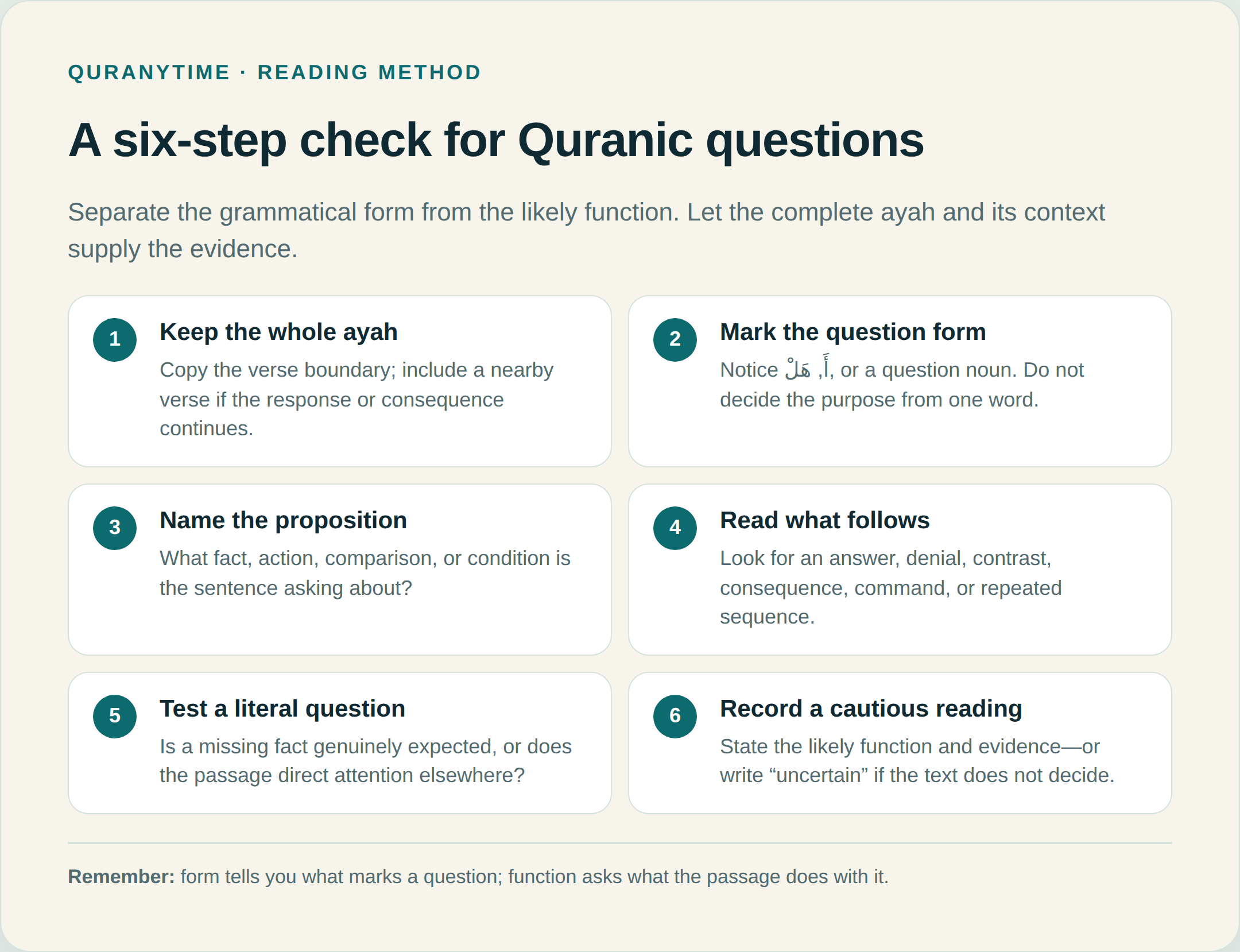
A six-step, text-first check
- Copy the whole ayah. Keep the verse boundary and the wording in front of you. Do not classify a clipped phrase from memory.
- Mark the interrogative trigger. Note the hamza, هَلْ, or question noun, but do not decide the purpose yet. The same word can occur in different sentence structures.
- State the proposition being questioned. Parse enough of the sentence to know what is being asked, denied, compared, or brought to the reader’s attention. A sentence-parsing routine can help you locate the clause and its main parts.
- Read the nearby context. Look for an answer, a consequence, a contrast, a list, a command, or an immediately following statement. Conjunctions such as وَ can carry a sequence forward, so a guide to Quranic conjunctions may help you follow how the surrounding clauses relate.
- Test the information-seeking reading. Is the speaker asking for an unknown fact, or does the passage supply the answer, make the point evident, or direct attention to something? Keep both readings open until the evidence favors one.
- Write a cautious conclusion. Label the most plausible function—information-seeking, confirmation, challenge, rebuke, or reflection—and note the clues. If the verse and its immediate context do not decide, write “uncertain” rather than forcing a category.
These steps are a study aid, not a substitute for careful grammar. For broader practice in following evidence across a passage, see Quranic Arabic reading-comprehension exercises. If an interrogative appears beside a negative particle, keep the jobs distinct; the Quranic Arabic negation guide can help you inspect negation without assuming it determines rhetorical force.
Worked example: Al-Ghashiyah 88:17–20
Surah Al-Ghashiyah 88:17 begins with أَفَلَا يَنظُرُونَ إِلَى ٱلْإِبِلِ كَيْفَ خُلِقَتْ, followed in verses 18–20 by a sequence directing attention to the sky, mountains, and earth. The wording includes the question-like opening أفلا (“do they not…?”) and repeated كيف (“how?”). Read the full sequence rather than treating the first interrogative token as a complete interpretation.
What can a learner observe directly? The passage asks whether its audience looks at the camel and how it was created, then continues with وَإِلَى and another كيف clause for each item. The sequence itself is a clue: it directs attention to a series of created things. A reader may describe the question as a prompt to observe or reflect, but should keep that description tied to the passage and avoid presenting it as a complete tafsir. The Quranic Arabic Corpus documents grammatical structures and interrogative uses of hamza; its Quranic grammar documentation can help check the grammatical entry point, while the passage context still matters for discussing communicative effect.
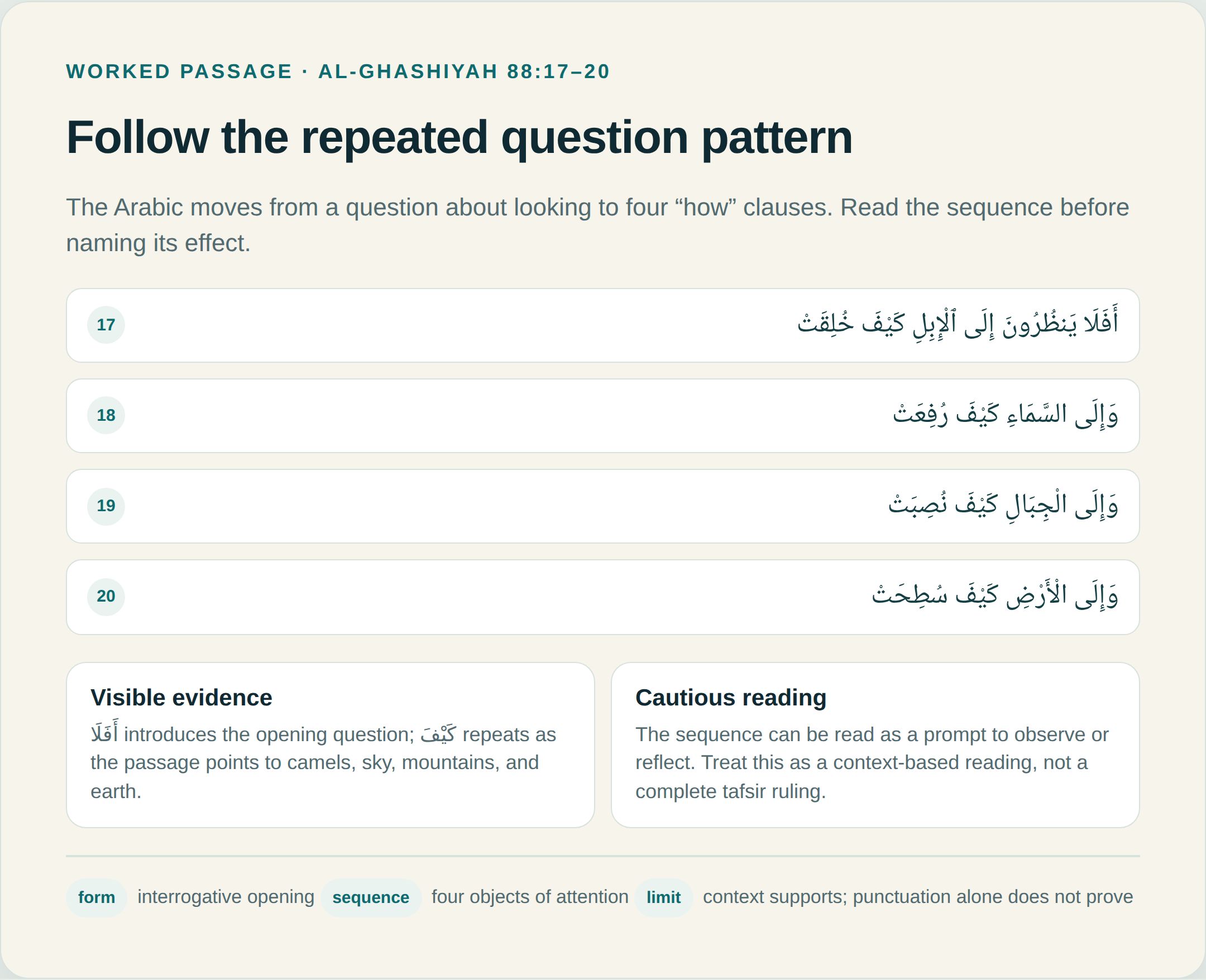
Try writing two notes side by side. In the first, record only what the Arabic form and clause structure show. In the second, describe the likely effect suggested by the sequence and its context. If your second note goes beyond what the words and nearby verses establish, mark it as an interpretation rather than a grammatical fact.
What kind of evidence supports a label?
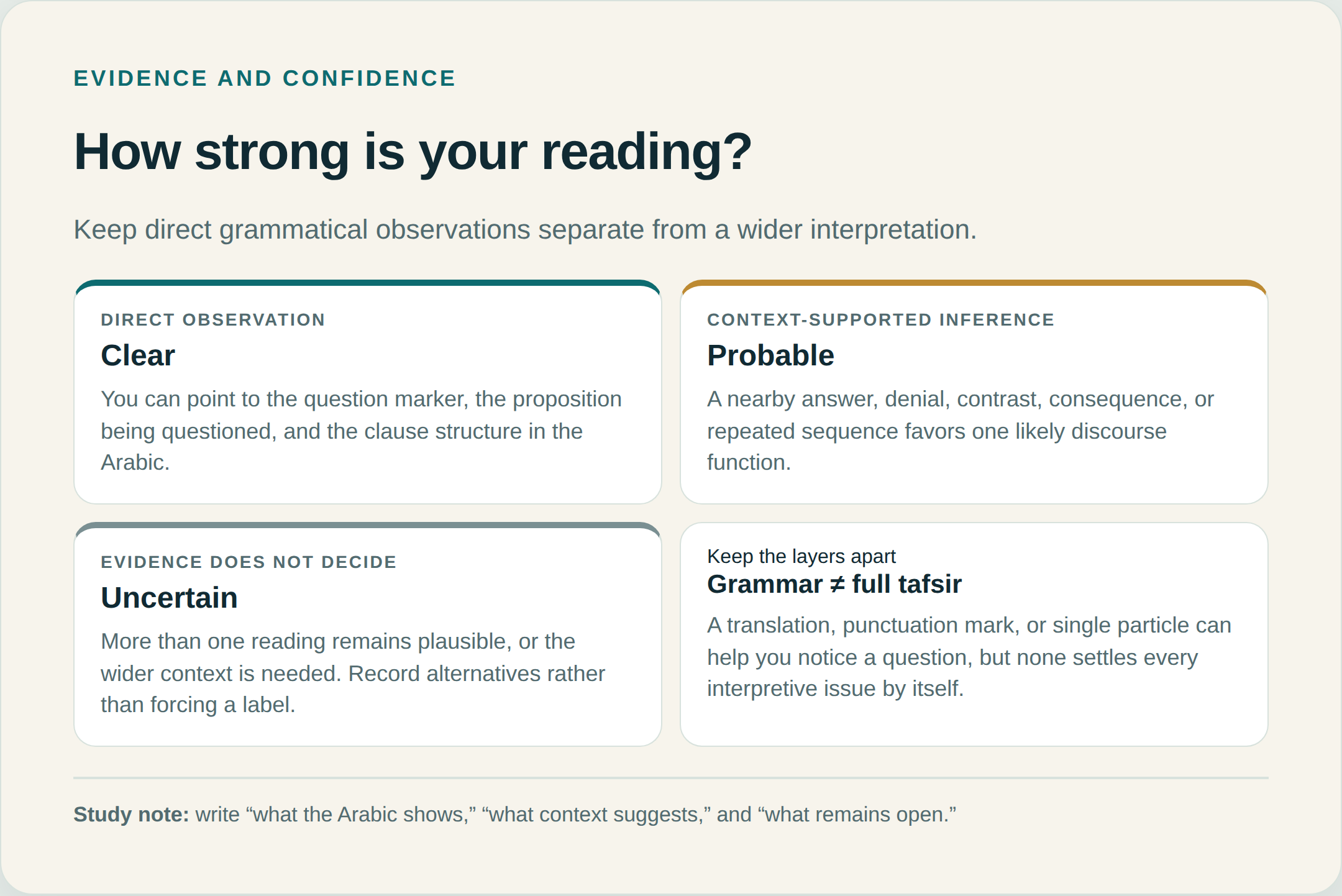
Evidence can be stronger or weaker. A question followed by an answer from another speaker often supports an information-seeking reading. A question followed by an obvious response, a denial, or a sequence of observations may support confirmation, challenge, or reflection. A translator’s choice can be useful to compare, but it should not replace the Arabic or settle a debate by itself. Where a verse has several plausible readings, preserve that uncertainty.
Keep three layers separate: (1) the interrogative form, (2) the grammatical proposition or question target, and (3) the likely discourse function. Students who already know question words can revisit how مَا is read in Quranic Arabic or review the vocative particle يَا as a contrasting form: identifying a particle’s grammatical role is different from deciding what a complete sentence communicates. Likewise, the restriction introduced by إِنَّمَا is a separate construction, not a rhetorical question merely because it emphasizes a point.
Common mistakes to avoid
- Stopping at the question word. Knowing that أَ or هَلْ introduces a question does not tell you whether an answer is expected. Check the entire sentence and the next line.
- Equating every question with a rhetorical question. Some questions request information. Do not assign a figurative function simply because a verse is religious or familiar.
- Using English punctuation as the deciding test. A question mark reflects the translator’s rendering; it does not by itself explain the Arabic discourse function.
- Reading negation as the whole meaning. In a form such as أفلا, inspect the question and negative element together. One grammatical label should not replace analysis of the complete construction.
- Claiming more than the evidence supports. A learner can describe a question as inviting attention without announcing a definitive theological purpose. When you cannot decide, record what is clear and leave the rest open.
A useful note might read: “Form: interrogative hamza with لا. Target: looking at the camel and how it was created. Context: followed by parallel references to sky, mountains, and earth. Likely effect: prompt to observe; this is a reading note, not a complete tafsir.” That format separates what you see from what you infer and makes later review easier.
Before you label the effect, try two paraphrases. First, write the most literal information question the Arabic could express. Second, rewrite it as a possible prompt, challenge, or affirmation and cite the neighboring words that support that reading. Ask which version better explains what the passage does next. If both remain plausible, keep the alternatives in your notes; the exercise exposes assumptions rather than forcing one answer.
Listen to the passage, then return to the text
The short video below recites Al-Ghashiyah 88:17–20 with Arabic text and an English rendering on screen. Listen for the repeated question pattern and follow how the verse sequence moves from camels to the sky, mountains, and earth. Use the audio and visuals as a listening aid; verify wording and interpretation from the text and context rather than relying on a video caption alone.
A quick practice routine
Choose one Quranic question you are studying. Copy the full ayah and one surrounding verse if needed. Underline the interrogative form, write the proposition in plain language, and note what follows. Then answer three questions: Is a new fact requested? Does the passage provide or imply an answer? What evidence supports a different function? End with a confidence label—clear, probable, or unresolved—and give one reason for that label.
If your goal is broader Arabic and Quran reading feedback, you can book a free Quran and Arabic trial class and bring a passage you are studying. A teacher can help you distinguish the visible grammar from a wider interpretation while you continue building your reading skills.
The safest habit is simple: identify the form, read the complete thought, check the surrounding evidence, and label your conclusion carefully. That is how a reader can study rhetorical questions in Quranic Arabic without turning a punctuation mark or one particle into a verdict.