

Saktah in Tajweed is a very brief interruption of the voice without taking a new breath. In the Hafs reading through the al-Shatibiyyah route, learners commonly study four required saktah positions when they continue the recitation. The skill is not simply “stopping for a moment”: you must keep the connection, avoid inhaling, and restart the next sound cleanly.
This guide explains where the four pauses occur, how they differ from a normal waqf, and how to practise them without rushing. It stays within the commonly taught Hafs scope; reading routes and qira’at can differ, so ask a qualified teacher to confirm your route and model the exact timing.
What does saktah mean?
As-sakt means briefly interrupting the sound and then resuming immediately, without breathing. Think of it as a tiny silence inside a connected phrase. The tongue, lips, and breath support should remain ready for the next word, but there is no fresh inhalation between the two parts. The pause is very brief; it is not an exact one-second count.
A full stop is different. With an ordinary permissible stop, the voice ends, you may breathe, and you begin again as a new phrase. Our guide to Quran waqf signs and their meanings can help you review that wider stopping system. Saktah, by contrast, preserves the intended connection. If you take a breath, you have made a stop rather than saktah.
The four commonly taught Hafs saktah positions
When connecting the recitation in Hafs ‘an ‘Asim via the Shatibiyyah route, the four familiar locations are listed below. One is at an ayah boundary (Al-Kahf 18:1–2); the other three are within an ayah. Al-Kahf and Ya-Sin also illustrate why a full permitted stop is different from continuing with a saktah. In every case, the learner should hear a tiny silence and then continue without a new breath.
1. Al-Kahf 18:1–2: عِوَجًا ۜ قَيِّمًا
At the end of Al-Kahf 18:1 and the beginning of 18:2, the connected wording is often written as ‘iwajan qayyiman. A saktah here lets you acknowledge the slight break while still joining the two ayahs. If you make a full permitted stop at the end of 18:1 and breathe, that is waqf—not saktah. On restarting, begin the next phrase as a new start according to your teacher’s guidance.
2. Ya-Sin 36:52: مَرْقَدِنَا ۜ هَٰذَا
In Ya-Sin, the saktah is after marqadina and before hatha—not after ba‘athana. When continuing through the marked boundary, pause the sound very briefly without a new breath, then release hatha. If you make a full permitted stop after marqadina, that is waqf rather than saktah.
3. Al-Qiyamah 75:27: وَقِيلَ مَنْ ۜ رَاقٍ
At Al-Qiyamah 75:27, the pause occurs between man and raq. When the two words are joined without this pause, a noon sakin followed by ra could be heard as an idgham-type meeting. The saktah keeps the words distinct for this prescribed reading. Pause the voice, do not breathe, and then pronounce the ra clearly. This point is inside the ayah, so do not treat it as an ayah-end stop.
4. Al-Mutaffifin 83:14: بَلْ ۜ رَانَ عَلَىٰ قُلُوبِهِمْ
At Al-Mutaffifin 83:14, the pause falls between bal and rana. Here it separates a lam sakin from the following ra, preventing the sounds from merging as though they were one continuous meeting. Keep the lam audible, make the very brief breathless silence, and then continue with ra. Like the previous example, this saktah is within an ayah rather than at its end.
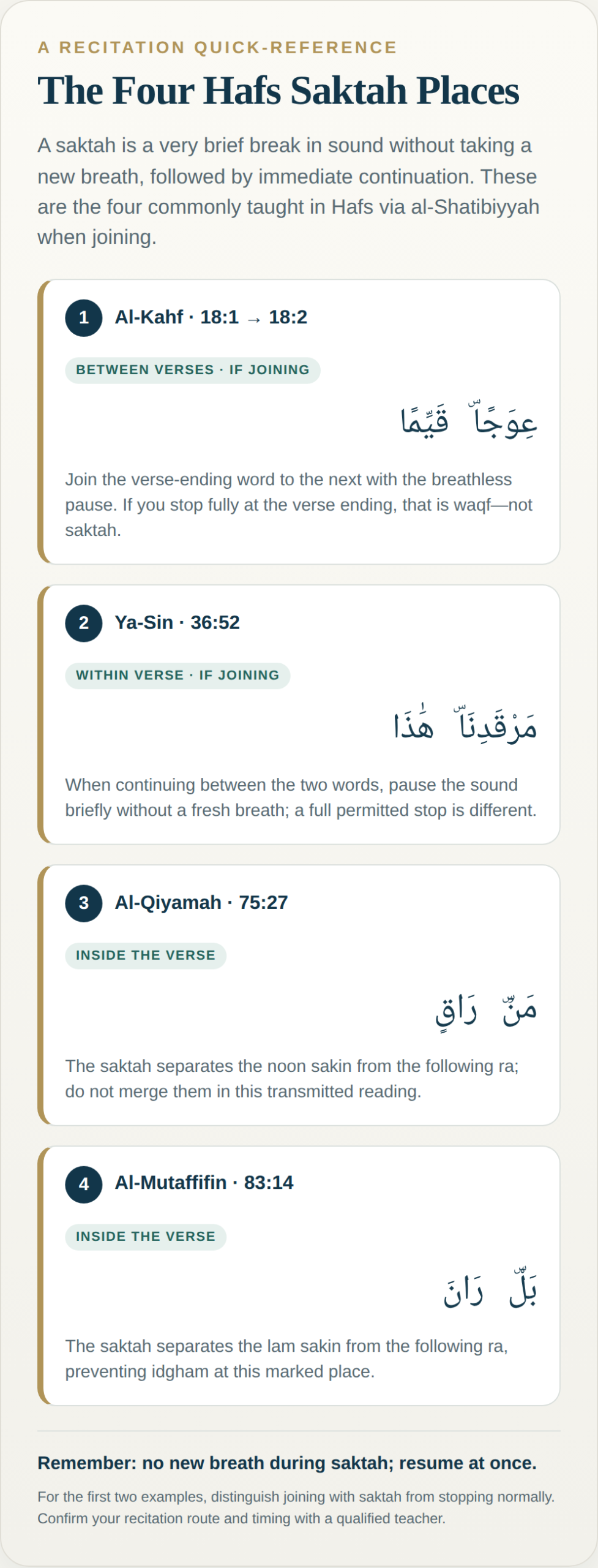
The card above is a quick visual reminder of the four references and the key join-versus-stop distinction. Use it for orientation, not as a substitute for listening to a qualified teacher. For a broader overview of articulation and rules, see the Tajweed rules chart and our Tajweed rules in the Quran guide.
How to decide: join with saktah or stop normally
- Identify the route. Confirm with your teacher that you are practising Hafs ‘an ‘Asim through the al-Shatibiyyah route and that this four-position lesson applies to your assigned reading.
- Find the marked meeting. Locate one of the four references rather than adding a pause wherever a phrase feels difficult.
- Choose the performance. If you continue across the location, use saktah: stop the voice very briefly, take no breath, and resume. If you end the phrase and breathe, call it a full stop and follow your teacher’s restart instruction.
- Protect the next sound. Prepare the first letter after the silence before you stop the voice. This prevents a hesitant restart or an accidental extra vowel.
- Check the meaning and flow. Do not stretch the silence for dramatic effect. Saktah is a controlled recitation detail, not a general punctuation mark.
A low-stress practice loop
Start with one location, preferably one your teacher has already recited for you. Read the surrounding words slowly two or three times while keeping the breath comfortable. On the next attempt, connect the phrase and insert only a tiny silence. Do not count seconds; instead, aim for “voice stops, no breath, voice resumes.” Then record one natural-speed attempt and one slower attempt.
Play the recording back immediately. Ask three questions: Did I inhale? Did the pause become a full stop? Did the first sound after the silence remain clear? A Quran audio repeat practice routine can give you a short loop for listening and repeating. Between lessons, use the steps in how to practise Tajweed at home rather than practising for a long, tiring session.
Once one location feels stable, add a second. Keep the Al-Kahf ayah-boundary example distinct from the three within-ayah examples so your mind learns both contexts. If your reading becomes tense, shorten the session. Smooth, accurate joining is more useful than many hurried repetitions. Our advice on building Quran reading fluency without rushing applies especially well here.
Common mistakes and simple corrections
- Taking a breath: This turns saktah into a full stop. Exhale comfortably before the phrase and do not inhale in the silence.
- Holding the pause too long: A dramatic gap can sound like a new sentence. Keep it very brief and let a teacher model the timing.
- Applying saktah everywhere: These are four specific positions in the stated Hafs route, not a permission to pause at every difficult word.
- Dropping the final consonant: At Al-Qiyamah and Al-Mutaffifin, make the separating function audible; do not blur the noon or lam into the following ra.
- Confusing a marked stop with a saktah: Review the difference with the izhar explanation and ask why the pause is prescribed in these examples.
- Practising without feedback: Keep a Quran recitation mistake log and note the location, breath, timing, and restart. Then use recording for Quran teacher feedback to get a modelled correction.
One specialist explanation of the rule is available in AboutTajweed’s explanation of as-sakt, the breathless pause. Use it alongside a qualified instructor, especially if your teacher has assigned a different riwayah or route.
Summary
Saktah is a very brief, breathless interruption that keeps the recitation connected. In the commonly taught Hafs route via al-Shatibiyyah, the four positions are Al-Kahf 18:1–2, Ya-Sin 36:52, Al-Qiyamah 75:27, and Al-Mutaffifin 83:14. Al-Kahf’s saktah is at an ayah boundary; the other three are within ayahs. At Al-Kahf and Ya-Sin, distinguish a connected saktah from a full permitted stop. Practise one location at a time, never inhale during the pause, and distinguish it from a full waqf with a breath.
Frequently asked questions
Is saktah the same as waqf?
No. Saktah is a very brief silence without breathing while you continue. Waqf is a full stop that may include a breath and a deliberate restart.
How many seconds should saktah last?
There is no exact one-second instruction here. It should be very brief and breathless. Let a qualified teacher demonstrate the timing for your route.
Are these four points identical in every qira’ah?
No. This article deliberately describes the four commonly taught positions for Hafs ‘an ‘Asim via the al-Shatibiyyah route when continuing. Other readings or routes may have different details.
Can I stop and breathe at the first two locations?
If a full permitted stop is made, it is waqf rather than saktah. Follow your teacher’s guidance for where to stop and how to restart.
What should I do if I cannot hear the difference?
Use a short listen-repeat-record cycle and ask a qualified teacher to model the contrast. Save both your question and the correction in a mistake log, then practise only that one location until the join feels relaxed.