
When Arabic reading feels difficult, it is tempting to stop at every unfamiliar word and translate the whole passage line by line. That can help at first, but it often hides the most useful skill: noticing how words and ideas connect. This guide to Arabic reading comprehension for beginners uses a short Quranic passage to show a repeatable way to read for meaning, find evidence, and check your understanding without guessing.
The same routine works with simple Modern Standard Arabic stories, signs, and classroom texts. For Quran study, read and recite accurately, use a reliable translation to check your understanding, and ask a qualified teacher or tafsīr for deeper interpretation. A comprehension exercise is a learning aid, not a substitute for religious explanation.
What does Arabic reading comprehension mean?
Comprehension is more than recognizing letters or saying a word aloud. You are comprehending when you can identify the main idea, see which phrase gives a reason or exception, connect a pronoun to its referent, and point to the words that support your answer. You do not have to know every word before you can understand the shape of a short passage.
If you are still learning how letters join inside a word, review Arabic letter forms in words. If vowel marks are missing, this guide to reading Arabic without vowels can help you avoid treating every unmarked word as a guess. These building blocks make comprehension practice less overwhelming.
A three-pass method for Arabic reading practice
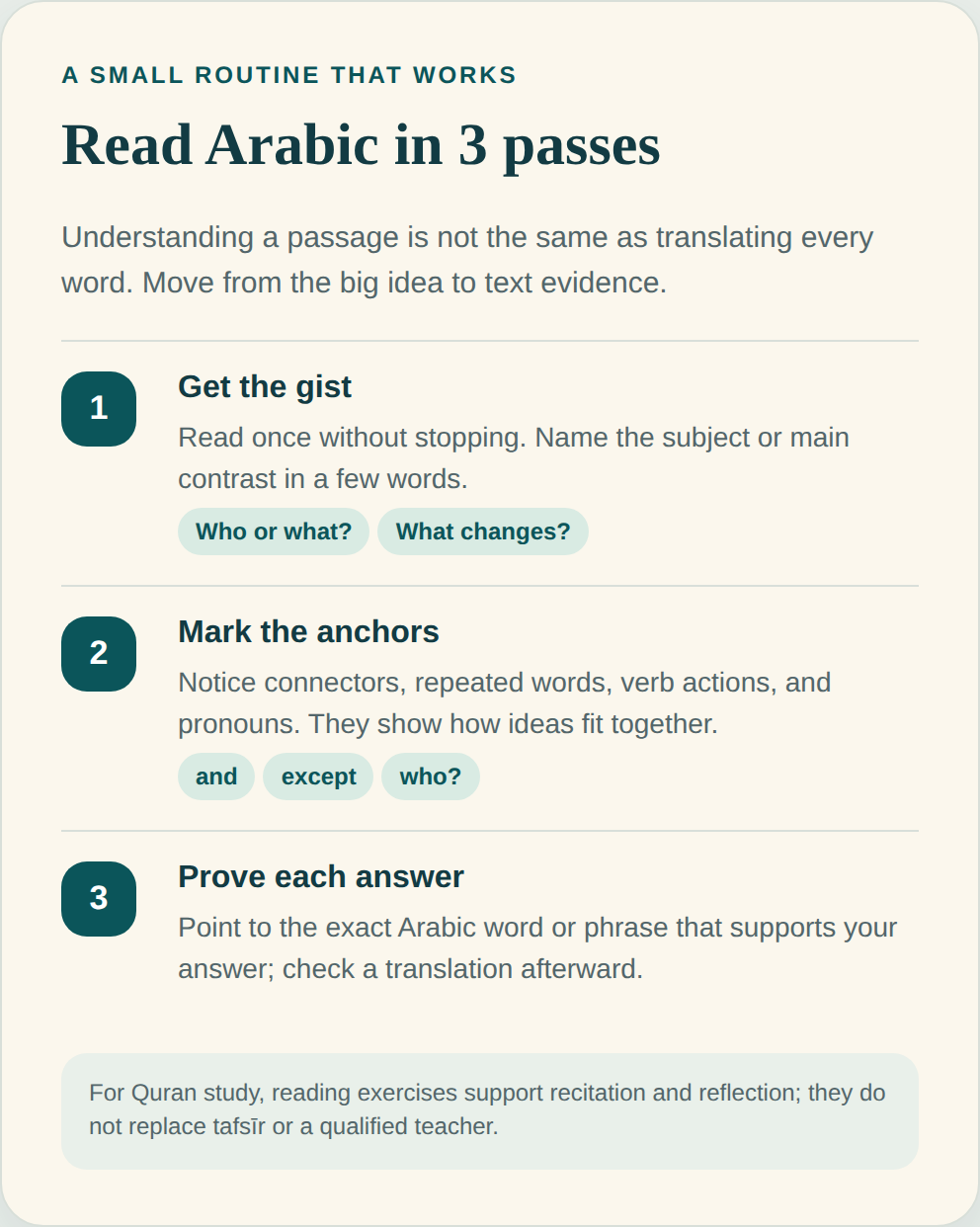
Use one short passage and read it three times, with a different goal each time. Keep a pencil or notes app ready, but do not turn the first pass into a dictionary exercise.
Pass 1: read for the gist
Read the whole passage once at a comfortable pace. Ask a broad question: Who or what is this about? Is the text describing, instructing, contrasting, or listing? Write a five-word summary in English if that helps. Do not stop to search every unknown item; mark only a word that blocks the main idea.
Pass 2: mark the anchors
On a second read, circle connectors such as وَ (and) or إِلَّا (except), underline action words, and box repeated phrases. Look for attached pronouns and ask what they refer to. A short review of Arabic pronouns for Quranic reading may help when a suffix or pronoun is doing more work than an English translation makes obvious.
Pass 3: answer from evidence
Ask two or three questions that can be answered from the text. For every answer, point to the exact Arabic word or phrase that proves it. If you cannot find evidence, reread the surrounding phrase rather than inventing a meaning. Arabic question words such as “who?”, “what?”, and “where?” can help you make simple, focused questions for practice.
Practice with a short Quranic passage: Surah Al-Asr
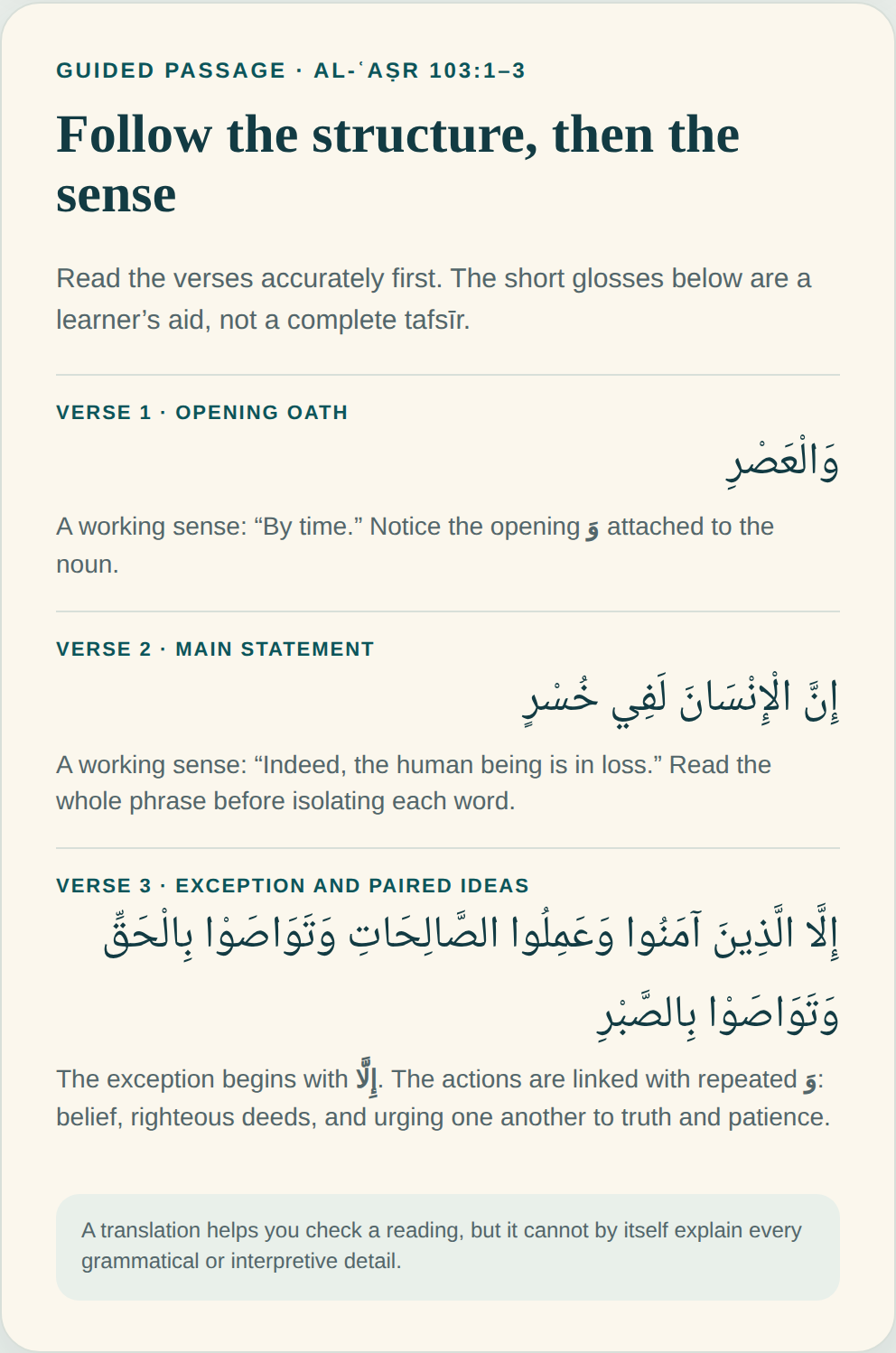
Surah Al-Asr is only three verses, so it is useful for noticing how a short text can move from an opening statement to a main claim and then to an exception with connected actions. First, read the Arabic carefully. If you need to locate the chapter or check its reference, use the Quran surah index.
وَالْعَصْرِ
إِنَّ الْإِنْسَانَ لَفِي خُسْرٍ
إِلَّا الَّذِينَ آمَنُوا وَعَمِلُوا الصَّالِحَاتِ وَتَوَاصَوْا بِالْحَقِّ وَتَوَاصَوْا بِالصَّبْرِ
A working sense—not a complete tafsīr: “By time. Indeed, the human being is in loss—except those who believe, do righteous deeds, and urge one another toward truth and patience.” English translations differ in wording; use a translation as a check, not as a word-for-word map of Arabic syntax.
Notice how the connectors work
In the first verse, the attached وَ begins an oath, often rendered “By time”; it is not simply an English “and.” In the final verse, إِلَّا (“except”) signals that a group is being distinguished from the preceding statement. Then the coordinating وَ joins a series of actions. Repetition is a cue: it helps you see that the passage is building a connected list rather than presenting unrelated words.
The phrase آمَنُوا وَعَمِلُوا pairs belief with action; the repeated وَتَوَاصَوْا introduces the shared exhortations. The final prepositional phrases name what is urged: بِالْحَقِّ and بِالصَّبْرِ. For beginners, it is enough to identify the structure and support an answer with the text. Detailed grammar and interpretive questions deserve a teacher or tafsīr, not an improvised one-word gloss.
For a general language-learning yardstick, the Council of Europe’s CEFR grid describes A1 reading as understanding familiar words and very simple sentences, and A2 reading as handling very short, simple texts and finding predictable information. That is a useful guide to text length and task difficulty—not a Quran-specific standard. See the Council of Europe’s English CEFR self-assessment grid.
Choose a passage that fits your current reading level
For everyday MSA, begin with two to four short sentences, mostly familiar vocabulary, and perhaps one new connector. A text with an unfamiliar word in every phrase is too dense for a first comprehension drill; shorten it or preview a small set of key words. Fully vowelled text can help you focus on meaning while you are still learning how letters and word endings work. Later, repeat the same kind of exercise with fewer vowel marks. With Quranic text, do not judge difficulty by an A1 or A2 label alone: recitation skill, vocabulary, grammar, and interpretive depth are different things. Keep the Arabic exact, use a reliable translation as a check, and take deeper questions to a teacher or tafsīr. Progress is visible when you can identify the topic and support a simple answer without translating every word.
Listen after your first read
Once you have made your own first attempt, listen to a clear recitation while following the Arabic. Notice where each verse ends, how the sounds join, and which repeated words you can now recognize. Listening supports reading, but do not rely on sound alone to answer a meaning question. This Arabic listening practice routine offers a simple way to combine focused listening with a short daily review.
Try four evidence-based comprehension questions
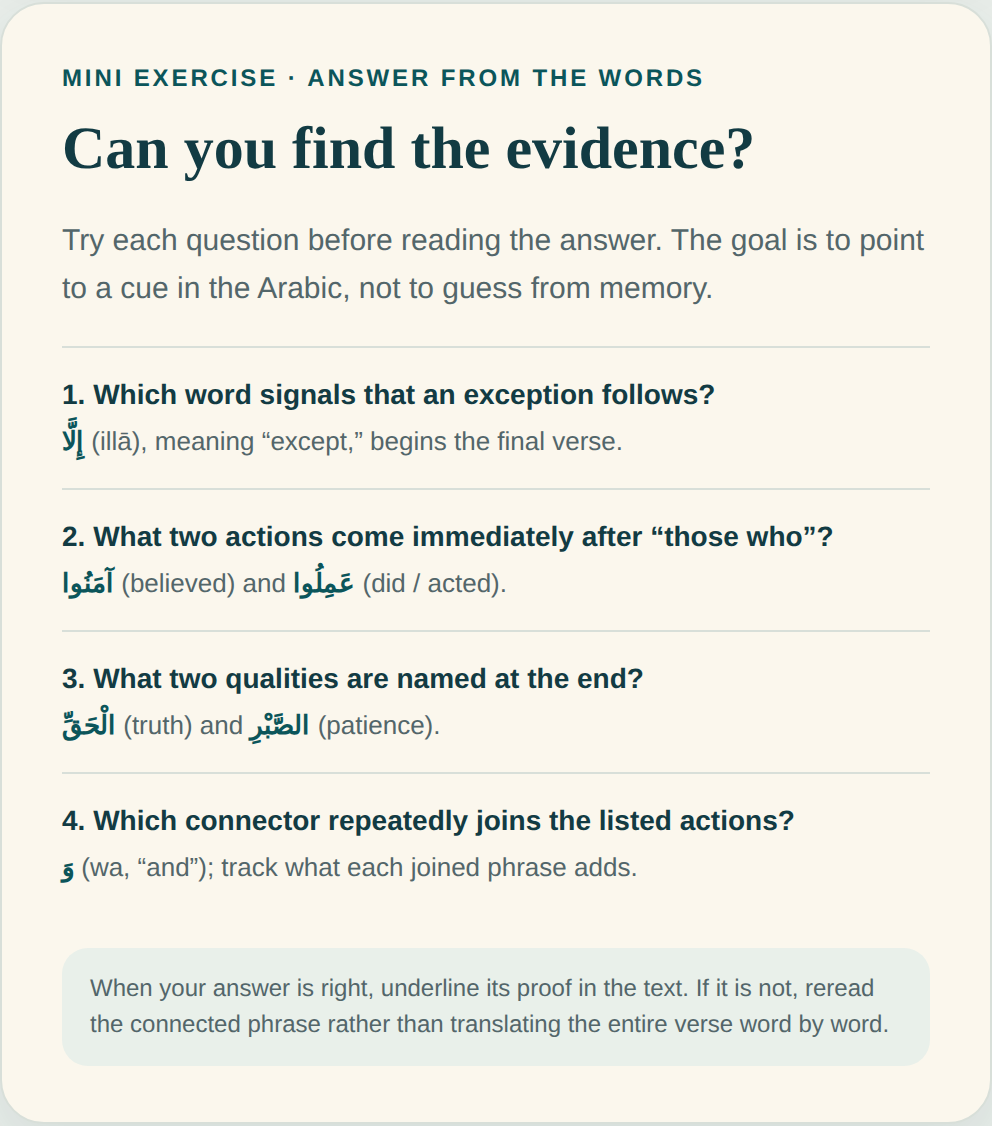
Cover the working sense above and answer these questions from the Arabic. Then uncover the meaning and check whether your evidence supports your answer. The goal is not to memorize an English sentence; it is to connect a question to a visible cue.
- Which word tells you that an exception follows?
- What two actions come immediately after “those who”?
- Which two qualities are named at the end of the passage?
- Which connector repeatedly joins the actions?
Answer key: 1) إِلَّا. 2) آمَنُوا and عَمِلُوا. 3) الْحَقِّ and الصَّبْرِ. 4) وَ, the coordinating “and” in the connected actions. After checking, try to explain the passage’s structure in one sentence without claiming to give its full interpretation.
Common mistakes that slow down Arabic comprehension
Translating every word before reading the sentence. This fragments the passage. Read a complete phrase first, then investigate only the words that change the main idea.
Assuming a familiar-looking root gives the whole meaning. A root is a clue, but a word’s form, attachment, and context matter. Review the grammar in this guide to studying a Quran verse word by word without losing the surrounding meaning.
Using a translation as the only answer key. Translations help you check a reading, but they may phrase a line differently and do not show every grammatical relationship. For a balanced study habit, learn how to choose a Quran translation for Arabic learners and compare meaning with the Arabic itself.
Confusing recitation with comprehension. Accurate pronunciation matters, but understanding also asks how a connector, pronoun, or repeated phrase shapes the message. Read the passage, listen, and then return to the text.
A 10-minute routine you can repeat
Choose a few lines at a level you can read without constant dictionary use. Spend two minutes reading once for the gist; three minutes marking connectors, repeated words, and actions; three minutes answering two text-based questions; and two minutes checking a translation or listening again. Write down only two new words, then revisit them the next day. If you are unsure whether a passage is suitable, start with fully vowelled text and work gradually toward unvowelled material.
With Quranic passages, keep recitation accuracy, language practice, and tafsīr in their proper places. If you want help choosing an appropriate passage and checking your reading method, book a free Quran and Arabic trial class. A teacher can help you build confidence while keeping the exercise suited to your current reading level.