
إنما (Innama) in Quranic Arabic: Reading Restriction and Emphasis
If you are studying innama in Quranic Arabic, the safest starting point is not a single English gloss but a question: what exactly is being limited or singled out in this sentence? إِنَّمَا is commonly rendered “only,” yet a translation can hide whether the focus is a response, a person, an action, or the whole proposition. Read the surrounding clause first, then decide what “only” is doing.
This guide gives you a repeatable way to read the construction in a Quranic verse. It uses Quran 24:51 as a worked example, distinguishes إنما from similar-looking grammar, and keeps grammatical observation separate from tafsir. It is a reading method, not a claim that one particle supplies every detail of a verse’s meaning.
What إنما signals—and what it cannot decide alone
In traditional Arabic grammar, إِنَّمَا is treated as a restrictive construction: it narrows a claim by setting something apart from relevant alternatives. In English, “only” is often a useful first approximation. Depending on the sentence, however, the point of restriction may be the action, the person performing it, a description, a response, or the proposition as a whole. The particle does not tell you which focus to choose simply by being near a particular word.
That is why translating each occurrence mechanically as “only” can mislead. A translator may choose “only,” “just,” or a sentence that conveys restriction without repeating that word. The translation depends on the clause and its context. Before settling on English, identify what the sentence says and what alternative the construction rules out. If you cannot name that alternative, keep your translation provisional rather than forcing an interpretation.
A broader overview of emphasis particles in the Quran can help you compare related signals. This article stays narrower: it focuses on إنما and teaches a way to locate its scope in a complete ayah.
A five-question routine for reading إنما
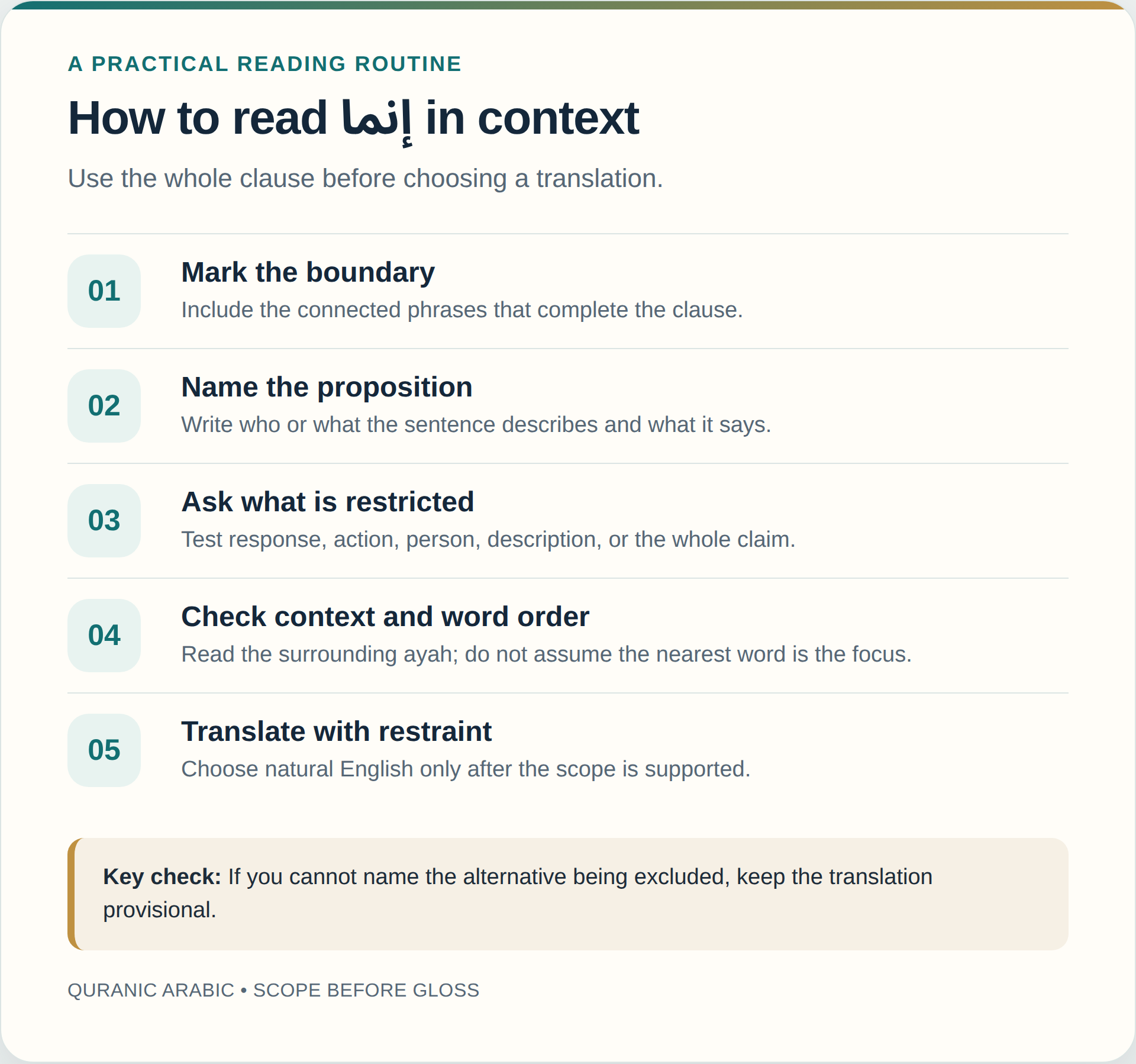
Use this routine before looking for a polished translation. It slows down the moment when a familiar English word can make the sentence seem settled too early.
- Mark the whole clause. Find the beginning and end of the clause containing إنما. Include its connected phrases and any words that complete its statement; do not stop at the next noun.
- Name the proposition. In plain language, write what the clause says. Ask who or what is being described, what happens, and under which condition or setting.
- Ask what is excluded. Is the sentence restricting the response, action, person, quality, or whole claim? Note the alternatives that make sense in this context. Do not invent a contrast the verse does not support.
- Check the surrounding wording. Look at word order, conjunctions, a following explanation, and the neighboring verse. Fronting can affect focus, but position alone does not prove scope; compare it with a focused example such as the fronted object in إِيَّاكَ نَعْبُدُ.
- Translate modestly. Draft a natural sentence, then test it against the Arabic: does it preserve the restriction you identified without adding a doctrinal conclusion? If not, revise the English or leave a note that the scope needs checking.
If you already use a sentence-parsing method, apply it to the full construction rather than treating إنما as a vocabulary item by itself. Quranytime’s step-by-step Quranic Arabic parsing guide offers a broader routine to pair with this focused check.
Work through Quran 24:51
One useful example is the opening of Surah An-Nur, verse 51:
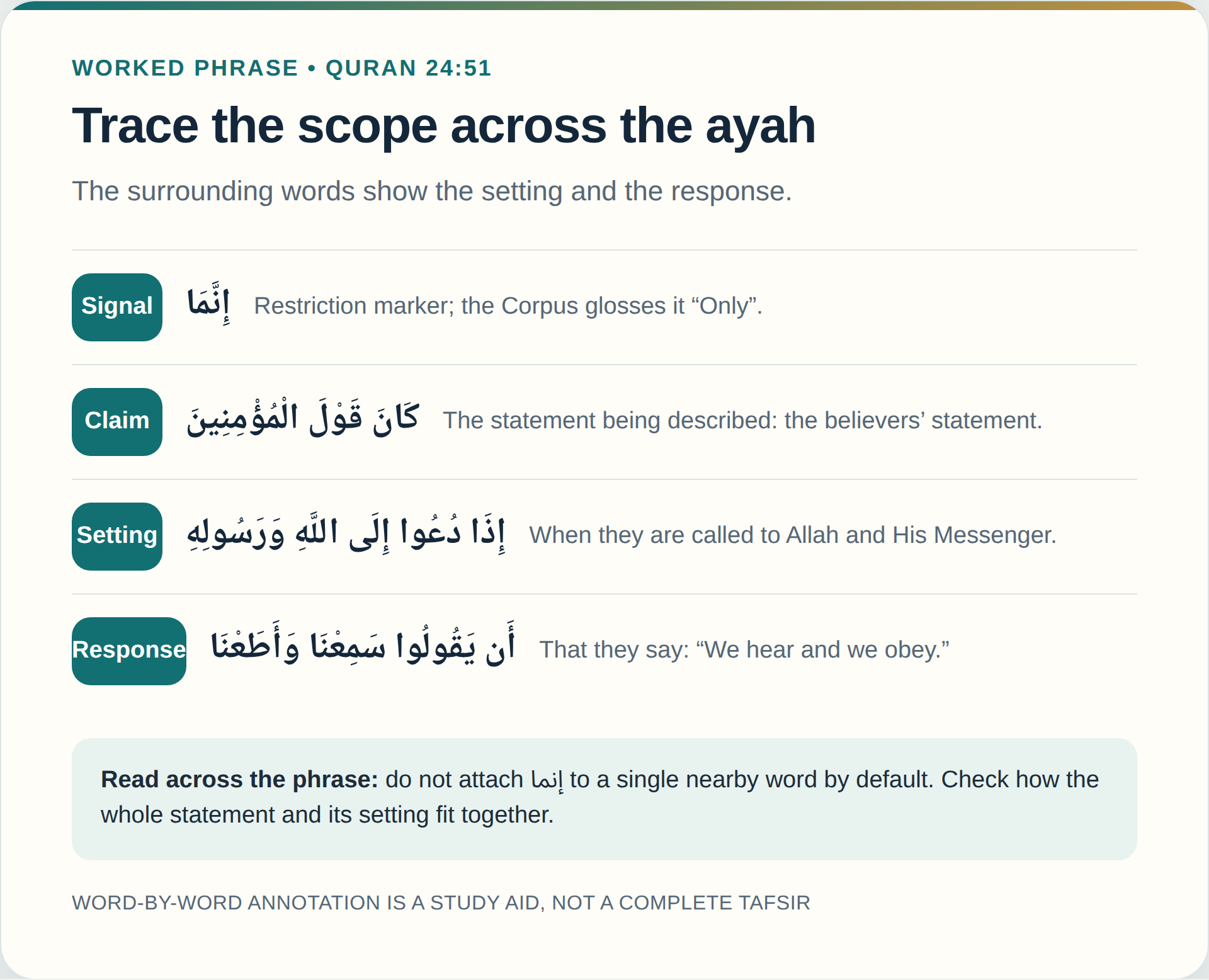
إِنَّمَا كَانَ قَوْلَ الْمُؤْمِنِينَ إِذَا دُعُوا إِلَى اللَّهِ وَرَسُولِهِ لِيَحْكُمَ بَيْنَهُمْ أَن يَقُولُوا سَمِعْنَا وَأَطَعْنَا
A close working rendering is: “The only statement of the believers, when they are called to Allah and His Messenger for judgment between them, is that they say, ‘We hear and we obey.’” Treat this as a study gloss, not a complete tafsir. The Quranic Arabic Corpus word-by-word analysis of 24:51 glosses إنما as “Only” and labels it as an accusative particle with a preventive particle mā. It then lists the following words and grammatical information separately, which is useful evidence for reading the construction in context.
Now map the phrase. إنما is the restriction signal. كَانَ قَوْلَ الْمُؤْمِنِينَ gives the statement being described. إِذَا دُعُوا إِلَى اللَّهِ وَرَسُولِهِ supplies the situation—when they are called—and لِيَحْكُمَ بَيْنَهُمْ gives the purpose in the clause. The following أَن يَقُولُوا سَمِعْنَا وَأَطَعْنَا identifies the response: “that they say, ‘We hear and we obey.’” The focus is not an isolated noun picked only because it is close to إنما; the whole reported response and its setting matter.
Notice also what this reading does not do. It does not claim that the particle alone explains every theological implication of the verse. It does not make the English word “only” a substitute for studying the rest of the sentence. It simply gives you a defensible grammatical question: in this setting, what response is being presented as the believers’ proper statement? Use the answer as a starting point, then consult tafsir when you need interpretive detail.
You can listen to this same ayah while following its written form below. The short recitation helps you notice the word in its actual phrase; it is not a grammar lesson or a substitute for a teacher checking your analysis.
Do not confuse إنما with إنّ, negation, or exception
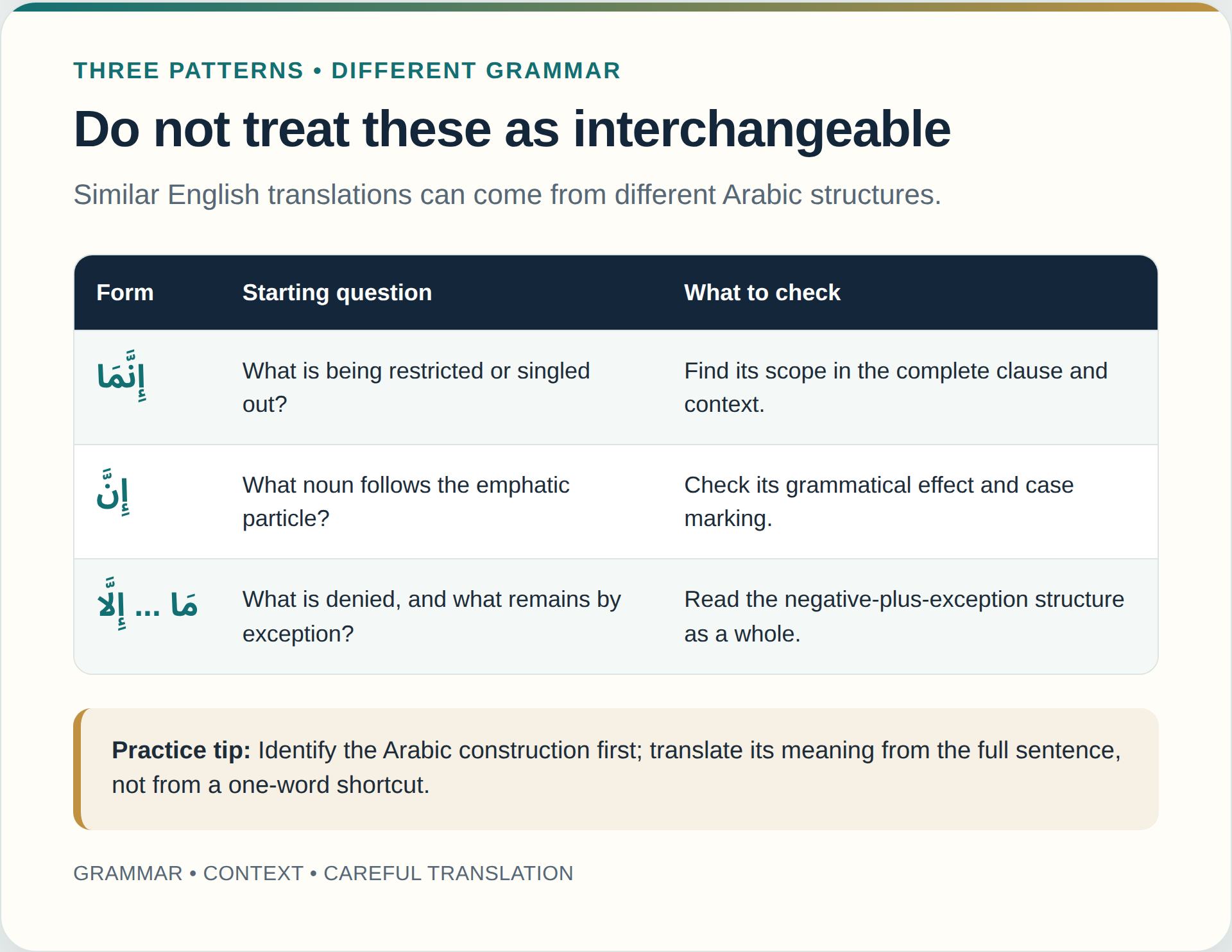
The written forms are related, but their grammatical jobs are not interchangeable. إنّ is a separate emphatic particle that governs a following noun in the accusative in the familiar construction taught as إنّ وأخواتها. إنما includes the attached mā that traditional analysis describes as preventive; the Quranic Arabic Corpus likewise labels the mā in 24:51 as preventive. Do not copy the case rule for standalone إنّ onto every word after إنما. For a wider contrast, see إنّ and its sisters in Quranic Arabic.
Restriction can also be expressed through a negative-plus-exception pattern such as ما … إلا. That pattern contains negation and an exception; it is not simply another spelling of إنما. Both may produce an exclusive reading in context, but the pieces and grammatical questions differ. When you see إلا, identify what is excluded and what remains after the exception. Quranytime’s guide to Arabic negation in Quranic reading and its explanation of إلا and Arabic exception can help you compare the patterns without blending them.
Also separate restriction from coordination and conditional or temporal framing. In 24:51, the words around the particle include a setting introduced by إِذَا and a purpose phrase; those parts help you understand the full claim, but they are not themselves إنما. Conjunctions can connect or contrast clauses, while a conditional construction relates a condition to a result. See the guides to Quranic Arabic conjunctions and conditional sentences in Quranic reading for those separate jobs.
Four mistakes to avoid
- Stopping too early. Translating إنما as “only” before reading the entire clause can attach the restriction to the wrong phrase.
- Assuming the nearest word is the target. Scope may cover a larger proposition. Mark the clause, then test the candidate focus against the sentence.
- Turning grammar into tafsir. Syntax helps explain relationships among words; it does not by itself settle every legal, theological, or rhetorical question. Use recognized tafsir for those questions.
- Confusing a first gloss with a final translation. A corpus label or dictionary gloss is an aid, not a complete translation. Compare the whole phrase, the verse context, and trusted explanations.
If two readings remain possible, record the evidence and competing scope choices instead of writing “إنما always means only X.” Check the full passage and established explanations before settling on a translation.
A short practice drill
Choose a verse that contains إنما and write it out with the surrounding clause intact. Circle the construction, underline the proposition, and label the words that set its time, reason, contrast, or result. Then write two short paraphrases: one that states the main claim and one that makes the excluded alternative explicit. If your second paraphrase adds information that the verse does not provide, remove it.
Next, compare your work with a reliable word-by-word grammatical resource. Ask whether the particle and its attached mā are being treated together, whether the clause boundary is correct, and whether your translation respects the visible syntax. A teacher can help when a parsing choice affects the meaning. Keep a note of the exact point you are unsure about—scope, case marking, or translation—so feedback can answer the real question instead of repeating a general definition.
Take the next step with a complete verse
For a reliable reading, treat إنما as a signal to inspect scope: mark the clause, state its proposition, identify plausible alternatives, and test your translation against the surrounding Quranic context. Compare it carefully with إنّ, negation, and exception, and keep grammar distinct from tafsir. If you would like a teacher to review your own Quranic Arabic reading and help you practise with full verses, you can book Quranytime’s free Quran and Arabic assessment class.